
Part of the success of series like Succession, House of The Dragon, and Game of Thrones transits in toxic family relationships and the fight for Power. Siblings against siblings, abusive parents, abusive partners, and a lot of politics that, in many cases, result in life or death. Unsurprisingly, these three award-winning HBO series generate engagement and much, much discussion about characters and motivations. They share another problem in common: the male view of women. Especially a woman in power. In almost all cases, they collide with clichés and simplifications, which contribute to what the feminist movement still finds as a major barrier, that of inverting the narrative of patriarchy.
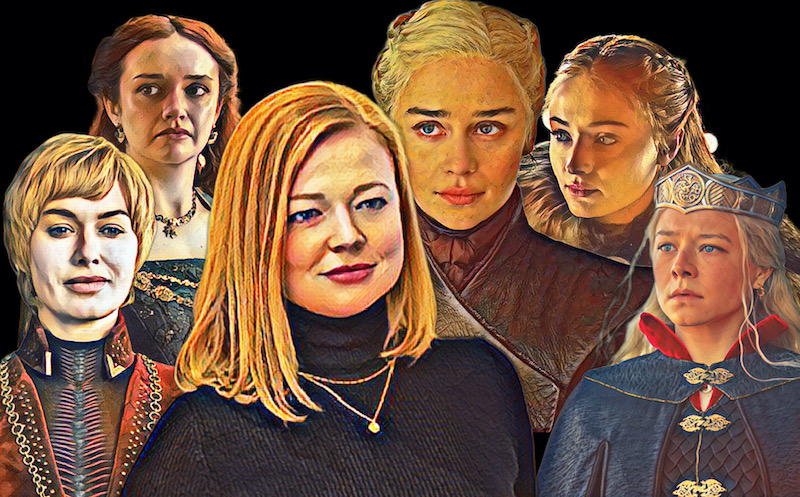
In Succession, Shiv Roy (Sarah Snook) committed the “ultimate betrayal”, overthrowing her brother Kendall Roy (Jeremy Strong) and removing him from the succession. Here the phrase is obviously to highlight the name of the series, but what Shiv did was take the Crown from Kendall, or, not let him sit on the Throne, to make it even clearer what unites the three most talked about series of the last decade.
Shiv Roy is already in the hall of iconic TV characters. Dubious, underrated, and manipulative, but sensitive and an effective player, she brought up in several moments how women are mistreated in current times. If the arguments that House of The Dragon and Game of Thrones do not reflect reality because they are fantasies set in medieval times, Succession is more than current. However, the situations remain the same, as I had already compared when I saw in Shiv a family reproduction similar to that of the Lannisters, but it can be applied to that of the Starks and Targaryens as well.
Over the four seasons of Succession, Shiv has been through several situations that are common for women: considered minor, considered doing an “easy” job (even Lukas Mattson dismisses her political ability), being interrupted by men, being “forgotten”, being called out from “flaky” or “passionate” when in an argument, from “talking too much”, from being flirty and even from being a scorpion. Because she is ambitious, she is immediately treated as a potentially bad mother and finds herself playing with this concept in order to be accepted. Even when she “wins”, she loses. It’s as tragic as Kendall and as complex as Sansa Stark.
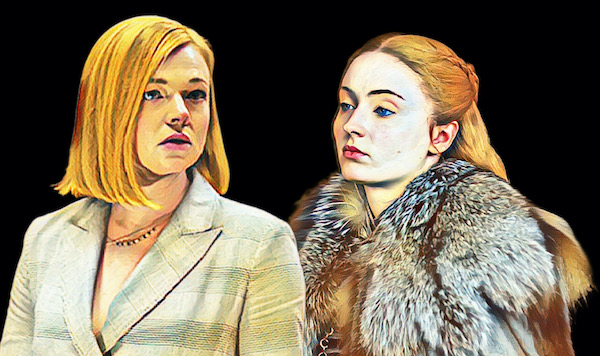

In Game of Thrones, Sansa is the character who understands what she can aspire to. She wants to marry Prince Joffrey, have children, and be Queen. She doesn’t care about battles or politics and because of this unpreparedness, when she gets close to her goal, she practically helps to destroy her own family.
Hostage of an aggressive and implacable culture, she survives other betrayals and threats, until she gives up being “nice” and starts to “play the game of Thrones”. In the final seasons, Sansa (Sophie Turner) resents that it is Jon Snow (Kit Harington) who is chosen to be King in the North in her place, even though she is the true heir of the Starks (he is a bastard) and the strategist of victory against the Boltons. Later, it is Sansa who does not accept either Cersei Lannister (Lena Headey) or Daenerys Targaryen (Emilia Clarke) as Queens, revealing to those who need it that Jon is actually Aegon Targaryen, the true heir to the Iron Throne. In the end, Sansa ends up Queen in the North, Jon is exiled, and Cersei and Daenerys are killed. Shiv sure kept up with GOT!


Just to follow the parallels, I remembered that Cersei was treated by her father, Tywin (Charles Dance), as an object to achieve political alliances, but, for more than half of Game of Thrones, she was called incompetent and stupid not only by him but also her husband and her own son, as well as by her brother, Tyrion (Peter Dinklage). Was Cersei wrong? Yes, several times, just like all men. However, as a woman, she was often ignored when got things right. Ultimately, she was more strategic than Tyrion, more effective in resolving the Kingdom’s economic crisis than any monarch before her, and effectively nullified Daenerys Targaryen, who had three dragons and nearly won the battle. As Daenerys needed to destroy King’s Landing to remove Cersei from the throne, we can even say that Cersei was the winner of the clash.
Shiv had the option of keeping Waystar Royco in the family but under Kendall. It could sell and be effectively run by Lukas Mattsson (Alexander Skarsgard), with her husband Tom Wambsgans (Matthew Macfadyen) as CEO. She implodes the brothers’ hopes and gives the final card, leaving open whether she will be able to overcome machismo and be the owner of everything later on or if she will submit to the patriarchy and be just a supporting character. The role that, incidentally, both the brothers and Lukas and Tom wanted from her. Was Shiv an evil queen like Cersei or suicidal like Daenerys or strategic like Sansa?


Of toxicity in family dynamics, the Targaryens have several books and several generations as an example, taking away from the Roys any dream of dominance in the dysfunctional family theme. In Game of Thrones, Daenerys suffered almost the entire first season from the abuse of her brother, Viserys, who, being a man and older, was the theoretical successor to the Iron Throne until their father was murdered. When he shouted that he “wanted his crown” he echoed Kendall’s screams for Shiv to be the firstborn, something that only confirmed her insecurity of crowning him CEO in the first place.
Daenerys approves of her husband, Khal Drogo, killing Viserys, and with that, she inherits the presumed Right of the Crown. Gradually, this ambition also affects her trajectory, but it is when she is confronted by Jon Snow being her nephew and heir BEFORE her, for the simple fact of being a man, she loses her reason. Okay, it’s oversimplifying, but it’s still on topic. Her choice of violence divided fans who did not accept the destruction of her character until this day.
Still in the same universe, House of The Dragon places the laws of patriarchy in the order of succession at the heart of the plot of the series. Rhaenyra (Emma D’Arcy), the only daughter from the first marriage of King Viserys I (Paddy Considine) is made officially his successor, something his second wife, Alicent Hightower (Olivia Cooke) does not agree with, encouraged by her ambitious father, Otto (Rhys Ifans), and we end the first part of the story with Alicent’s son by Viserys, Aegon (Tom Glynn-Carney) as King of Westeros, just because he’s a man. He and Rhaenyra go into a battle for Power so bloody that it nearly decimates the family.

So far, everything seems fine, right? Just a story of politics and wars, but the women’s battle is always on the losing side. Cersei is ambitious and unscrupulous, Sansa is deceitful and manipulative, Daenerys is bloodthirsty mad, Alicent is spiteful and manipulated, Rhaenyra is careless and insecure, and Shiv is vengeful and callous. We will easily bump into these simplifications, including me. The plots lead to this trap that only reinforces the negativity of a female figure capable of being a leader and recognized for her abilities to lead a company or a kingdom. No character has yet won without sacrificing either her femininity, her love, her family, or her soul. Heroines like Wonder Woman have seen their partners killed “for the greater good” where only she ends up paying the price of loneliness.
I am angry with Shiv because I was torturously driven to question her more by choosing one of the two sides that betrayed her, selecting the one that apparently works her best but destroys her brother. And it would be great until it was her decision, but that is not necessarily, for reasons of dramatic storytelling, she had to look like an insecure woman who changes her mind at the last minute, crying and suffering. It brought humanity to her, no doubt. Does it make sense precisely because this is the dynamic of the Roys? Clear. But it reinforces the figure of female victory over dubiousness, impulse, jealousy, and falsehood. Not cool.
The open ending of all, showing Tom in a position of power (fictional and temporary, until Lukas changes his mind) which she accepts with reservations, led to many theories that she already had a deal with him (I don’t agree) or that she submitted to be like her mother was (I also disagree) or, who is just setting her back later (possibly). A friend assessed that she chose to leave her father’s archaic and toxic administration behind, opting for something new in the technological world, despite being betrayed by both. I don’t see it that way, after all, Lukas morally and sexually harasses his team, in addition to lying about numbers and being possibly broke. Shiv’s choice turned out to be even darker and more uncertain than having Kendall in power. Again, Shiv has always been portrayed as fake, manipulative, hypocritical, spiteful, and ambitious making it very difficult to root for her. This doesn’t stop me from regretting once again seeing the perfect chance to have a woman turn the game with scruples and intelligence, just because it’s a man trying to portray the female soul.
Women are not so difficult to decipher if you stop putting them as something lesser. If the construction of Shiv, Sansa, Cersei, and Daenerys wasn’t highlighting the flaws common to men much more, I would have liked to have seen Shiv as “queen”. But it was another Crown lost in clichés and errors of the patriarchy. Will they still get it right one day?

Descubra mais sobre
Assine para receber nossas notícias mais recentes por e-mail.
 miscelana.com