
The film Chevalier highlights a series of stories so incredible that they would easily be considered ‘fiction’ but were true. Among them, the romance between the composer and the Marquise de Montalembert, a love story doomed to an unhappy ending, as we see in the film. Kelvin Harrison Jr. and Samara Weaving (Hugo Weaving’s niece) play the young lovers whose impossibility of being together moved many who witnessed their passion.
Marie-Joséphine de Comarieu was an actress and singer, married to Marc-René de Montalembert, a military engineer and writer, who reached the position of Marshal during the reign of Louis XVI. Their home was renowned for its luxurious receptions and culture, so unsurprisingly, they and Joseph Bologne, Chevalier de Saint-Georges crossed paths. As a scholar, Marc-René wrote some short plays, all staged by Marie-Joséphine, which greatly pleased French society in the last years of the monarchy.

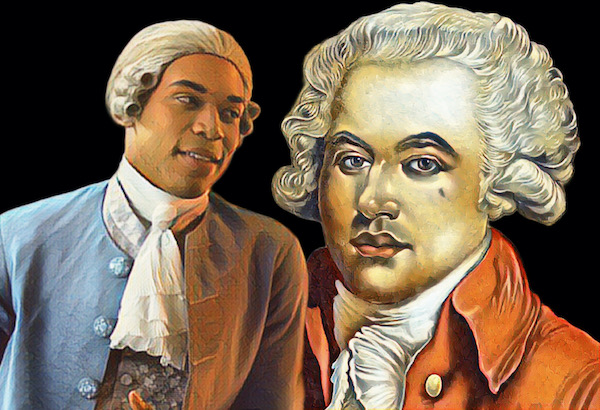
It was for Marie-Joséphine that Saint-Georges wrote his first opera, Ernestine, to a libretto by his friend and author of Dangerous Liaisons, Pierre Choderlos de Laclos. It was performed on July 19, 1777, at the Comédie-Italienne, but had only a single performance. The problem was not with the music or the artist, but precisely with Laclos script, considered “weak” and confusing. Marie-Antoinette, a personal friend of the composer, was in the audience on opening night. However, the failure of the opera caused financial problems for Saint-Georges and he was helped by the wife of the Duke of Orléans (brother of the King). These relationships would be dear to everyone in a few years, when the revolution took shape.
Chevalier fought for the rebels, but the Montalemberts fled to England after all their possessions were seized by the new government. Before returning to France and managing to recover everything, with the official pardon of the rebels, Marc-René and Marie-Joséphine divorced.
After she was abandoned by her husband in London, Marie-Joséphine needed help from friends to survive Few people know, but in addition to being a singer and actress, she was also a writer and composer. She published two successful novels: Elise Dumesnil (1798) and Horace (1822), thus publishing a collection of 6 sonatas for harpsichord or fortepiano.

The fate of Chevalier Saint-Georges was also sad. His music was practically forgotten and lost over time, even though he was a contemporary, a friend and compared to Mozart. In the Terror period in the years following the fall of the Bastille, he was imprisoned because of his nobility background. He was in prison when friends – including Marie-Antoinette – were killed on the guillotine. He gained freedom, but lived a simple life almost in poverty, only to die 7 years later. His trajectory has been recovered, but Marie-Joséphine’s follows in the shadow of men. A pity, as she must have been a remarkable woman.
Descubra mais sobre
Assine para receber nossas notícias mais recentes por e-mail.
 miscelana.com