
Readers of George R. R. Martin‘s books have their own impressions of what the ‘truth’ actually is in House of the Dragon and Game of Thrones, criticizing at times harshly the screen adaptations. The beauty of the universe created by the author is in the only certainty he reminds us of: stories are told by the winners, therefore, not always transparent. The subtexts that require each to come to a conclusion are purposefully and often obscure,e and each can have its own interpretation. However, there are some facts that are what they are and are different in the book and on screen. In view of this, anticipating the second part of the story and far from the premiere of the first, even having evaluated each main character here in Miscelana, it is worth returning to Westeros. Because I miss it!
Whatever the great, jealousy and resentment stained the Targaryen generations throughout their history, with the period of the Dance of the Dragons being pointed out by all historians as the bloodiest. The HBO series reinforces all of this and reveals even more.

Rhaenyra and Aegon II: Hatred and Competition
Viserys I (Paddy Considine) was obsessed with having a son as his successor. We later learn that it’s part of a prophecy, but apparently, it’s just the tradition that the Crown is never passed to women, only men. His insistence and lack of luck in producing a surviving male heir end up costing the life of his first wife, and the love of his life, Aemma. This relationship strongly impacted the personality of his only daughter from this union, Rhaenyra (Emma D’Arcy), who was eventually announced as his successor, breaking a taboo and planting a serious conflict for the dynasty.
As we’ve seen in the series, even more explicitly than in the book, Otto Hightower (Rhys Ifans) has been laying the groundwork to unite his family with the Targaryens ever since he set foot in King’s Landing. Alicent (Olivia Cooke) was placed at the heart of the kingdom – literally – as Rhaenyra’s best friend and later, as Viserys’ chosen second wife. Alicent’s role will be evaluated next, but among her primary roles was childbearing and, of course, a male child. Something she did right away, incidentally, with Aegon II (Tom Glynn-Carney).


Who “created all the trouble” was Viserys, a good king, but whose choices (late or innovative) had tragic consequences. If he felt guilty, for some reason, for having insisted on the heir that cost Aemma’s life, he married Alicent almost out of political obligation and never showed affection or dedication to the children of the second marriage, planting in Aegon the seed of jealousy towards him, to her older sister, Rhaenyra. She was chosen by Viserys; she was the heir. Nothing he did had an impact on her trajectory, not even the clearly bastard children presented as legitimate. “Conformed” to what was apparently inevitable, Aegon never realized (as Aemond (Ewan Mitchell) quickly understood and prepared for) that the patriarchy would fulfill the promise of crowning his sister after Viserys died. He was drunk, he lived with prostitutes, and he raped the chambermaids. It is on the journey that would take him to his coronation, which he rejected as usurpation, that he opens his heart to his mother for feeling a lifetime without being loved by her or by his father. He wasn’t wrong, and part of that gap created the monster. So we’ll see more, but Aegon II’s soul was destroyed by abandonment and lack of attention. And his reign was born out of his jealousy of Rhaenyra.
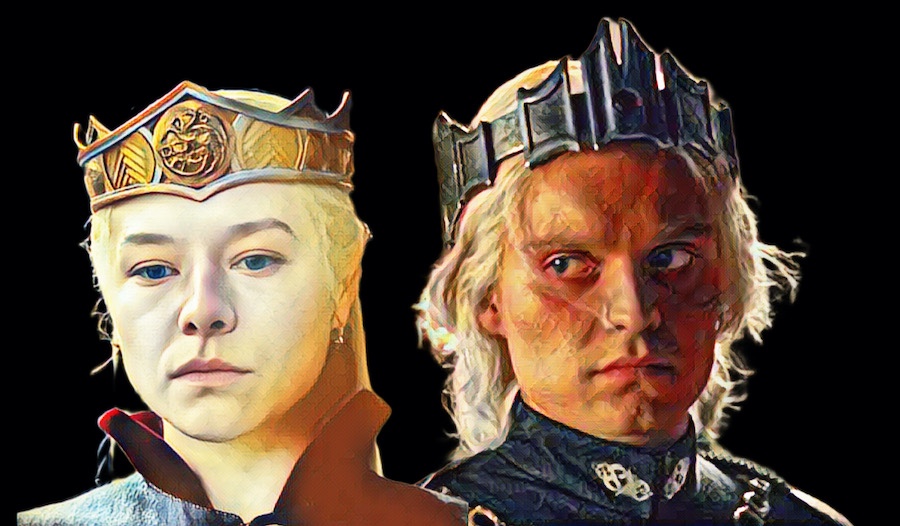
Rhaenyra: envious of men (and Alicent?)
If there’s someone who seems to have everything, it’s Rhaenyra Targaryen, but she also has her insecurities and makes some mistakes because of that. So it is.
Rhaenyra may be the princess and – for many years – the sole heir of Viserys I, but she felt constantly reminded that she was not a priority for her father, as he always wanted a son and only chose her under pressure from the Council and after Aemma’s death. In the book, the account of her relationship with her father differs from the series, as they were close indeed, but, from what we saw on HBO Max, during the mourning, they were distant and constantly in conflict, even more so after he announced the decision to marry Alicent, who was not well accepted by the princess. And being always perfect in everything, the (ex) friend turned stepmother soon provided the ‘heir’, creating even more space for tension to grow between them.
Rhaenyra had a certain jealousy of Alicent, even more envy, because as a perfect daughter of the Hightowers, the devotion and obedience of delivering what was expected of her made Alicent a “perfect” woman: subservient and submissive. Rhaenyra, as a princess, had greater apparent freedom, but both had only one use, which was to generate male heirs. So, for Rhaenyra, Alicent’s betrayal in marrying her father was playing on her trust.


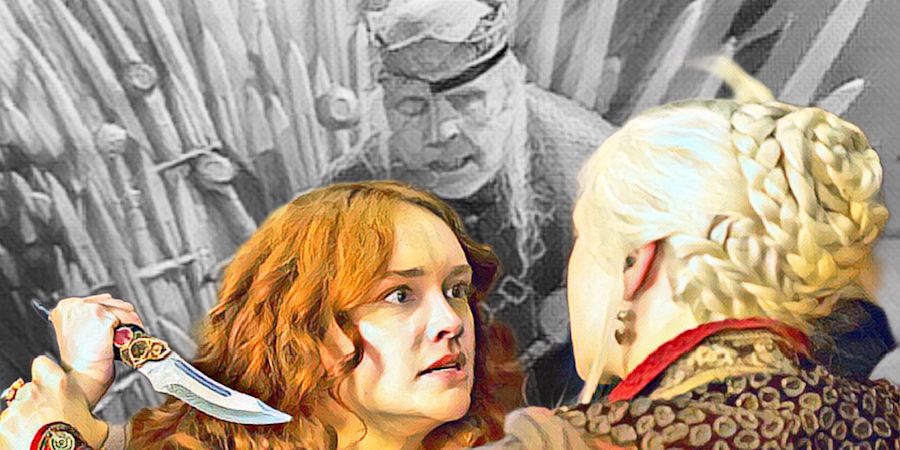
Rhaenyra had a certain jealousy of Alicent, even more envy, because as a perfect daughter of the Hightowers, the devotion and obedience of delivering what was expected of her made Alicent a “perfect” woman: subservient and submissive. Rhaenyra, as a princess, had greater apparent freedom, but both had only one use, which was to produce male heirs. So, for Rhaenyra, Alicent’s betrayal in marrying her father was playing on her trust and never clarifying that she was becoming involved with the king. There’s no forgiveness for Alicent her;, she took the game and made herself useful to her father (Otto), but we’ll come back to that when we talk about her. For Rhaenyra, marriage was a knife from the start, and although she understood that Alicent had “family obligations”, as she didn’t respect the rules, her friend only made her more unhappy.
As a matter of fact, not even Aegon II actually became a problem for the princess. The age difference between them was significant, and since Viserys I never changed the order of succession, the prince meant nothing to her. The converse was obviously not true. That left Rhaenyra’s biggest jealousy target: her uncle, Daemon (Matt Smith).
Daemon Targaryen is the symbol of everything she wanted to be, even more, what she imagined her father wanted her to be:e, a man with a strong personality, an excellent knight, and a prince of ‘pure’ Targaryen blood. With no woman to be considered an equal, Daemon was the obvious heir. If it weren’t for Viserys’s knowledge that his unstable personality would always be the only obstacle, perhaps everything would go more smoothly. But Otto managed to convince Viserys I, and by a fatal combination for the ‘steppe’, she was announced as the official heir. At this point, Daemon represented the male version of what she envisioned as ruling and living, a mixture of admiration and idolatry, so much so that Rhaenyra is direct with her uncle when she meets him again at his wife’s funeral and asks him to marry her. As she argues, with Daemon at her side, no one would dare question her Crown, and they would be perfect in command of Westeros. There was practicality and passion.

In the book, there are more doubts than in the series about the nature of the relationship between Rhaenyra and Daemon. He effectively ‘seduced’ her, or at least accelerated her sexual awakening, but he was not her first lover. There was a mutual understanding that the partner would be perfect to rule, something Viserys disagreed with and which indirectly accelerated the internal conflict. The King had the opportunity to unite them, but chose to expel his brother, leading Rhaenyra to a marriage of convenience that was effectively problematic because Laenor did not “work” with women; Rhaenyra would have no heirs. She tried for years with her husband, we know, but it was with her lover of more than ten years that she ended up having three children, creating the perfect opportunity for her enemies to act. When we meet her again at the funeral of Daemon’s wife and sister-in-law, Rhaenyra is extremely vulnerable.
Here, the change from House of the Dragon, for me, becomes complex. Daemon and Rhaenyra make a pact of love and government against the ‘Green’, but they need to ‘get their hands dirty’ so that they will lose any trace of innocence. After Ser Harwin Strong (Ryan Corr) was murdered (a fire in Harrenhall) and Viserys is increasingly ill, Rhaenyra knows that her enemies will come with everything against her position, so she can no longer insist on her sham marriage to Laenor Velaryon. In the book, there is doubt as to how he conveniently turns up dead, and Daemon and Rhaenyra are immediately married, but it’s the prince who ‘takes the blame’ himself.
In the series, the two agree that Laenor has to leave the equation, but it is uncertain whether Daemon decides alone for the homoaffective couple or if she asks to spare her husband and his lover. Although this human side of the couple was beautiful, it brought greater inconvenience than described. The main reason she marries Daemon is to have legitimate heirs. By allowing Laenor to live, the plan has an essential bigamy problem. Furthermore, it highlights one of Rhaenyra’s character flaws, which is that she is inconsequential and hypocritical, whose behavior ignores any rules when applied to her, but demands that others follow the letter. Essentially, the showrunners wanted to build sympathy for Daemon and Rhaenyra’s marriage, but they just justified all of the Greens’ arguments.
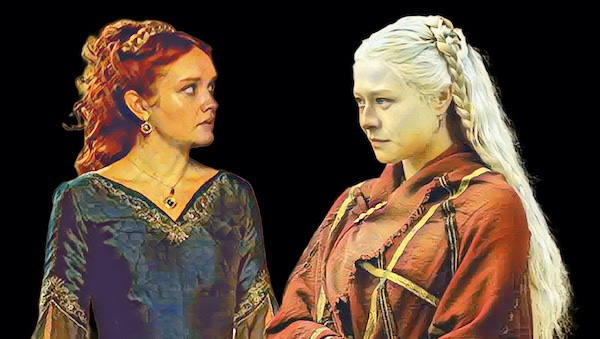

Meanwhile, Daemon isn’t immune to Westeros’ jealousy either. He always wanted Viserys’s approval (he didn’t care about others), but he never got it. The brother did not make him heir, not even Hand of the King, but he defied public opinion and tradition for Rhaenyra, making his niece the target of guilty jealousy, for he liked her a lot himself. As the ‘reserve’, Daemon transports to history the dramatic fate of those who do not effectively have a role in the Nobility: he may be superior by blood, but he has no defined role or purpose in life, waiting for something bad to happen to his relatives to maybe replace them. His marriage to his niece resolves most of the conflicts, even without being the King. It would certainly be his Hand, would have clear power in a universe where women have no voice, and their children, in the probable case that their stepchildren die beforehand, would be – and were – Kings.
Doubts about the couple’s true feelings were not clarified either on the pages or on the screens, but will be the subject of other posts. However, no one questions that both loved and envied each other, a “perfect” marriage in Westeros.
Alicent represses desires and aspirations, with Rhaenyra highlighting what she “lost” in the Game of Throness
The differences between Alicent from the book and the series are so significant that we need to clarify which one we will continue commenting on. The TV becomes the main reference because it brings new information.
In the book, Alicent is described as a spiteful and ambitious person. From the moment her son Aegon was born, any relationship she had with her stepdaughter ended. The age difference between the two was much greater, so the maternal hierarchy has always been part of their trajectory. In the series, there is a deep friendship (some claim something more) between them, contemporary and close.

We meet a motherless Alicent, respectful of society’s rules and always trying to please everyone. She is Rhaenyra’s opposite in every way. The princess is pure impulsiveness, but her position allows such freedom. More than that, it is the good relationship between Viserys and his daughter that arouses the envy (also jealousy) of Alicent, who is emotionally distant from Otto. She submits to sexual exploitation, keeping “company” with the widowed King and creating a connection that results in marriage. There is no sexual pleasure; there is a friendship, but no more than that, and she quietly accepts it. After scripts were shared, we confirmed (or discovered) that there was sentimental noise from the start. And it was vital to the story.
Still youngand without a true perspective of what could happen, Alicent and Rhaenyra know that one day they will marry someone of power, but that is the maximum they can aspire to. At the tournament in honor of the birth of Viserys’s son (who dies in childbirth), the two meet Daemon and meet Ser Criston Cole (Fabian Frankel). The writers’ observations say that when Daemon approaches to ask Alicent to be his maid, Rhaenyra becomes jealous. And he only does it to provoke Otto (and he succeeds), but she is the niece who feels the most that she was not chosen. However, when Cole enters the arena, the two are drawn to him, and he chooses the princess, something Alicent secretly resents. We are talking about great love, of course – not yet. But she draws the graph that drives the conflicts of House of the Dragon. Rhaenyra has what everyone wants (love, position, freedom), but she doesn’t have what others have (gender, autonomy).
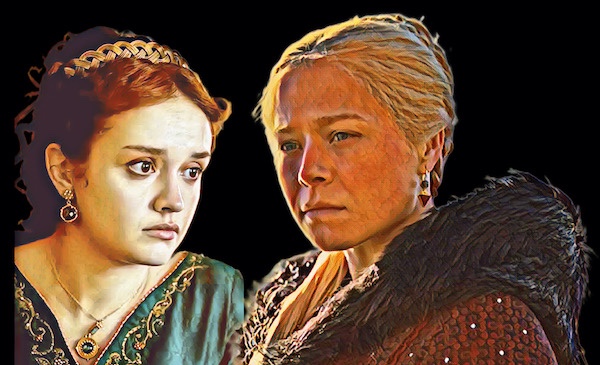

To make matters worse, Rhaenyra ‘seduces’ Ser Cole, just as Alicent defends her honor, which is questioned by her connection with Daemon, and the Queen consort is disappointed with her former friend. After years of trying to help her, she grows tired of Rhaenyra’s stubbornness. I swear I don’t. Alicent submitted herself to a marriage with a much older man, without loving him, just as she accepts being asked for sex when he wants to. She has children she doesn’t love who will be heirs, and here comes Rhaenyra doing what she wants, how she wants,s and when she wants. She and Ser Cole understand each other, er and Alicent finds peace in religion and hypocrisy.
The Queen Consort is so obsessed with her resentment of Rhaenyra that she doesn’t plan; she just reacts. Her father gains momentum and sticks to his original plan. The mistakes of the two former friends help him with the legitimacy he would not have had for his coup.
I see a big problem in Alicent’s series. Although more humanized and consistent with what any noblewoman of her time would do, her relationship without planning makes little sense. We don’t see her arguing for her children, for whom she has no affection or dedication, just to reach Rhaenyra. Her interpretation of what a delusional Viserys spoke was simplistic, her objection to her father’s plan strange. There’s more to discover about her.
Jealousy in general continues to guide connections. A scorned Ser Cole is jealous of Daemon and any of Rhaenyra’s lovers. He and Alicent act from the heart, and it’s a big danger. In the book, they linked by their common ambition to maintain the status quo. And we don’t even get into Aemond’s jealousy!
Targaryen toxicity is simpler than it seems. Really?
Descubra mais sobre
Assine para receber nossas notícias mais recentes por e-mail.
 miscelana.com
1 comentário Adicione o seu