
As published in CLAUDIA
For anyone who loves film and fashion, getting the chance to meet Sharon Long was equally intimidating and incredible. Those who follow the column know how much attention I pay to the work of the costume designers, after all, what the character wears and how she presents herself is very important in the narrative. The English designer has had an amazing career ever since she started her career. Her credits (as an assistant) put her on the sets of films such as Guardians of the Galaxy, Phantom of the Opera, and Emma, and she was also on the Oscar-nominated teams for Gangs of New York and Finding Neverland, as well as on the winning team of the Academy by Elizabeth: The Golden Age. Sharon has been leading her own team for a few years now and her work on The Great, which returns for a third season on Lionsgate Plus, is simply mind-boggling. Sharon entered the second season and right away was the winner – deservedly – of the Emmy Award for her work on the series. We chatted over Zoom before she was nominated again in 2023, but it was a safe bet that she would be among the finalists. Surrounded by her designs and fabrics, Sharon tried to avoid spoilers (because her favorite dress would give one away) and I’m already rooting for her again.
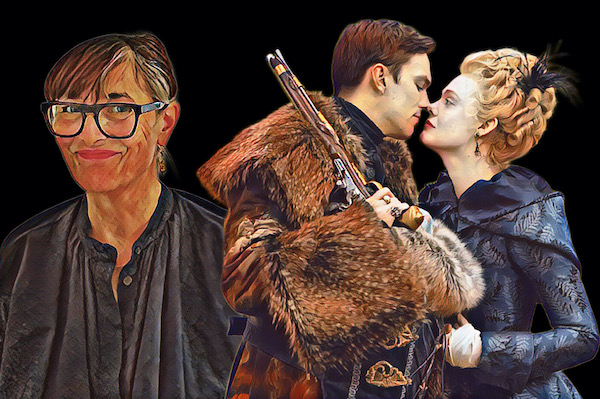
CLAUDIA: First of all, as a fan, she wanted to congratulate you on the 2022 Emmy Awards for her work. I bet she will win again in 2023! [our chat was before the award nominations, which were confirmed on July 12]. So, starting with season 3, was it easier to think about the costumes for The Great?
SHARON: On the one hand it’s obviously a lot easier when you know the actors and you’ve been in the world of The Great, but even more so because I know [showrunners] Tony McNamara and Marian McGowan and I say ‘easy’ because the scripts are fantastic. But it is also difficult because they arrive very late for the team that will work on the costumes. We prepare two scripts at a time. When we finish shooting those two, the next two arrive creating an accelerated turnover. What helps is also knowing people’s bodies, knowing what they like and what they don’t like, and of course, they also know me.
CLAUDIA: I was going to ask about how long in advance you have access to the scripts. Is it more complex not to know the whole story?
SHARON: We’re usually aware of the arc, which is the backbone of the script, but it doesn’t always turn out the way you expect. For example, there were characters that were going to die and then they didn’t, but I kind of bought a really dark fabric for that and had to use it a different way because there really wasn’t time to order a new one. We usually only have eight weeks before we start shooting to try it out. So sometimes what happens is we can do all the experimentation in the first four or five episodes because then we get too busy to try something new.
CLAUDIA: Does the fact that the show says it is “occasionally true” give more freedom or do the costumes have to be more true to the period?
SHARON: It’s a balance because Tony McNamara, who is the showrunner, is not interested in it being a period series. He’s telling a story that’s about a historical period, but the speech is completely modern, they do things that have nothing to do with the 18th century. laughter]. That’s why I say it’s a kind of balance. I can keep the classic shapes and still manage to make them modern at the same time. It’s happened to me that it wasn’t going to work, that it was going to look too modern or too boring, too 18th century or there would be no humor or even drama. For example, this season Elizabeth [the Emperor’s aunt Peter] is getting a little less demanding and a little more open, she might be falling in love. [pause trying to avoid spoiler]. May or may not, you know! [laughter]. So there’s a little bit of that kind of gentle change that also needs to go into the clothes to tell the character’s story.
CLAUDIA: Okay, we don’t reveal too much. [laughs] One thing that isn’t always clear to anyone who doesn’t work in fashion is the textures. The fabrics are also related to the period of history. How long does it take for all this research?
SHARON: A long time. I mean, we have a buyer, Fiona, who works specifically with fabrics and sends us samples from all over the place. What we really try to do is keep, for example, women’s dresses in silk wherever possible, or materials that behave like silk because that’s what the court women in those days wore. While the patterns don’t always echo 18th-century patterns, I try to use the right quality of fabric to also convey the right kind of feeling. There were lots of flowers and birds and all sorts of things inside these amazing 18th century silks and I have a lot of references to the originals. In men’s fashion, I used something more metallic because I can’t talk about sequins [they used] because we simply don’t have the manpower. A metallic thread captures the light well and the effect is similar. And it also matches my personal aesthetic.
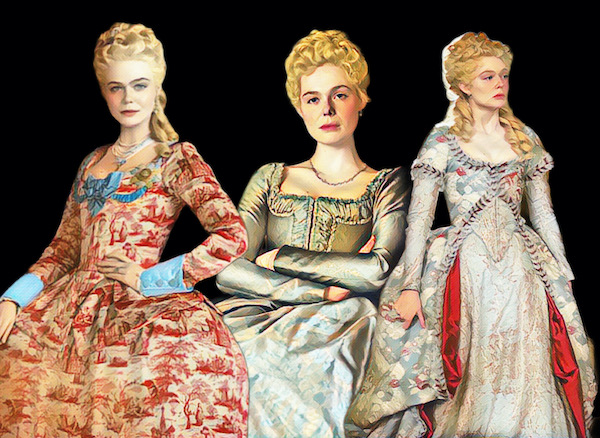
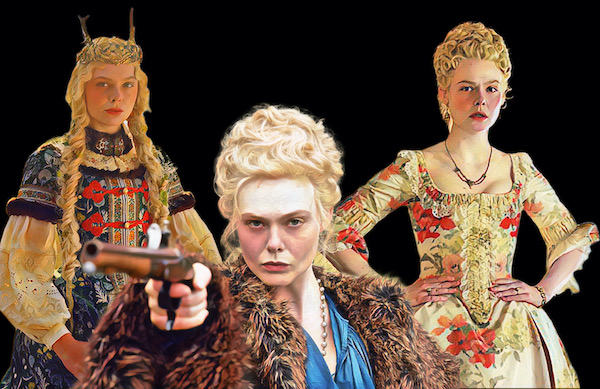
CLAUDIA: And in the midst of so much beautiful things, can you have a favorite look from the series?
SHARON; Yes! We love Elle [Fanning, who plays Catherine]’s first dress at the Ambassador’s dinner. It’s pale pink and super in. You can’t see it on the canvases, but it was all embroidered with little animals and lacework. It’s really pretty in person and I thought she looked stunning in it. I also really like Aunt Elizabeth’s dresses and clothes, I had a lot of fun with Tatiana because she is over the top and we also had a lot of fun with the baby [Paul, Catarina and Peter’s son]. The knitted outfits with ducks and stuff were so much fun to make. But my favorite is Elle’s final dress of the season, which you’ll have to wait until you see the conclusion.
CLAUDIA: And the challenge of dressing Peter and Pugachev, his double, who will play an important role in the season? Same actor, different personalities…
SHARON: The scariest thing is when Nick [Nicholas Hoult] walks into a fitting, sometimes he walks in as both Peter and Pugachev, so he has to change into Pugachev, who moves differently than Peter, and then wears the clothes that belong to the emperor. In this case, we have Pugachev who should be trying to be Peter, and to highlight that it’s just different fabrics, they get slimmer, dirtier, and darker. It’s always funny at tryouts because Nick gets, you know, really greasy and he’s so hot! [laughter]. Suddenly it’s not beautiful anymore.
CLAUDIA: Nicholas Hoult not being handsome is hard! [laughs] What about Cat Stevens’ references to Peter’s costumes? Any other icons?
SHARON: We have pictures of Mick Jagger and Jimi Hendrix, but the idea is to have that loose type from the 1960s through the 1970s and into the 1990s, basically the golden rock types.
CLAUDIA: And at the last Emmy you and your team signed Elle Fanning’s beautiful dress too! Was it easier or more difficult?
SHARON: I had sleepless nights. [laughs] We worked on the weekend, it was really stressful because it had to be perfect for her. It didn’t matter if it was perfect for me, it had to be perfect for her.
CLAUDIA: It was for me! [Laughter]
SHARON: Thank you! But Elle had good ideas and knew more or less where she wanted to go. It turned out fabulous.
CLAUDIA: Sharon and her team are all women, isn’t it? And before leading a team, he made his way by supervising and having mentors. Could you talk a little about that experience and how it has been to help new artists?
SHARON: I think because I have this history of having worked for a long time, being an assistant and supervisor, which helps a lot, also because I didn’t come straight into design, so I understand what my team needs. I always try to make the work more comfortable for everyone because I did their job one day so I know when I put them on a more difficult task. For example, maybe I give a dress or a skirt to run in the mud, but I take responsibility. I say don’t worry because later we’ll go over it and we can clean it up because the camera won’t see it again. I couldn’t say that if I didn’t have the experience I have and know what the camera sees. Sometimes it’s very important here [at the waist] and less important at the hem. But obviously, when you’re really young and starting out, you think shoes are going to be seen all the time and they’re never, you know, that kind of thing. So really help.
CLAUDIA: Look, I hope one day to see all the pieces in a book or an exhibition because they are works of art!
SHARON: It would be lovely to see them on display. People have done some fabulous things. Who knows?
Descubra mais sobre
Assine para receber nossas notícias mais recentes por e-mail.
 miscelana.com
2 comentários Adicione o seu