
In the film Napoleon, Ridley Scott will focus on the troubled relationship between Bonaparte and Josèphine de Beauharnais, his first wife and great love. Josèphine, who was already a widow when she married the future emperor, survived the intrigues of the French Court and was almost beheaded by the Guillotine (her first husband did not escape this fate), so she was a fascinating and controversial woman. For those who like gypsy tarot, here’s the curiosity: will we see the empress’s relationship with Mademoiselle Lenormand? After all, the empress had her as her main and closest confidant.
Mademoiselle Lenormand, for those who don’t know, was the French seer who read the future in cards, having created what we now call the Gypsy deck.

Marie Anne Adélaïde Lenormand was born on May 27, 1772. Daughter of a fabric store owner and Anne Marie Gilbert (more on this ahead) the family lived in Alençon, in Normandy (France) but was soon the target of many sorrows. This is because Monsieur Lenormand died young and his widow, who remarried, did not long survive her second marriage. That is, at the age of 5, little Mademoiselle Lenormand became an orphan. For this reason, she was taken to be educated by nuns in a Benedictine convent. The intention was that one day the young woman would become a milliner, but inside the convent, she “began her vocation” which did not bring much popularity, after all, Catholicism condemns any mysticism or paganism.
At the age of seven, little Marie-Anne already demonstrated superior intelligence to other girls and, according to her, years later, she was already in “contact with the celestial bodies”. Her divination skills were revealed near her first Eucharist when she predicted that Mother Superior would soon be discharged. For apparently wishing her harm and spreading lies, the girl was punished and subjected to a penance, which let’s face it, was more than saying Hail Marys and included physical punishment. But she stood her ground and when what she predicted actually happened, people were shocked. She went further, anticipating the name, age, and various other data relating to the successor of the deposed abbess. As there were many candidates for the position, and the decision was suspended, they did not give credit and once again regretted it. When once again the answer was confirmed, so was Mademoiselle Lenormand’s gift of revealing the events of the future assured.
When she was 17 (or 14, according to some biographers), she persuaded her mother’s mother-in-law to send her to Paris to live with her stepfather, and thus left Alençon with a single six-franc piece and the clothes on her back. Be that as it may, in the French capital, Mademoiselle Lenormand immediately began to earn a living by reading letters. There is a current that claims that in Paris she studied with a Madame Gilbert, but as that was her mother’s maiden name, it is also believed that she used both before signing her final signature or that she was a relative. This is because there is a record of the arrest of Marie Anne Gilbert, in 1794, found with “three decks of cards, including one called Thoth”, accompanied by a François Flammermont and a Louise Gilbert. As the fortune teller as she was childless or married, there is controversy over who Louise was or whether there was indeed a Madame Gilbert. What is confusing is that Lenormand herself wrote in 1814 that she had been arrested and fined in the same period for having predicted that there would be the Years of Terror, thus being considered an anti-revolutionary. If Madame Gilbert was not Mademoiselle Lenormand, she might have been a relative on her mother’s side and perhaps actually a teacher of Lenormand.
In any case, his precision gained fame and soon well-known people became clients such as the Count of Mirabeau, the Duchess of Guiche, the Princess of Lamballe, and Madame de Staël, as well as the revolutionaries Jean-Paul Marat, Maximilien Robespierre, and Louis Antoine Léon de St. Just. She alerted both Marat and Robespierre to their tragic deaths, which obviously led to further arrest and interrogation before being released without conviction. She got it all right again and so her divination skills gained even greater fame.
In this bloody period of French history, in which Napoleon emerged with force and seized power, Mademoiselle Lenormand will have an extremely important behind-the-scenes role, thanks to the influence she had on her client, Joséphine de Beauharnais. In reading for her, Lenormand predicted that Josèphine would one day hold a higher position than Queen Marie Antoinette as well as warned that Napoleon Bonaparte would have more power than King Louis XVI. When everything happened, the Empress took her to constant consultations in the palace, occasionally with the presence of the Emperor himself who was “assisted” with some pre-battle predictions and warned of his fate of exile on Saint Helena.
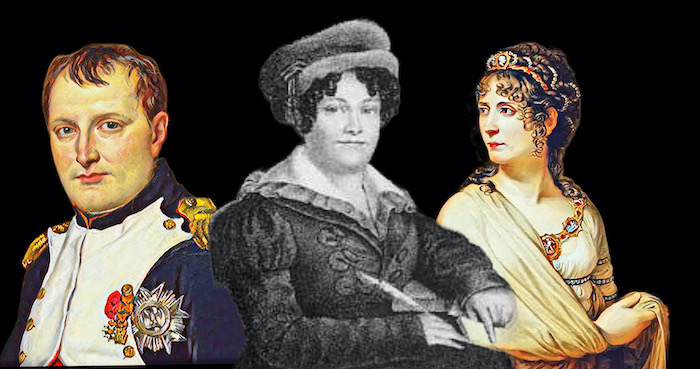
In Paris, apart from the Minister of Police, the dubious Joseph Fouché, only Mademoiselle Lenormand could be singled out as the best-informed person in the country. Some even claim that they worked together, establishing a relationship of exchange of information, beneficial for both parties. Here is a parenthesis because only skeptics could imagine that a person with the skills to predict the future through cards would sell his talent to sell information. Anyway, it’s one of the strands and before getting there, let’s talk about Lenormand’s ‘method’.
Her reading records are mentioned in publications of the time, but nothing is kept of “how” she played or predicted. Mademoiselle Lenormand used 36 cards to read and, over time, personalized the deck with the images we now call ‘gypsy’. In Paris, she worked for almost 40 years at the same address: Rue de Tournon 5, where the door read: “Mademoiselle Lenormand, Libraire”. By saying it was a library, she avoided problems with the police.
The dynamic was like this: the client arrived at the house and waited in a richly decorated first hall, where there was also a false mirror behind which an employee was hiding. He was responsible, of course, for reporting any useful conversation to the fortune teller. This servant then led the querent into the reading room, where there was a shelf full of books by Mademoiselle Lenormand herself, such as Les Souvenirs Prophétiques and a few others on “kabbalistic subjects”. Lenormand, described at this point as a short, overweight woman wearing a wig with blond curls, tied back by an oriental turban and her hands full of rings, received reading while sitting in a large armchair, in front of a pedestal table laden with card games and tarot sheets. Invited the consultants to sit at the table where she shuffled the cards and asked them to cut the deck with the left hand (divide the cakes) and so she began to distribute them one by one, asking a few questions, often in an unintelligible way and generally so quickly that it was impossible to keep up with her. Sometimes she used coffee grounds or a broken egg to read the future too, always reported in a “monotone voice” and without emotion, being relentless in what she predicted about loves, fortunes, sadness, or catastrophes.
Skeptics suspect that her accuracy would come from the information and observations passed by her servant in the waiting room, or just her ability to fish out the customers’ gestures, but if you believe the letters, it’s clear that she connected because she knew secrets that few knew and when she proved it, everyone came to respect what she read for the future.
Fame and a busy schedule helped her to become a wealthy woman, although she served from nobles to poor people, charging “twenty sous” or good tips in return. In addition to attending Paris, she traveled to Vienna, Geneva, St. Petersburg, and Venice. By the end of her life, she had houses and land in Alençon, a castle in Poissy, and a spectacular house in Paris on Rue de la Santé, as well as paintings and jewelry.

Mademoiselle Lenormand is still considered today as the greatest seer of all time, and she even saw in the cards until the First World War and the existence of airplanes. She was just wrong with herself. Although she predicted that she would live to be 115 and expressed that she wanted to end her life in Alençon, she died in Paris, aged 71, of cardiac arrest, on 25 June 1843, i.e. 180 years ago. With no direct heirs, his fortune of one million francs (over 2 million euros) was passed on to a nephew. However, the greatest value was in her study papers, documents that unfortunately were destroyed by him, who was a Catholic and decided to burn everything.
Records say that a huge crowd followed the funeral procession, including politicians and celebrities, to the Père-Lachaise cemetery, where she is buried and where curious people leave offerings such as flowers, cards, and candles to this day.
Today, those who like Tarot and Gypsy decks are well aware of Lenormand’s cards, which appeared two years after his death, in 1845. The deck had 54 cards and 5 books, including a female and a male card introducing the consultant and themes of astrology, chiromancy, and other forms of divination, as well as figures from Greek mythology, stars, geomantic symbols, 22 letters (Kabbalah), 7 talismans, playing cards and flowers. Years later came variations with 55 letters or 36, more or less in 1850. There are at least 16 publications signed by Mademoiselle Lenormand still in France. If she will be in Ridley Scott’s film, we don’t know, but nobody doubts that she deserves to have her story told!
Descubra mais sobre
Assine para receber nossas notícias mais recentes por e-mail.
 miscelana.com