
In Serpent Queen, Ludivine Sagnier had the challenge of being on an equal footing with Samantha Morton to give life to Catherine de Medici‘s archenemy, the famous Diane de Poitiers. Her performance brought complexity to a controversial role, after all, Diane seduced the future king, Henry II (of France) when he was still a minor. She was his favorite until his death, making the French actress need to play her at different ages and times. In Napoleon, the film by Ridley Scott that opens in 2023, she returns to being a lover known in the history of France, Théresia Cabarrus, one day Marquise de Fontenay and later Madame Tallien, best friend of Joséphine de Beauharnais, and lover of the fearful Paul Barras. A vital figure in the plot.
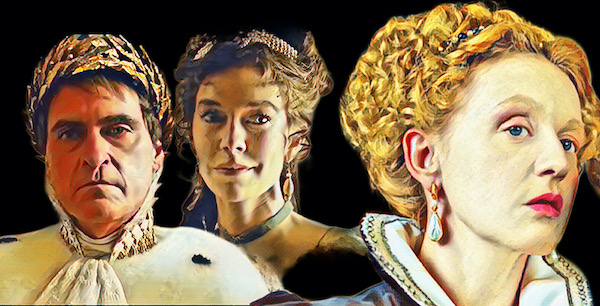
For Ludivine, it will be doubly curious. In 2002 she was cast in the French production of the series Napoleon, playing Hortense, Joséphine’s daughter. Now it gains prominence because of the figure of Théresia, famous as Our Lady of Termidor, among other nicknames, thanks to her prominence in the early years of the Revolutionary Regime. Although she does not appear in the trailer – which only shows a few scenes of Barras – she will certainly be important because she is a central figure in the trajectory of General Napoleon Bonaparte.
Spanish by birth, Jeanne Marie Ignace Thérésia Cabarrus had French and Basque ancestry. She was born to a life of scandal, it seems. At the age of 12, she was “seduced” by her paternal uncle, and the family, in order to distance her from him (and stifle the gossip), sent her to Paris, where she began to circulate with great success among the nobles, frequenting the store ´Au Grand Mogol´, rue Saint-Honoré, by milliner Rose Bertin, who dressed Queen Marie Antoinette (Catherine Walker) (as shown in Dangerous Liaisons as well).
At one of the balls, aged just 15, she met her first husband, the Marquis Jean-Jacques Devin de Fontenay, but they say he secretly preferred to be with women. Anyway, she knew how to relate and her beauty made her famous in Paris, as well as at her parties. However, the French Monarchy was a few years away from its violent end and Théresia was attentive. She embraced revolutionary ideas, despite her title, became affiliated with the Freemasons, and befriended the future leaders of the Revolution, the Jacobins, including Jean-Lambert Tallien, whose lover and wife she would later become.
When the Bastille fell in 1792, she was already divorced from her first husband, after having had an extra-marital affair, and left France, seizing the chance to finally join her uncle. She was arrested but helped by Tallien, however when she returned to Paris with him, she was imprisoned again. In prison, she met Joséphine. This period will feature prominently in the film and is important for understanding the dynamics of the people who helped and later opposed Napoleon.
Shortly after overthrowing the Monarchy, the rebels spent years dealing with violence and famine in France, while trying to establish a new Regime. It was the period of the Terror, where no one was safe, not even the rebels, with riots and attacks across the country, thus planting the seed for Napoleon’s rise. Tallien was one of the main leaders of those years, sending many to the guillotine, including friends and companions, until he became involved with Théresia. The story does not describe the union of the two as a romantic tale but as a meeting of interests (and yes, a romance). Théresia was famous, rich, and beautiful and is said to have famously declared that “it is better to marry than to be beheaded.” Thanks to her influence, many nobles were spared and Tallien reduced the number of executions. Joséphine de Beauharnais was one of these ‘saved’ people. The “Thermidorian Reaction” marked the end of the Reign of Terror as many were disillusioned and fearful of centralized government, preferring a more stable and democratic political order, impeaching and executing Maximilien Robespierre and associates. Joséphine and Théresia became best friends in prison.
The lives of the two women would have a man in common: Paul Barras (Tahar Rahim). In addition to leading politics, Barras led the social life of Paris, with luxurious parties and joints. Elegant, vain, and also known as a man of excess (unsurprisingly, he was the nephew of the legendary Marquis de Sade), as well as obviously unscrupulous. Without realizing it, he planted his enemy in a key position when, in order to suppress a monarchist rebellion, he did not hesitate to call General Bonaparte, giving him command of the improvised defense forces, which, with the overwhelming victory, gained fame, wealth and prestige. It was at one of his parties that his former lover, Joséphine, met Napoleon. They got married in just six weeks.

And Théresia? Well, if Joséphine was popular in Paris, the truth is that she was still in the shadow of her friend, the greatest fashion influencer of her time and considered responsible for making neo-Greek fashion the most popular in the country. With Tallien losing power, the marriage was threatened and that’s why the romance with Barras gained steam, something that apparently didn’t bother Joséphine. Théresia, Barras, and Tallien were witnesses to the marriage of future emperors. However, the friendship would not last long after the coronation because Napoleon thought that the Spanish’s lively love life was a negative influence on Josèphine and forbade her to maintain relations with her after marriage.
Far from the Empress and without Barras, Théresia divorced Tallien and married a wealthy banker. She lived among musicians and painters, putting on weight in the last years of her life and enjoying her children. She died surrounded by luxury and security. As she always wanted. In British literature, thanks to the popularity of the hero Scarlet Pimpernel, Théresia emerged as a seductive antagonist, but was, as we see, a shrewd survivor. Ludivine’s choice for the role is perfect, we know. Yet another reason to look forward to the film’s release.
Descubra mais sobre
Assine para receber nossas notícias mais recentes por e-mail.
 miscelana.com