
The cast of Napoleon is led by the award-winning Joaquin Phoenix and the praised Vanessa Kirby, but the equally awarded and prestigious Tahar Rahim will have a prominent role in the plot. He will be none other than Paul Barras, a man who changed the destiny of France and in whose house the general was introduced to Joséphine de Beauharnais. It was Barras who paved the way for Boparte’s rise and of course, fate eventually made them enemies.
For Ridley Scott, Napoleon still has relevance today because he came from nothing and managed to dominate the world in his time. “I know that after Commodus in Gladiator one of the most complex Roman emperors, Joaquin Phoenix will be perfect in Napoleon. He will perfectly match the character of this young officer who will also become a legendary emperor,” he said two years ago. Tahar’s presence on stage with Joaquin is a guarantee that there will be an exciting artistic clash.

Viscount de Barras, or Paul François Jean Nicolas, is an equally controversial figure and without him perhaps Napoleon would have had greater difficulty achieving absolute power. Barras was a nobleman and politician of the French Revolution and president of the Directory between 1795 and 1799, being overthrown precisely by Napoleon Bonaparte in what became known as the Coup of 18 Brumaire (which opened in tow).
Paul Barras was a cousin of the Marquis de Sade, and at the age of 16, he joined the army of the King of France, making a distinguished career in India. Along the way, he joined the democratic cause and supported the Revolution, rising so high to be one of the main leaders of the movement. Earlier, he fought in Sardinia, where he meets his future rival, Napoleon. With the fall of the monarchy, his biography is also marked by one fact: he was one of those who personally voted for the beheading of King Louis XVI, but according to what is known, he was opposed to the cruelty imposed on the little prince and son of Marie Antoinette, who died for mistreatment in prison shortly afterward.
When Robespierre also fell and was a victim of the guillotine, it was Barras who became supreme commander of the armed forces of Paris and the Interior, but in this position, he had to deal with the revolt of the royalists, who surrounded the Palace of Tuileries and threatened order. To contain them, he chose the young general Bonaparte, who had beaten the English two years earlier, giving carte blanche to act. The result was more than thirty thousand people injured and a new leader promoted by Barras himself.
More than a political position, Barras changed Napoleon’s life at a party. One of several that the Viscount hosted in Paris. There he met a former lover of Barras, Joséphine de Beauharnais. She had been traded for Théresia Tallien and heard of a good opportunity in the young general to secure status and security for her and her children. Legend has it, immortalized by paintings, that it was Thérésia who would have introduced Josefina to Barras, with both dancing naked for him, but there is no confirmation of the ménage. The fact is that Théresia was known to be involved with the most important men in politics, with a negative nickname of Government Property, and Joséphine needed men to support her life of excessive spending. Pretty sexist comments, no?
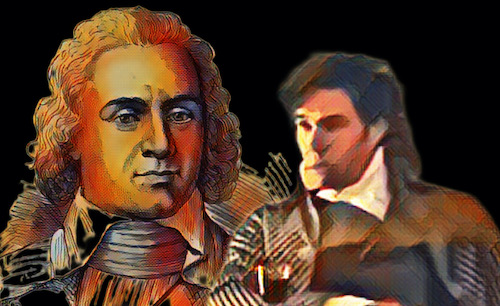
Anyway, Barras was the best man at their wedding, but the “gift” was sending the General to Italy just two days after the wedding, some claim to have more time with Joséphine again. At this moment, in 1795, he is, in fact, the most important man in the State. But that would all change soon.
One of Barras’ tactical mistakes was to resign the post of commander to give it to Napoleon, not realizing that the general had other plans and was already participating in a coup that would change world history. The Viscount’s sympathy for the sons of Louis XVI became clearer when he allowed women from the Bourbon family to return to France, which increased royalist pressure. Betrayed by the Minister of Police, Fouche, he is not informed that Napoleon, who was in Egypt, would have returned to Paris to seize power. Completely deluded, Barras saw himself as part of the political changes but is unceremoniously sidelined when Napoleon reveals himself to be the true man of power. He is said to have been astute in identifying that one day Fouche and Napoleon would one day be rivals. “One will avenge the other,” he reportedly said.
Rich and immoral, he lived his days on the fringes of Power. He died aged 73, disconnected and disillusioned. It will no doubt be fascinating to see how Ridley Scott portrays him in the film. The drama will not be missing!
Descubra mais sobre
Assine para receber nossas notícias mais recentes por e-mail.
 miscelana.com