
In the world of ballet you dream of the ‘ballerina’ trifecta: Odette/Odile- Giselle – Aurora, to prove technical ability, interpretation, and charisma. However, I had the privilege of having interviewed some great Brazilian and international dancers. Nine out of ten answered without blinking which role they most want to dance as “Manon”. And it makes sense.
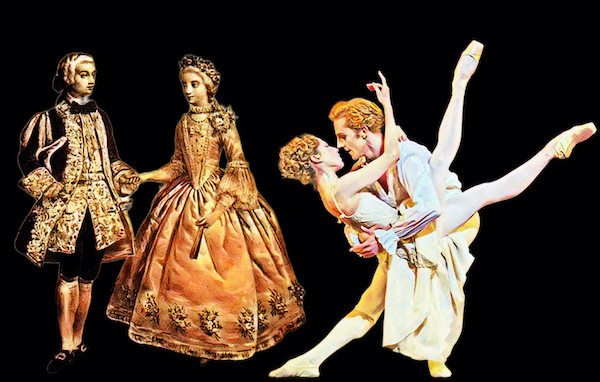
Manon, of course, refers to the ballet Manon Lescaut, a work that will complete 50 years in 1974 and which is the epitome of what classical dance could have been, but which did not advance. A ‘complete’ ballet, where there is a dense story that demands interpretation and a complex choreography that demands physical domain, is a work created by Kenneth McMillan for the Royal Ballet, after Romeo and Juliet and before May, and it is, for those who have seen it live, sublime.
There is a technical maturity to Manon that makes the ballet one of the most challenging ballets of the 20th century, a divine work in every way and with the rare opportunity to challenge men and women, principals and soloists in equal measure. Though Romeo and Juliet is even more popular, I consider Manon to be MacMillan’s masterpiece.
The story of Manon Lescaut came out of the book by Antoine-François Prévost, written in 1731, and had already inspired an opera, with music by Giacomo Puccini, but McMillan used other scores by composer Jules Massenet With Antoinette Sibley and Anthony Dowell in the lead roles, it premiered in London in 1974. Since then, it has been part of the repertoire of several companies around the world.

The desire to transfer the tragic story of Manon Lescaut to the Royal Ballet began a year earlier and was an old dream of Kenneth MacMillan. After all, he had been the artistic director for three years now, and he really wanted to create a grand work with exciting roles for the entire cast. He presented Antoinette Sibley with a copy of the book, recommending it for the following year. However, as Manon Lescaut’s copy was in a double volume with Prosper Mérimée‘s novel Carmen, the dancer was confused about which of the two stories the choreographer was talking about and asked Anthony Dowell, her partner, to help her find out. Rehearsals began before the end of 1973, leaving room for Antoinette to interpret her one way, but for another dancer to also have the freedom to find “her Manon”. The only thing they saw in common was the character’s desire to escape her poor background.
The novel written by Abbe Prévost is part of his memoirs and was considered scandalous, seized, and condemned to burn, forcing the author to publish a new version in 1753. The work was an immediate success.
Antoine-François Prévost was 34 years old and living in Amsterdam when he published the text. He had affairs with several women despite being a priest, including the courtesan Hélène Eckhardt, which makes many believe that there was an autobiographical side. The courtesan would be a combination of stories of “women of a bad life ” and, in particular, that of Marie-Anne Lescau, nicknamed Manon, who was deported to Île Dauphin, which in the book and ballet passes to New Orleans.
Repeating the Romeo and Juliet doublet, McMillan worked with Nicholas Georgiadi‘s costumes and created a series of athletic pas de deux for the lead duo in this tale of the disgraced courtesan. Faithful to the plot of the 18th-century novel, the choreographer maintained the story’s sensuality, as well as the character’s contradictions, precisely what still makes Manon one of the most coveted roles in the classical repertoire. And one of the favorites too.
Descubra mais sobre
Assine para receber nossas notícias mais recentes por e-mail.
 miscelana.com