
Shortly before his death in 1973, John Cranko experienced glory with his company, the Stuttgart Ballet, with a tour of the United States and the Soviet Union where they were acclaimed. With his muse, Márcia Haydée, alongside the stunning Richard Cragun, the choreographer presented two of his most famous works: Eugene Onegin and The Taming of the Shrew. And from these tours a small pearl was born, immortalized in the movie The Turning Point: the pas-de-deux Legend.

The beauty of the small choreographic piece lies both in the stage and in the inspiration that gave rise to it, as it unites the love of a genius – John Cranko – for two legends of classical dance: Galina Ulanova and Marcia Haydée.

Galina Ulanova was one of the greatest ballerinas in the history of dance, a living legend, and an extremely popular icon around the world. She retired from the stage at age 50, nearly a decade before the Stuttgart tour, which she witnessed and enjoyed when they performed in Moscow.
The presentation of the German company by the closed Soviet Union at the height of the Cold War was historic. Those who witnessed it, like the dancer Steven Wistrich, who was a member of the Stuttgart Ballet at the time, were unforgettable. The demanding audience that crowded the Bolshoi Theater to see the company, applauded The Taming of the Shrew for about 20 minutes non-stop. It was no different with the prudence of Eugene Onegin, a Russian story that had Marcia and Ricky in the lead roles.
“They are very serious ballet lovers in Moscow, and the audience went crazy, demanding encore after encore, applauding in unison,” Wistrich said in an interview a few years ago. “Finally, the orchestra left. But the audience continued to clap, demanding more. So Mr. Cragun and Mrs. Haydée bowed again and gave them what they wanted. With the house lights on and the audience on their feet, they repeated an entire pas de deux. In complete silence.”
Wow.


And backstage, when he met Galina Ulanova, Richard was presented by her with a tunic that he wore in Romeo and Juliet, for whom he also presented Marcia, his wife at the time and partner until the end of their career. From that small moment, Cranko envisioned what became Legend, which premiered in 1972 and is described as purely “the lyricism of love between a man and a woman through the smoothness of the steps, the confidence and surrender in the movements and the challenge of the fusion of bodies in tenuous equilibrium”. In other words, a piece that perfectly reflected the partnership of the three: John Cranko, Márcia Haydée, and Richard Cragun.
With music by Polish violinist Henryk Wieniawski – Legend, op. 17 (which in turn he composed as a confession of love to his future wife, Isabel Hampton), the pas-de-deux is short (about 7 minutes) and it wasn’t for the film The Turning Point – which it only shows a minute and a half – it wouldn’t be well known. But it’s perfect.

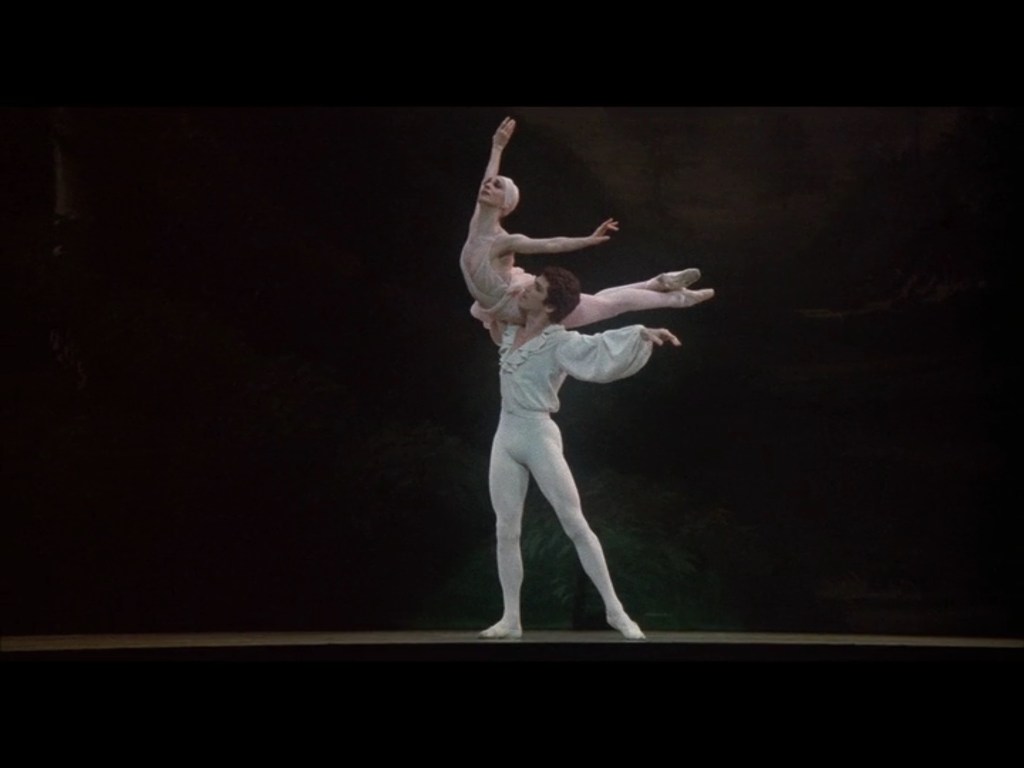
The pas-de-deux, which was staged for the first time on June 29, 1972, has no scenery and features the main couple in white in movements that display lyricism and technique, in movements typical of Galina Ulanova as well as Márcia ( via Cranko). At the premiere, the Brazilian danced with the tunic of the Russian legend, which is the basis for the current costume.
There’s more to point out when you know about this connection. The tunic was worn by Galina in the production of Romeo and Juliet, a production that today has many versions, between Kenneth McMillan and John Cranko himself, but which was created for her in the 1930s, with music by Prokofiev and much behind-the-scenes discussion.
The idea of putting the ballet on top of Shakespeare’s story originally came from Sergei Radlov, at the time Artistic Director of the Kirov (now the Mariinsky), still in 1934, who developed the script and asked one of his favorite chess partners, Sergei Prokofiev, to compose the music. Prokofiev had already made soundtracks, but he had never composed for a complete ballet and he accepted the challenge, finishing the score in September 1935. Then, things went awry. There is the version that the theater did not see how “dead people can dance” and another that blames the communist regime, in any case, the alternative was to change the original ending to a happy one. Obviously, Prokofiev did not like this imposition. The impasse brought everything to a standstill and the project was shelved before being transferred to the Bolshoi, where it was deemed inadequate.
Six years later, Kirov himself rescued the proposal, this time with choreography by Leonid Lavrosky made especially for Galina Ulanova (Juliet) and Konstantin Sergeyev (Romeo). It premiered successfully on January 11, 1940, but became a rage in 1946, when Lavrosky and Galina, now at the Bolshoi, revived the ballet. The film made of this presentation is one of the most iconic of the period, going through other controversial ones (it was banned in Brazil because it was considered propaganda of communism) and it was with Romeo and Juliet that the Bolshoi first visited London in 1956 (as shown in The Crown).

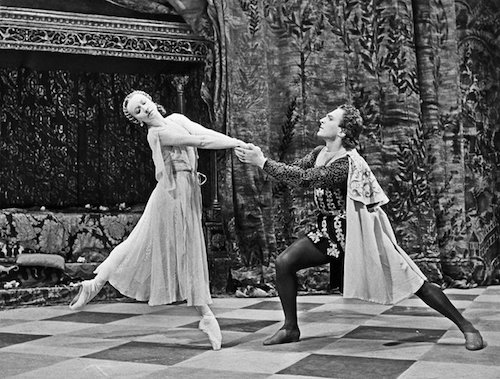
The success of Galina’s performance as Juliet impacted not only stars like Margot Fonteyn but two budding young choreographers who were in the audience: Kenneth McMillan and John Cranko. Cranko immediately went to work on his version, which many say was greatly influenced by what he saw. So much so that its first staging was just two years later, in 1958, in Italy, with Carla Fracci, then 21 years old, as Juliet. The version we know today was the 1962 revision, with Marcia Haydée and Richard Cragun in the lead roles, with critics identifying the influence of Lavrovsky’s choreography in the elevations and pirouettes. After seeing what Cranko did with Romeo and Juliet McMillan created his version in 1965, which is now the most popular outside Russia. However, it is from this original Romeo and Juliet that Legend was born, a romantic pas-de-deux in every sense that unites the legends – metaphorical and real – in a beautiful choreography.
Legend was first revived in Brazil by São Paulo Companhia de Dança, under the supervision of Richard Cragun, before his death in 2012. In those Internet things, I came across the recording that didn’t make it complete in The Turning Point. The film was only less than two minutes long, but the pas-de-deux was filmed in its entirety. A special, legendary moment that deserves to be remembered.
Descubra mais sobre
Assine para receber nossas notícias mais recentes por e-mail.
 miscelana.com