
In 1983, Barbra Streisand debuted behind the camera with a musical at a time when the genre was considered tacky. She talked about sexism, potentially homosexuality, sexual repression, religion, romance, and feminism. Yentl was a success, winning two Oscars – well deserved, for the soundtrack – but the star was ignored when it came to nominations for best director. Forty years later, the star is about to release her autobiography (in November) and, anticipating the event, is celebrating the anniversary of one of her most praised works.
The album Yentl: Deluxe 40th Anniversary Edition is part of the celebration and features a wealth of new material, with 15 additional tracks, some that include demos that Barbra recorded in her living room on a stereo cassette player, as well as demo narration, all with the actress accompanied only by Michel Legrand on the piano. For fans? Unmissable.

For Yentl to reach the screen, production took a few more decades. Barbra was enchanted by the short story Yentl: The Yeshiva Boy, written by Isaac Bashevis Singer in 1968 when she was still finishing Funny Girl, the film for which she won the Oscar for Best Actress in 1969. Although the rights to the book were purchased Even though Czechoslovakian director Ivan Passer had made a first draft, like “Mask”, he didn’t want Barbra in the cast precisely because by that point she was a huge global star. For him, having a celebrity in the cast would hurt the film. Eventually, he left the project. In 1973, while recording The Way We Were, the actress sought support to continue with Yentl but was already considered “too old” for the main role. And feminine. Unable to convince the male executives that they were wrong, around 1976 and starring in A Star Is Born, she began to agree that perhaps she was not young enough, but became determined to direct it. She quickly wanted the lead role again and this, instead of helping, made the studios even more suspicious.
Now the question was how she – a first-time director – would deal with a multimillion-dollar project. They also questioned whether a musical was commercial enough or too ethnic. Yes, at the suggestion of Barbra’s lyricists and friends, Alan and Marilyn Bergman, Yentl went from being a drama to being sung. Now, with so much refusal, the project has become a matter of honor for Barbra. Even millionaires offer to do shows and give up.
Her biography has to be confirmed, but according to reports – and it is reinforced by the film’s dedication to her father – Barbra became even more determined to film Yentl after visiting her father’s grave in Mount Hebron Cemetery. The signs were clear: she asked her brother to take a photo of her next to her father’s tombstone and when she saw it, Emmanual Streisand’s grave was directly next to that of a man called Anshel, which was precisely the name of her dead brother of Yentl which she adopts when she assumes a male identity. With a consultation with a medium, she would have had confirmation.
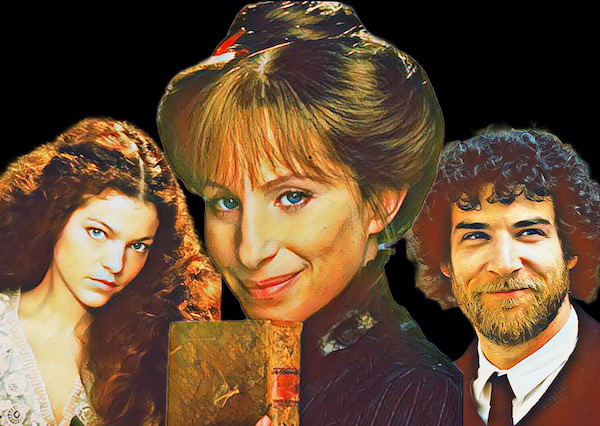
In total, Yentl took no less than 15 years to start filming, then at least 20 versions of scripts, to be turned into a musical and to have Barbra Streisand in front of and behind the cameras. And, of course, for those who haven’t seen the film, Yentl is a Jewish girl who, at that time, just because she was a woman, couldn’t even study, but, breaking the rules, her father taught her in private. Always curious, she has to make a radical decision after his death: she dresses as a man and pursues further studies. What complicates everything is that she falls in love with a colleague Avigdor (Mandy Patinkin) who was engaged to a typical young woman of the time, Hadass (Amy Irving). When the engagement is broken, Yentl can’t escape replacing him and marries Hadass, who falls in love with Yentl. That’s right, 40 years ago the film dealt with gender change and homosexuality, but it ended with an ending that many criticized as “traditional”.

Papa, Can You Hear Me, and The Way He Makes Me Feel were nominated for Oscars (the first won and had none other than Donna Summer playing at the ceremony) and Michel Legrand won his last Oscar for the complete Yentl soundtrack. That’s why the commemorative album is so significant, which will bring some moments so close to the composer and his performer. A great opportunity to mark four decades of a great musical.
Descubra mais sobre
Assine para receber nossas notícias mais recentes por e-mail.
 miscelana.com