
In Swan Lake, the role of Siegfried is more than just the central male role of the ballet, it is also possibly one that some believed to have been inspired by a true story. Of course, no princess Odette transformed into a bird for revenge by wizards existed, but contemporary with Pyotr Ilyitch Tchaikovsky lived a German prince whose tragic fate left him known as the Swan King, which is why they believe that he would have possibly inspired one of the greatest classics bred for dancing. We are talking, of course, about Ludwig Otto Friedrich Wilhelm, or Ludwig II, the prince of Bavaria and Swan Lake.
Before moving on, a warning: despite the coincidences, the ballet was created a few years before the prince’s death, aged just 41, in a lake. So, could it be art being revived in reality? Be that as it may, Ludwig II’s trajectory still fascinates historians.
He reigned for 18 years and became known as the Fairy Tale King or, more critically, the Mad King. His time on the throne yielded luxurious and iconic artistic and architectural projects, such as Neuschwanstein Castle (which inspired Disney’s Cinderella castle), and was the patron of composer Richard Wagner, but his obsession with beauty and Art accelerated his deposition from the throne, the day before he was found dead (still suspiciously to this day).
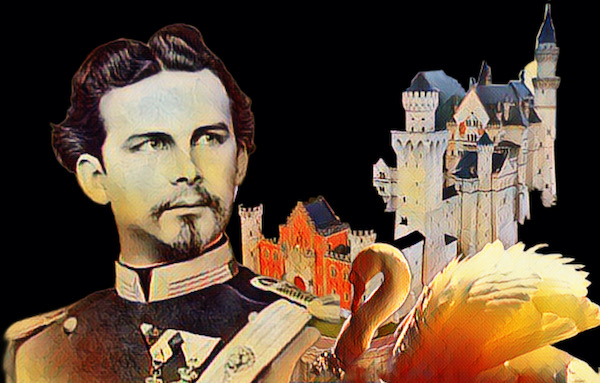
The “Swan King” reference, according to historians, is about his childhood spent much of it in the castle owned by Hohenschwangau, or the great swan country, in the Bavarian Alps. There was the lake, the “Swan Lake” (Schwansee), where little Ludwig grew up with real swans, as well as icons and portraits. Another characteristic that suggests that Ludwig inspired Siegfried is his introverted personality, unhappy with his destiny as sovereign. Under a strict regime that kept him isolated even from his younger brother, he was not exactly a happy prince. Even less so because he was made King when he had barely reached the age of majority and was pressured to find a bride.
His profile did not fit with what was expected of a monarch, without paying attention to matters of state and passionate French culture, investing in building several fantastic, luxurious, and beautiful castles, such as Neuschwanstein (New Swan Stone Castle), Linderhof, and Herrenchiemsee. More than fortresses, they were visually stunning. Ludwig was also passionate about the legend of Lohengrin (“Swan King”), and was, therefore, a fan of his music and operas, whom he sponsored for a time.
Isolation did not help the mental health of the young king, who spared no efforts or values to create fairytale scenarios. By putting the Court in debt, he became unpopular. Parliament, in possession of a medical report describing the king’s mental state as “insane”, was declared incapable and removed from the Throne.

Imprisoned in Berg Castle, located south of Munich, on Lake Starnberg, he was last seen alive going for a walk with his doctor, Dr. Gudden. Their bodies were discovered in the lake a few hours later. Officially, his death was ruled a suicide by drowning, even though an autopsy confirmed that he had no water in his lungs and the lake was too shallow for ‘an accident’. It also does not help to support this version when there was evidence of strangulation and a blow to Dr. Gudden’s head. Witnesses claim that Ludwig was shot dead, but there were no bullet wounds on his body.
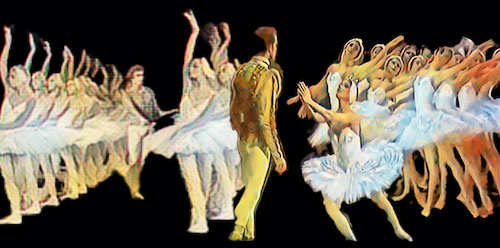
In general, ballets place Siegfried at an undetermined moment in History, but recently the Royal Ballet, in yet another ‘updated’ version of the work, placed costumes and sets that make the connection between Ludwig and Siegfried, with the prince wearing a military uniform similar to Ludwig’s.
The mystery surrounding his death fueled the legend that Ludwig saw himself in a mythical kingdom. After all, Siegfried also ends his life by throwing himself into the lake, shortly after Odette’s death. For many, it would be the final connection of his life to the work, after all, whether murdered or taking his own life, the Swan King had a destiny that can only be found in the world of fantasy. Or in a kingdom that had no room for a man who was obsessed with beauty.
Descubra mais sobre
Assine para receber nossas notícias mais recentes por e-mail.
 miscelana.com