
I love Mike Flanagan‘s dark franchise on Netflix because as a fan of literary classics, I appreciate the way it presents iconic works to new generations who are a bit averse to reading. On the other hand, if you know the work he is adapting, it can be irritating. I liked the first phase of The Haunting of Bly Manor, for example, but I hated when it distanced itself from Henry James‘ original work, The Turn of the Screw. There was quality, a soundtrack that I consider one of the best ever made. But I’m very attached to the original material, I admit. The same doesn’t happen with The Fall of the House of Usher because although I’m familiar with Edgar Allan Poe‘s work, I haven’t read it all so I’m more than ready to let myself go and what a difference it made!

The horror series does better than the previous ones, with great performances, period reconstruction, and yes, a brilliant soundtrack. We follow, in a non-linear but always easy-to-follow way, the rise and fall of the Ushers, the family of the ruthless brothers Roderick and Madeline Usher, who made their fortune leading Farmaceutic Fortunato. Their empire of wealth, privilege, and power was obviously built on greed, death, and lies, but the time for accountability comes suddenly when the heirs begin to die suspiciously. In common there is always a mysterious woman who knows all the Ushers’ secrets.
Horror fans – cinema or literature – know that Edgar Allan Poe is one of the greatest authors and that, in the 1960s, he served as a source for films by Roger Corman, who to this day is the “Pope” of the author’s filmed versions. But Mike Flanagan placed himself on that altar, without a doubt. His precision in the irony of the texts with Bruce Greenwood (replacing none other than Frank Langella), keeping the scares at the right dose and even avoiding exaggerated sentimentality. It works perfectly. Especially because, more than violence and graphic images (which are used) it is the psychology that works. Fear is generated by guilt and we, even without empathy, suffer in anticipation for each person.


Each episode is freely inspired by a Poe story and so we have a journey through the writer’s dark imagination. The first episode is the one that gives the series its title, where Roderick Usher (Bruce Greenwood) is at a joint funeral for several of his children who died in a series of “freak accidents”. In a ruined mansion, Usher has a conversation with Auguste Dupin (Carl Lumbly) – a recurring character in Poe’s books and considered the first detective in fiction) – where he makes a long and detailed confession that takes us back in time and to few understand what is happening. To update the weight of the story, Flanagan also piggybacks on the Sacker family scandal and the opioid pandemic, so that we are in constant pain and never on the side of the Ushers. We know what happened, we follow how it happened and we are only anxious to find out, or confirm, why.
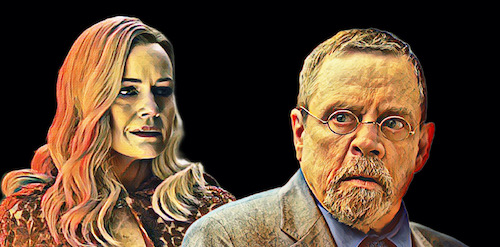
For those familiar with the franchise, you know that Mike Flanagan ostensibly works with the same cast, with few changes. With that we have the usual “culprits”, and it’s fun how they change and confirm the chemistry between them. Carla Gugino stands out as the mysterious woman and Mark Hamill gives us another unforgettable voice and is dark, ironic, and also wonderful. The series is Bruce Greenwood‘s, however, with long monologues full of nuances in a great performance.

In theory, The Fall of the House of Usher “closes” the showrunner’s contract with Netflix and, if it is indeed goodbye, it is a worthy farewell. Capturing the mystery and fear, not just of those who love the genre, but the soul of perfect works of horror. Especially, in this case, by Edgar Allan Poe. Enjoy, Octobers with content like this may take a while to return.
Descubra mais sobre
Assine para receber nossas notícias mais recentes por e-mail.
 miscelana.com