
In January 2024, it will be 25 years since an independent film that was so disruptive that it is still legendary today: The Blair Witch Project. This small production from 1999, written, directed, and edited by Daniel Myrick and Eduardo Sánchez, was innovative for working with simplicity and brilliance on a simple concept of mixing reality and fiction without making it clear where one begins and the other ends and was born as a classic. Films that change the game of business and storytelling are rare and this is one of them.
With a maximum budget of 200 thousand dollars, the production grossed almost 250 million dollars worldwide and is still one of the most profitable in the horror genre and one of the most iconic in independent cinema. It also took prestige to the Sundance Festival, where it was released in a midnight session on January 23, 1999.
It is necessary to emphasize the importance of the originality of the concept of every project, born with the first Internet bubble, but before social networks. It was a worldwide fever, it was impossible to escape from a circle of friends where it wasn’t being seriously discussed. I give my personal testimony: I went to watch it cynically, I didn’t enjoy it while I was in the cinema, I loved the final sequence (one of the best I’ve seen to date) and I was only impacted by what they were presenting when I left the projection room and went to retell the story and I was scared remembering the final scene. Yes, The Blair Witch Project is one of the best horror films ever made. I defend its importance, even recognizing the work’s deterioration in parodies and its less successful exploitation in the form of a franchise. The original is brilliant.

In pre-digital days, we follow a fictional story of three students, Heather Donahue, Michael C. Williams, and Joshua Leonard, who disappeared five years ago while filming a documentary in the Black Hills, near Blair (actually the city of Burkittsville, Maryland). They were investigating a local legend about the “Blair Witch” and what we see is the material from the three cameras, found in the woods which may give us a hint of what could have happened to them. Simple, scary. We follow the trajectory until the unexpected conclusion. So far, nothing innovative, so if you haven’t seen it yet, you might wonder, what moved so many people?
I tell you, it was also how the film was promoted. First, the actors use their first names (something they later regretted) and the 35-page script was almost just a script: they had no dialogue or prior direction, just suggestions and improvisations. They went through deprivation (no food and no direction or map), a reality show tactic (still starting in 1999) that took away from the cast more reactions than interpretations. The legend of the Blair Witch is a combination of several stories conceived as a common thread by the screenwriters. The detail is that the film is not about the Witch, but about people trying to find out about her and we are finding out about them by researching her. Metalanguage in the vein, whose poster campaign using photos of the three missing actors “went viral” before the concept of “going viral” even existed. After all, it was still January 1999! In the twilight of social media and reality shows, the gray field between reality and fiction has found a still unexplored and potentially consuming field.
The second success factor lies in this innovative marketing concept, carried out by a public relations agency that created a website with alleged police reports on the disappearances, interviews, and testimonies. They also had leaflets asking for help and information about students were distributed in cinemas. It was so realistic that people started to “believe” it was true. International rights to The Blair Witch Project were purchased at Sundance for a mere $1.1 million. When it gained worldwide distribution, the fact that everyone “knew it was fiction” generated a certain amount of doubt among the audience and almost unanimity among critics (who approved).
And who was the Blair Witch? We have heard reports that in the 1940s, a Blairite hermit, Rustin Parr, kidnapped and killed seven children in the basement of his isolated forest home. He turned himself in to the police claiming that “a hooded ghost woman forced him to do it”. The sole survivor, Kyle Brody, described that Parr made him stand in a corner of the basement, facing the wall, while the brutal murders took place. It’s essential information that’s mentioned somewhat without emphasis, but when we remember it, it’s too late.
The testimony about the crimes committed by Parr is given to the missing trio by fishermen who believe that the forest is cursed and that the woman in the hood is the ghost of Elly Kedward, a lady banished from Blair and hanged in 1785 after being accused of witchcraft. Before Blair’s massacre, there was already a legend about a child called Robin Weaver, who disappeared for three days in 1888 and when he returned he talked about an old woman whose feet never touched the ground. Additionally, in the 19th century, five men were found ritualistically massacred at Coffin Rock, but their corpses disappeared. Camped and following the trail, Heather, Michael, and Joshua come across strange situations, hear noises, and soon get lost. It’s just the beginning of a lot of tension.
We follow the scares, and the fears, but the sequence that I say is spectacular is the editing that unites the images of Heather and Mike until the (unexpected) conclusion that leaves us breathless. It’s just a few minutes where everything we hear throughout the film materializes, ending before anything happens, but enough for us to use our imagination. Seriously, I’ve already given away the spoilers, but it’s still amazing.
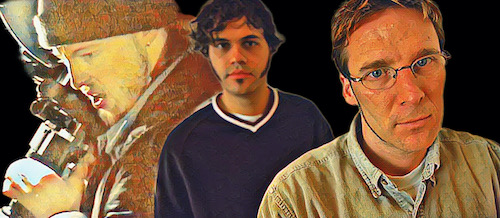
Daniel Myrick and Eduardo Sánchez created the concept of The Blair Witch Project by watching documentaries about paranormal phenomena and becoming more scared than watching horror films. Other influences were Stanley Kubrick‘s The Shining; Alien, by Ridley Scott, The Prophecy, and even Jaws, by Steven Spielberg, which takes its time showing the predator and using music to scare the audience. The final scenes were filmed at the historic Griggs House, located in Patapsco Valley State Park near Granite, Maryland. Filming concluded on October 31, Halloween, or so the legend goes.
Today it is more challenging to see something artistically unique in The Blair Witch Project, with the images deliberately poorly recorded and even edited, but due to its initiative as a whole, for having changed the proposal, mixing the morbid curiosity of true crime and the supernatural, it guarantees its position at the top for horror fans, revolutionizing the genre and inspiring a new wave of horror popularity. Although it is difficult to find it on platforms, having been around for a quarter of a century, it is already confirmed as being as legendary as its witch. Halloween classic.
Descubra mais sobre
Assine para receber nossas notícias mais recentes por e-mail.
 miscelana.com