
In the first episode of the second season of The Gilded Age, the route to the “Opera Houses” conflict was charted. On one side is Bertha Russell (Carrie Coon), who wants access to a box at the Academy Of Music to watch the operatic season. On the other, Caroline Astor (Donna Murphy), “controls” the list of those who have access to the theater. The wait is long and subjective, and of course, Bertha doesn’t accept it. Ready: the war is starting. And there’s more.
Of course, all the discussion about the Academy of Music and the option, the Metropolitan Opera House was already in its first season, but now it’s taking center stage. And it wouldn’t be dramatic without a star, who has already heated up the atmosphere between Bertha and Caroline, the Swedish soprano, Christina Nilsson. That’s right, did you notice how everyone was delighted with the talk Christina gave at the Russells’ house? Because she was the “Taylor Swift” of opera at the time. What’s more: just as the fight between the opera houses in New York in 1883 happened, Christina also existed. What’s more: she not only enchanted composers like Piotr Tchaikovsky, but she also inspired the creation of Christine, from The Phantom of the Opera.

The story of Christina – later the Countess of Casa Miranda – is fascinating. She was born into a peasant family in the Swedish countryside, where she always demonstrated musical talent, singing and playing the violin and flute, but her family did not have the money to pay for the necessary education. To help around the house, Christina would sometimes go to local fairs with her parents or brother to perform and earn extra money. She soon gained fame and at just 14 years old she was “discovered” by a rich judge, who became her patron and sent her to Stockholm. This is how she finally learned the bel canto techniques and gained even greater fame for her pure voice with a range of two and a half octaves. She was also considered beautiful and had a great stage presence.
When Sweden became small, she went to study in France. There she made friends with important artists, and the composer Meyerbeer chose her for the lead role in L’ Africaine, but she preferred to appear in Italian operas. When she appeared as Violetta in La Traviata she became a star in Paris. But no role surpassed Marguerite in Gounod’s Faust.

Christina was so perfect as Margueritte that the composer Piotr Ilyitch Tchaikovsky, upon seeing her perform in Moscow, would have said that she “personified Goethe’s ideals”. In the United States, she enchanted New York with her performances at the Academy of Music in 1871. From there, she became a superstar, singing in front of up to 50,000 people. She has been compared to her contemporary, Adelina Patti (also mentioned in The Gilded Age), but unlike Adelina, she never made a recording of her voice. A pity! In the 1883 season, at the opening of the Metropolitan, she played her most famous role, of course, so we just might see her again in the HBO Max series.
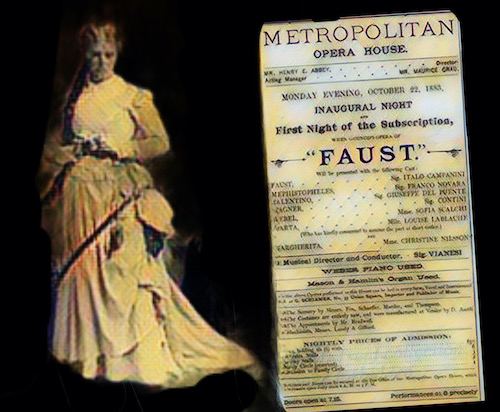
She was married twice and widowed twice. It was with her second husband, a Spanish nobleman, that she gained the title of Countess. Five years after the season in the United States, in 1883, she said goodbye to the stage. She died in Växjö in 1921.
Her fame was so great that she was a minor character in Edith Wharton‘s The Age of Innocence and mentioned in Leo Tolstoy‘s Anna Karenina. Everyone suggests that Gaston Leroux was inspired by her life to create Christine Daaé, the heroine of The Phantom of the Opera, which is obvious not only from the character’s life story but also the quote from Faust in both the book and the Broadway musical.
Aware of these details and precisions such as Christina Nilsson’s participation in The Gilded Age are even more interesting. Don’t you think?
Descubra mais sobre
Assine para receber nossas notícias mais recentes por e-mail.
 miscelana.com
2 comentários Adicione o seu