
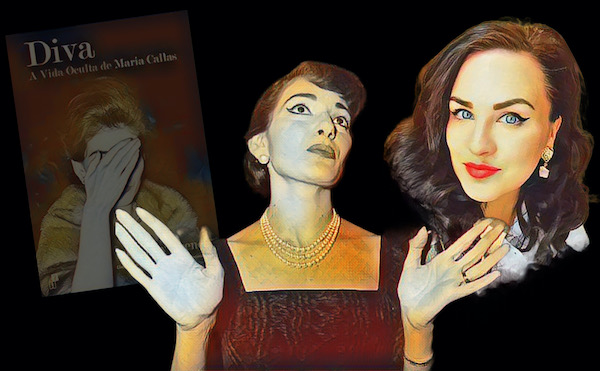
Liking the same things and having the same Cinema muses kind of helped Lyndsy Spence and I cross paths on social media, talking about incredible and iconic women. Naturally, one of them is precisely Maria Callas, one of the main female icons of the 20th century who would have turned 100 years old on December 2nd (official date). The chat Lyndsy and I had via Zoom was long and we could have continued for hours because there are many curiosities, many aspects through which revisiting these important women gains another perspective, especially with recent cultural advances in the feminist movement. In particular, Callas.
It is common to separate “Maria” from “Callas”, Maria Callas herself did this. Unsurprisingly, director Pablo Larraín is directing Angelina Jolie in a feature film called Maria, which will be released in theaters next year and aims to delve deeper into the artist’s reality in the last days of her life. Callas, who passed away in 1977 at just 53 years old, had a life full of drama, trauma, glory, and passion. There are incredible legends about her professional and personal life, Lyndsy and I cover some of them today. We just didn’t choose the same aria for the “soundtrack” of the day. Lyndsy chose Casta Diva, from the opera Norma, I think Vissi D’Arte, from Tosca, is the aria that identifies Maria for me. I hope you enjoy our chat!
CLAUDIA: When did you fall in love with Maria Callas?
Lyndsy: I’ve always been interested in “old Hollywood” since I was a child, and my mother’s side of the family is American, which is quite exotic here in Ireland. So I always felt like I had a link to this world of glamor because I met my great-grandmother, who was stunning like an MGM movie star. She was the one who really introduced me to all of this.
CLAUDIA: My connection with that time also involves my connection with my grandmothers…
Lyndsy: And I also remember that I was about 12 or 13 years old and one Christmas there was something on TV called Fever la Diva, with names like Judy Garland, and Marilyn Monroe until I heard a supernatural voice and I was like “Wow, who is that?”. Of course, it was Maria Callas.
CLAUDIA: Have you ever heard of her?
Lyndsy: I kind of always knew the name ‘Maria Callas’, and you know, we didn’t have the Internet like kids do today so anything I was exposed to about her was when there was something on TV and you had to wait for a show to come on. , Something like that. That’s why I initially thought that Maria Callas was just an opera singer, but as I was impressed and didn’t know anything about her I started buying all the old biographies until with YouTube I was able to watch more things about her. That’s how my connection with her began. I’ve been obsessed since I first saw it.
CLAUDIA: We were talking that we have this common passion for these iconic women of the 20th century, devouring their biographies and in the case of Callas, there is always the mystery of “who Maria really was”.
Lyndsy: That’s right. Whenever I read about her and compared her to books like Judy Garland and Marilyn, because I had them all, I thought, we don’t really know who Maria is. We know Callas and we also know everyone she was involved with, all the scandals and curiosities, but even when I was young, I felt like we didn’t know Maria. There have been more than 20 years of fascination with this mystery.
CLAUDIA: And how did you find the unpublished documents that are the basis of her biography? Because you had access to letters that greatly changed the narrative that we all grew up learning, including the idea that she was a very passionate and dedicated woman who almost threw everything out of love for a man who was not worthy, and that she died from her heartbreak. Would it be a wrong view, including thinking that this was romantic?
Lyndsy: That’s a good point because, for me, I know when people say it was very romantic, I think about what romantic really means, and it was sort of in the Victorian sense of women suffering and dying young, martyrs. I wanted to look at Maria in the context that she lived and I don’t think anyone has really done that because if you look at a woman, and it’s probably a lot like your grandmother in Brazil and it’s a lot like my grandmother in Ireland, we live in a very masculine society. Women did not have many rights and, if they did, they could not exercise them. And Maria lived with this reality.
CLAUDIA: Hard periods of War, post-War…
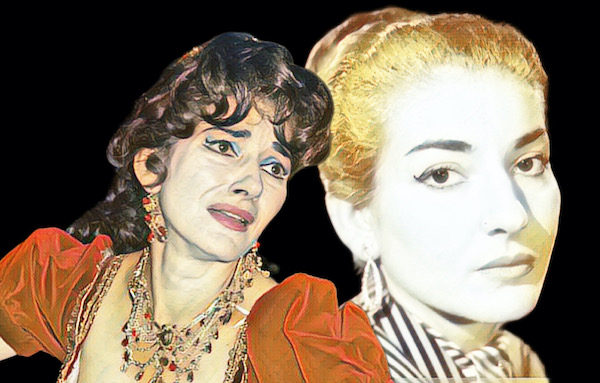
Lyndsy: When she was a girl in Athens she had absolutely no rights. Her sister was pushed into prostitution because she had no other way out. Fortunately, Maria had the music, otherwise, her mother would probably have explored it in a similar way to Jackie. And even later, as an adult, she goes to Italy and marries an Italian where she literally belongs to her husband. She didn’t even have the right to ask for a divorce. I always say that Callas had all the authority when he sang, but at home, Maria was Mrs. Meneghini. She lived under the rules of her husband, who had full access and control over her money, made all decisions in her name, and did so because he legally could. He’s the one in charge. So I thought it was interesting to see her in that light.
CLAUDIA: And she really had an attraction to men who were called ‘dominant’, right?
Lindsy: The way she grew up, idolizing her father who often said in a romantic way he wanted her to go back to New York and live happily ever after, but he just wanted her to be like a servant.
CLAUDIA: That version of the woman taking care of the man.
Lyndsy: Yes, this sexist mentality that Maria herself had as a woman. She was treated like a second-class citizen in her time and I don’t think people, when they looked back at her life, really looked at that. They just thought, ‘Ah, she was responsive, she liked to fight, she liked drama’, but they never noticed that she had no choice but to do that. But, going back to your other question from the research material, I always exploit my blind intuition which always makes me believe that I will find something that no one else can. And I really have this talent: I go, look and find. And that was what guided me with Maria Callas.
CLAUDIA: A superpower?
Lyndsy [Laughs] I started applying my usual research methods and there were files from a huge collection at Stanford, which belonged to Robert Baxter, who was a great collector and died recently, in 2019. He donated everything in boxes to the university and as we were in the middle of the pandemic and I couldn’t go anywhere, I sent an email to the archivist who explained to me that they hadn’t analyzed the material yet and if I wanted to pay and take the risk? I transferred and it was an absolute treasure.
CLAUDIA: What was in the boxes?
Lindsy: Complete correspondence with Mary and her godfather, 1949 to 1977. And letters to her sister, mother, father, husband, and friends. About her art. In other words, just everything she was going through and thinking at that moment. Of course, we look at it in hindsight, but she had to go through all these steps to experience it all in real-time. There were letters to opera managers like the San Francisco Opera, and La Scala. For example, people remember it as if she had canceled her performances in San Francisco when all hell broke loose and had letters from Meneghini, in Italian, repeating what the doctors had said about her health. I had to hire a translator to translate all of this. I also accessed other letters, from the collection available at the New York Public Library.
CLAUDIA: Any surprises?
Lyndsy: In some moments we see that she is more bitchy and in others that she is more in control, she has others that she wants to know about gossip, and I found that very funny. And when she is separating from Meneghini she says things about him. Her correspondence with Leo Larman, her best friend and editor of Playbill magazine is so intimate, she simply told him everything. Other times, when you get to know all these sides of her, you realize that Maria can be quite shy and it’s kind of reading between the lines of what she’s really saying. In these letters, of course, she is very in-depth in terms of [Aristotle] Onassis where she talks about pregnancy and illnesses, how she can’t get a divorce, and that she is afraid, that her ex-husband is blackmailing her. So there is much more than the Greek archives.
CLAUDIA: Would you say that the biggest difference in her biography then is the source?
Lyndsy: Yes, when I read other biographies, I felt like a lot of the material was taken from auction catalogs and was in the public domain, or from Life magazine. There is a book that I found to be of great help: Maria Callas, The Greek Years.
CLAUDIA: But was there any reaction to what you published?
Lyndsy: Yes because after my book was written, there were really horrible things written in the tabloids and some still think I’m a bad person. Heirs of people mentioned who didn’t like what was published, but when we established that the sources were the letters, it passed. When I sent Maria’s letters to Di Stefano [Giuseppe Di Stefano, Callas’s tenor partner and later lover] for his daughter, I said ‘It’s like reading your parents’ letters to each other’ and she replied ‘You see that Maria is when she is in love’.
CLAUDIA: Was it different?
Lyndsy: In some letters she is possessed, she is jealous, as if she is irrational, saying things like ‘you should leave your family for me’, she is actually attacking him [Di Stefano] while other biographers have treated him as if he were the villain, which he prevents I told Maria to return to Juilliard, but it is certainly the opposite. Some of this material will be included in the documentary “The Unknown Maria”, which we are making.
CLAUDIA: I find it impressive that even in times of less technological reach, it was she who broke the opera bubble and became a pop star, and yet it is the drama of her life that is the most explored.
Lyndsy: That’s it. People, people don’t realize that the meaning of Italian opera is very combative, its heroines are always fighting with people on stage and Maria transferred all the emotions of real life to the stage. When you see her in an interview and she’s not having a good day, let her know that she’s not having a good day. There is no pretense or filter.
CLAUDIA: And her rivalry with Renata Tebaldi? Fake News or truth?
Lyndsy: They were young women at the time, and I know they absolutely despised each other in the ’50s, but I really like this: whenever Callas was going through a bad time, like in 1973 or 1974 in New York, Tebaldi was the first to call her and break that decade of silence and say “what’s going on, Maria?” They get their friendship back together and it’s so fabulous. When we see Tebaldi at Callas’ memorial, her tears are genuine.
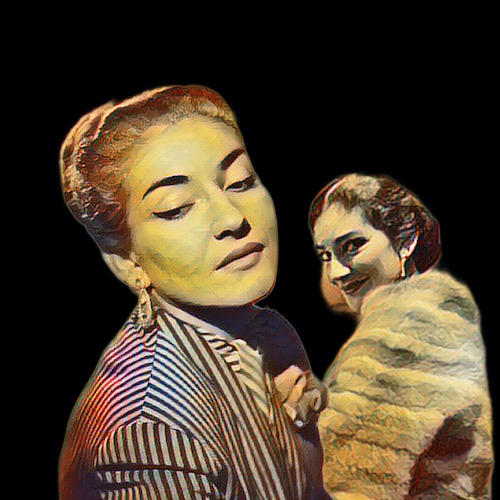
CLAUDIA: And of the other Callas myths, I know there is one that blows your mind: saying that Maria lost weight to look like Audrey Hepburn. Why?
Lyndsy: Yeah, it drives me crazy because it kind of dismisses everything that Callas was going through at the time. I read things where they say “Oh, she was huge, even as a child she was so fat” and that’s not true. They were starting to really humiliate her, humiliate her because of her size and she was deeply unhappy about being criticized by her colleagues, by the public, and by the press.
CLAUDIA: And she was always a vain woman!
Lyndsy: But she was also dissatisfied with her husband because he was also her manager and she didn’t like that dynamic at home. She wanted to be a wife and have children, but, as she wrote, she became a singing machine. I think it was also because of this unhappiness that she really started to take care of herself and lose weight. When you don’t have your partner’s respect or their love, in a way you start living for yourself and that’s what she did. It was a way of assuming her own identity, so saying that she saw Roman Holiday and wanted to be Audrey Hepburn is wrong. Never in any of her letters do we see her even saying that she saw the film or mentioning Audrey Hepburn. She became very thin and liked the attention – and everyone does – look at Adele, who had a complete transformation.
CLAUDIA: And was it difficult to maintain?
Lyndsy: Unfortunately, she started to like being hungry and having a bad relationship with food. Onassis didn’t help because she said, ‘Look how fat Maria got’ and she wasn’t even big. He liked very thin women like Jackie Kennedy so Maria was always conflicted trying to conform to his ideal, so much so that she wrote a letter to Leo Lerman: “I wish I could just take one pill and not have to eat food.”
CLAUDIA: Oh my God.
Lyndsy: Yes and she also had a lot of health problems. People thought she was a hypochondriac, but she wasn’t.
CLAUDIA: Yes, and that brings me to another kind of secret, which was her health was not really explored.
Lyndsy: It was like it all started with her changing look. She went to Switzerland, to a clinic where all the movie stars went, and underwent treatments with iodine, which is relatively safe for thyroid treatment, which was not her case. She had iodine injections that revved up her thyroid. She was really playing with her mortality, but she did it.
CLAUDIA: Any other legends about Callas’ weight loss?
Lyndsy: That she ingested a tapeworm [a worm that lives in the intestine]. This is also not true.
CLAUDIA: What about dependence on medication?
Lyndsy: Back in the 1950s she started having a panic attack and still had to sing. And that’s when she started to like what they called “vitamins” and people had a different relationship with prescription medications in the 50s and 60s. That was the beginning but it was Onassis who became addicted to Mandrex, which has many different names. streets and today it is prohibited, but at that time it was legal. It calms the nervous system, but also gives feelings of euphoria and she came to rely on it, becoming very dependent on it in the 70s, although I believe she was self-medicating, to try to alleviate her symptoms. [according to the author’s research, Callas faced neurological problems in secret, even due to a lack of correct diagnosis.
CLAUDIA: How can we look at her relationship with Onassis with everything we know today?
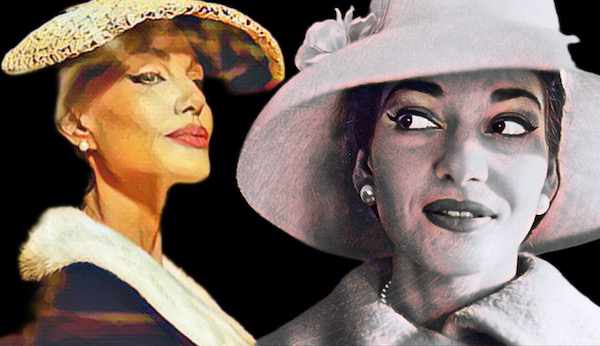
Lyndsy: I think she met him at his lowest point. It’s not true that Maria left her husband for him, before the cruise [with Onassis], she asked for freedom. She discovered that Meneghini was spending her day and said ‘I don’t want to be with you anymore’, but he replied ‘You can’t get a divorce and you’re stuck with me’. He followed her on the cruise and I know that Onassis was married, but Onassis’s wife got divorced and Onassis didn’t want to give her a divorce because he was just horrible. They were all married, but not married if that makes sense. Maybe not in the eyes of the church, but I mean, that’s the dynamic. And I felt like she thought Onassis was this big masculine protector, taking care of business and she didn’t see his flaws as a red flag. But then again, she grew up in a society where men raised their hands to women. Psychologists also say that when a child is abused, they look for people similar to adults because they need that adrenaline rush. She liked it when the men in her life behaved badly, she saw it as a sign of their feelings for her. She wrote this to Meneghini in the 1940s: ‘Have you never been jealous of me? This is not good and I am unhappy. I would like to see and feel that you are a little jealous of your wife, even if you trust me.
CLAUDIA: Didn’t she have a better reference?
Lyndsy: And other times she creates her own drama. Maria is not an innocent bystander, she just uses the tools given to her in childhood and throughout her life and keeps coming back to the same thing over and over again.
CLAUDIA: Any expectations for the film Maria, with Angelina Jolie playing Callas?
Lindsy: I think she has that elegance and Callas air. I think she’ll be fair, I’m curious. After the photo was released I saw her as Maria Callas, I think she looks good, she has that vintage look, but it’s too early to give an opinion. But I would like to see Angelina Jolie as the real Maria.
CLAUDIA: How would you like your 100th birthday to be celebrated?
Lyndsy: Sometimes I feel like it’s a little oversaturated and overdone, that everyone is doing the same thing, which is cool because obviously they’re celebrating, but nothing different. I’m just going to eat ice cream in her honor [Callas was passionate about ice cream]. [Laughs] It will just be a day of reflection for me and a great desire to channel the person, Maria, because, you know, it’s not the artist’s centenary, her career came much later, so it’s just Maria and I don’t feel like every day someone has Maria only for me.
Descubra mais sobre
Assine para receber nossas notícias mais recentes por e-mail.
 miscelana.com
1 comentário Adicione o seu