
The pace of The Gilded Age really picked up in the second season, almost as if one would prefer to tell the stories before a cost cancellation, which, given its current success, I doubt is on the horizon. On the contrary! The mix of drama and humor is ultra balanced and inclusion also has its due space in the series. Unfortunately, we are approaching the end, shall we review the second to last episode of the season?

First my concern for Oscar Van Rhijn (Blake Ritson). For some reason, he is destined for suffering and humiliation, perhaps to teach Agnes (Christina Baranski) some lesson? Because poor thing, he started out being physically beaten in a bar and now he will be crushed by the obvious blow he is suffering at the hands of Maud Beaton (Nicole Brydon Bloom) and he will receive another beating, this time morally. An injustice because hiding that he is gay, at the time, was necessary and it seems to me to be being used against the character more than being empathetic to his suffering. I felt sorry for Oscar and almost shouted “Take the check and run”, but there it is: we will have a ruined Oscar by the end of this season.
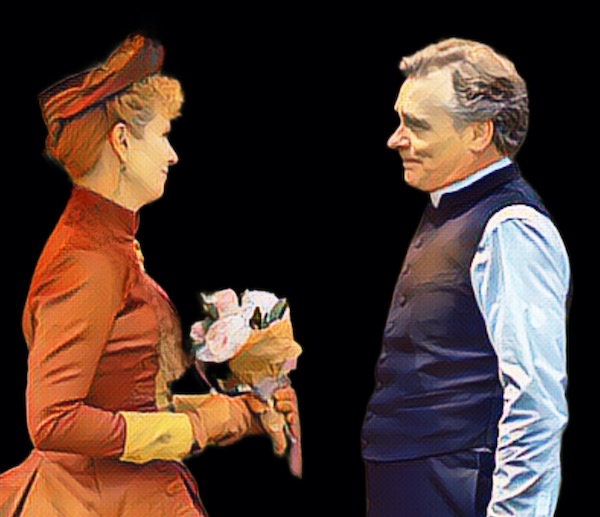
And speaking of sadness, I also found the quick happiness granted to Ada (Cynthia Nixon) cruel. The entrance of Luke Forte (Robert Sean Leonard) and his decision to marry the spinster was so quick that we thought it was a coup! And it was one, but of fate. His immediately compromised health weeks after meeting his life partner would have been more exciting if they had given us time to enjoy the union so idyllic that they waltz at home to the Blue Danube because they love each other so much. There’s definitely a lot coming to the Van Rhijn household and it doesn’t look good to me. Not even Marian’s (Louisa Jacobson) sudden engagement.
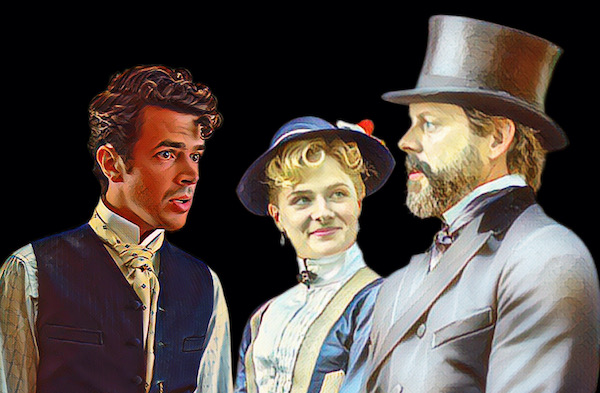
Well, just when a very single and looking Larry (Harry Richardson) is available at the front door, Marian is the target of the affections of Agnes’ nephew, Dashiell (David Furr). Affection is the correct word because there are no passions in The Gilded Age, apart from Larry’s affair with Susan Blane (Laura Benanti). Marian likes Dashiell, the perfect candidate for everything that was expected at that time. And of course, we finally identify where the conflict will be in this relationship.
During his “conquest”, Dashiell has been an unconditional supporter of Marian, which has given me a flea behind my ear. And now we see how much he is a man of his time: not only does he embarrass Marian in a public marriage proposal, in a situation where she could never refuse without creating a scandal, but by forcing her to attend the event, he calmly says that “she doesn’t need to work”, a red flag that puts him in agreement with Agnes, but against Marian’s personality. I’ve always been team-Larry, and now I’m with passion.


Marian is clearly upset by everything and trying to navigate the drama so that she can “do what’s right” and still “be happy.” In The Gilded Age, this is a paradoxical proposition. His “yes” was kind of King Charles meets Diana (“whatever Love means”) with an awkward “if you really want” instead of a simple straight “yes.” Am I finding it difficult for Marian to free herself from the trap she has gotten herself into, even though five minutes later she has forgotten that she is engaged and is reminded by a probably jealous Larry?
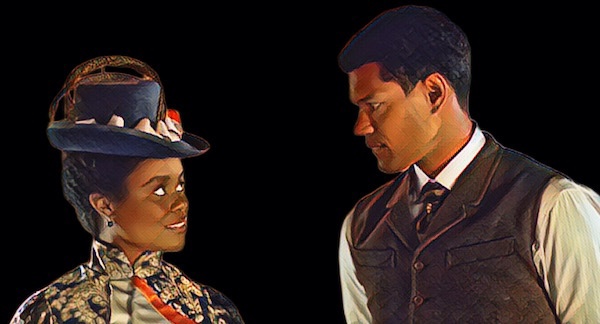
Meanwhile, Peggy (Denée Benton) may be a good reporter, but although she thinks she’s investigative, she’s really acting blind about the “married” T. Thomas Fortune (Sullivan Jones). She finally asks him “Aren’t you going home to your family?”, but walks away before he can answer. God… Peggy dear, the man is a widower. He lost a son and his wife must have gone next. He doesn’t talk about her, she doesn’t appear… hasn’t she fished yet?
But the traumatic experience in Alabama transformed our journalist, now with family support and a clearer objective of exposing racism in America, even in the North, where the fight for abolition provoked a Civil War. Not that Marian, always leading structural racism, actually heard her friend describe the horror scene she experienced in the South. All Marian realizes is that the attack “brought together” Peggy and Thomas, but ‘girl, be careful: he’s married !”. Look, for Peggy, maintaining this friendship with Marian seems to be a constant challenge.
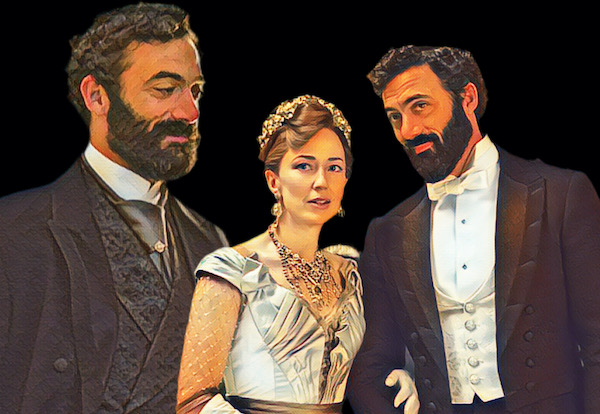
And we come to the Russells. Always mixing facts and people with fiction, George (Morgan Spector) is dealing with a strike while Bertha (Carrie Coon) only thinks about parties and beating Enid (Kelley Curran), in addition to snubbing Caroline Astor (Donna Murphy). Bertha’s game is dangerous for all sides. She is isolating herself from her own family, being harsh with her children, calculating with her friends, and irascible with her husband. When Bertha becomes an antagonist, don’t say it’s the showrunner’s mistake! The drama George is dealing with impacts society, the country, and even his own economic stability, but Bertha only thinks about Dukes and operas.
Considered cruel and ruthless, George becomes sensitive to the workers and makes his worst enemies among his business partners. Halfway through, literally, he once again resolves his wife’s problem regarding the box that Enid was taking from her, but his patience seems infinite to me. Knowing that Alva Vanderbilt divorced her first husband, I try not to get attached to the Bertha-George couple I’m talking about here: the French maid hired to take care of Bertha seems ultra suspicious to me. Either she is with Enid or she is a new Enid Turner, but entering a more vulnerable moment in their relationship. What about the Duke? Caroline wants to “buy” him into the opera war… won’t he also join the matriarch war?
Descubra mais sobre
Assine para receber nossas notícias mais recentes por e-mail.
 miscelana.com