
For those who like tarot, the name Peladan is immediately associated with the quick game we use for ‘yes’ and ‘no’ questions. Created by Joséphin Péladan, the novelist, art critic, and aspiring guru who rose to great prominence in 1890s Paris. Such was his confidence that he became Le Sâr, Sâr Mérodack, named after the ancient Akkadian word for “king.” Furthermore, he walked around in a flowing white cape, a blue jacket, a lace collar, and an Astrakhan hat, combined with long hair and a double-ended beard. That’s right, a figure and the image of a Wizard. Apart from that, his reading method is still one of the most popular today.
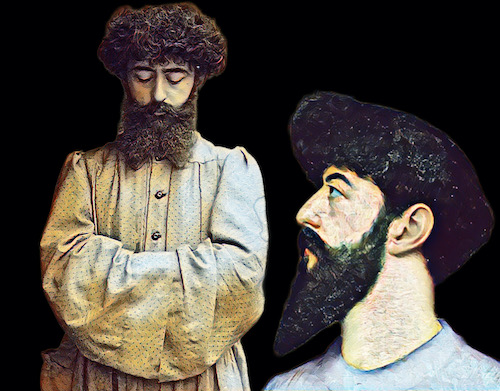
Born in 1859 in Lyon, the son of a journalist who had written about prophecies and founder of Rosicrucianism and universalist Catholicism, before being a “magician”, Joséphin became a literary and art critic, but his entire family was curious about alchemy and the occult. . Unsurprisingly, when he began writing his novels, he kept the theme at the center of his stories. His first, Le vice suprême, recommended man’s salvation through the occult magic of the ancient East. Absolute success!
This is because in that period, the end of the 1880s, there was a lot of interest in themes of spirituality and mysticism and the author was based on principles inspired by the order of the Rosicrucians of Toulouse. The person who started it was his brother, Adrien, and they had the goal of doing good in the world and achieving spiritual ideals. While circulating in this environment, he met Gérard Encausse, with whom he developed the Kabbalistic Order of Rosa-Croix (French Cabalistic Order of Rosa-Croix, O.K.R.C.).
Although the partnership did not last forever, the proposal was to mix kabbalistic teachings with mysticism, and the order even granted university degrees on esoteric themes. In 1892, with the Salon de la Rose + Croix exhibition, he embraced the symbolist movement, emphasizing its supernatural forms, and achieving maximum fame and criticism as well. A few years later, before he died in 1918, many were already laughing at Joséphin Péladan and others even accused him of being a fan of occult magic.

Symbolism scholars and artists such as composer Erik Satie revered Péladan (before they fought), with historians pointing to the ‘wizard’ as one of the avant-gardists of modern art. After all, he believed that art with encoded spiritual messages and symbols could awaken spiritual ascension and many works followed the concept.
Around the 1900s, Péladan stopped signing as Sâr Mérodack, disappointed with the reactivity to his proposal. In total, he left a bibliography of more than 100 titles and was always linked to esotericism. The tarot game that bears his name uses only 5 cards, Major Arcana, in the shape of a Cross which allows a direct assessment of the issue. He died 105 years ago from seafood poisoning combined with pneumonia. His image never regained credibility, but his game? Well, it’s one of the most efficient and popular tarot cards. I think he would like that legacy.
Descubra mais sobre
Assine para receber nossas notícias mais recentes por e-mail.
 miscelana.com