
Classical dance was born in the ballrooms of the French Court but evolved into its original format over the years. It was only after the French Revolution of 1789 that, to have greater freedom of movement, ballerinas abandoned heavy skirts with baskets and corsets, opting for flowing Greek-style dresses, which emphasized the body. A little more than that, conservatives judged, in particular, the Church. Unsurprisingly, for a long time, dancers were compared to prostitutes and the moves they made on stage were a scandal. One of them became a legend, Mademoiselle Parisot, as she became known.
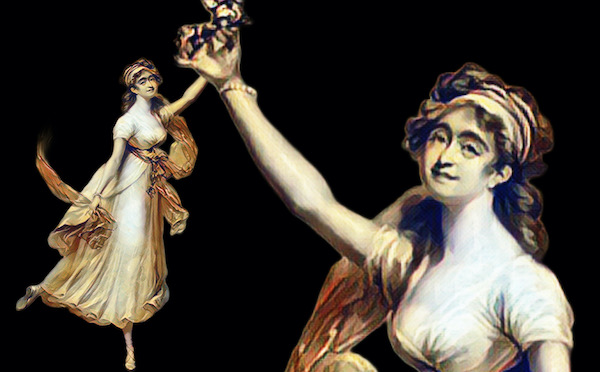
Born in France, her origins are somewhat controversial. Some records place her as the daughter of a sculptor, others a journalist, Pierre-Germain Pariseau, who was guillotined during the period of terror of the revolution for being mistaken for a monarchist supporter. Be that as it may, she debuted on stage as a dancer and opera singer at age 14, but at 19 she moved to London where her performances quickly became the talk of the town.
In the books, it was recorded that Rose Parisot’s voice was beautiful, but what made her legendary was her thinness, unusual in those times, but which obviously made her lighter in her movements. Their transparent costumes, with skirts considered short for the time, were called ‘vulgar’ by some, even more so because as the costumes followed Greek models, the skin-colored fabric was light and the straps often fell down and exposed their bare breasts during the performance. Another detail that distinguished Mlle Parisot from the others was her virtuosity as she raised her legs “higher than the others”, that is, instead of appreciating the Art, the men treated the ballets like a cabaret performance, staying closer to the stage to see which she revealed by raising her legs so much higher than expected.
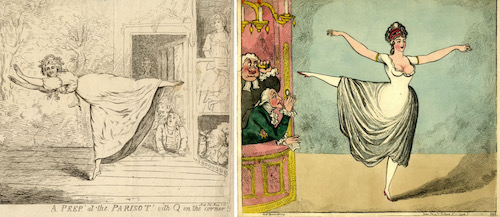
The ballerina performed at the King’s Theater and her balance was described as “positively magical, as her person was almost horizontal as she pivoted on her toe.” From the engravings of the time, we can deduce that her signature step is one uncommon for women and seen more frequently in male variations, the Pirouette à la Seconde. The step demands a raised leg while turning at a 90-degree angle (or higher), ending with a passé. His 1796 performance in the ballet Le Triomphe de l’Amour created “a stir” according to the newspapers. Soon she was a star across Europe.

With her fame, she caught the attention of some antagonists. Although she often danced with Rose and Charles Didelot, who would take the ballet to Russia, it was Parisot who was most cited and recorded in engravings. In 1798, Shute Barrington, Bishop of Durham, denounced a dress she wore while dancing as “indecent” and her movements as “immoral.” In the record with Parliament, in which the issue was treated as a threat to good morals maliciously planted by the French in England, he argued that “the French rulers, though desperate to make any impression upon us by the use of force of arms, attempted a more subtle and alarming war, striving to reinforce the influence of its example, in order to tarnish and undermine the morals of our naive youth.” According to the bishop, “They [the French] sent among us several dancers who, seduced by the most indecent attitudes and the most unrestrained theatrical displays, managed, but very effectively, to loosen and corrupt the moral feelings of the people.”
So it is. He imposed a ban on performances after midnight, which meant that the dances – as happened to happen – were interrupted in the middle or canceled, with theater managers having to lower the curtains on time to avoid fines and closure of the theater. establishment. Caricatures of the Bishop and his supporter, the Duke of Queensberry, were immortalized by artists such as James Gilray, Isaac Cruikshank, and Robert Newton, where they appear in the front row of the theater looking down Parisot’s skirt.
Another immediate consequence was that the color of the dancers’ costumes, previously light pink or skin color, was changed to a less provocative white. But it was the censorship of the time that provoked the audience’s reaction. Not that Parisot felt threatened because in 1799 she “surprised” fans when she dressed in men’s clothing to play Lindor in a production of The Agreeable Surprise and her “shawl dance”, in 1805, part of the ballet La belle Laitiere, took the audience goes wild when cut in half. According to the administration, the curtain came down because it was almost midnight and Parisot did not have time to complete the dance. Caused fury among paying guests who “threw all the chairs from the boxes into the pit, tore up the benches, destroyed the chandeliers, jumped into the orchestra, broke the fortepiano and broke all the instruments of the poor harmless performers” in response, it was a riot that generated news. And it did not bring popularity to the bishop.
Just two years later, Mademoiselle Parisot retired when she married “an eminent florist-worker” of Golden Square and became known as Mrs. Hughes. By this time, she was officially a millionaire. After some time she returned to France, accompanied by her husband. They believe she died in 1845.
Her story is fascinating, as is her contribution to what we see today as so common in classical dance. Just the fact that her most famous step is one of the most technically complex says a lot about her on stage. A legend whose history not even the Church could erase.
Descubra mais sobre
Assine para receber nossas notícias mais recentes por e-mail.
 miscelana.com