
The ballet Manon premiered in 1974, with legends Antoinette Sibley in the title role and Anthony Dowell as her unhappy lover, Des Grieux. Created by Kenneth McMillan, after the enormous success of his version of Romeo and Juliet, almost 10 years earlier, it is today one of the most coveted roles for all dancers, alongside the classics Odette-Odile, Aurora, and Juliet. It wasn’t always like this, of course! After all, half a century ago, ultra-sexualized ballet was still scandalous, even if today it is just commonplace. Unsurprisingly, in the February season, the Royal Ballet will have a new season of the work, marking 50 years of the production and 101 years of the designer, Nicholas Georgiadis.

The ballet is an adaptation of the novel Manon Lescaut, by Abbé Prévost, which obviously when it was released in 1731 was considered “spicy”. Manon is a beautiful, penniless young woman who wants social advancement and is used by her equally ambitious brother, selling herself to rich nobles. However, she falls in love with the idealistic and romantic Des Grieux, having to choose between fortune and love. She drags Des Grieux into a dangerous world of debauchery, but when she is convicted of prostitution and deported to New Orleans, even accompanied by the devoted, possessive, and obsessive Des Grieux, she meets a tragic fate.
Nothing in this story screams “classical ballet”, but that would be the case with Ivan the Terrible, the ballet that I consider the male counterpart to Manon, interestingly created by Yuri Grigorovich the following year, 1975. After all, the Manon described by Prévost was the prototype of the “femme fatale”, a sexist term that has been solidified in literature, cinema, and other arts of misogynistic culture that portrays a cruel woman who uses sex and seduction so that men follow her to death. Yes, The Lady of the Camellias, Carmen, and many others, are equally punished by death, but whose story is basically the narrative of her role influencing the downfall of a man. That’s right, instead of looking at a young woman abused, exploited, and sold into prostitution, Manon Lescault is about the tragedy of Des Grieux, who sacrifices his heritage and his principles for his passion for a futile woman.
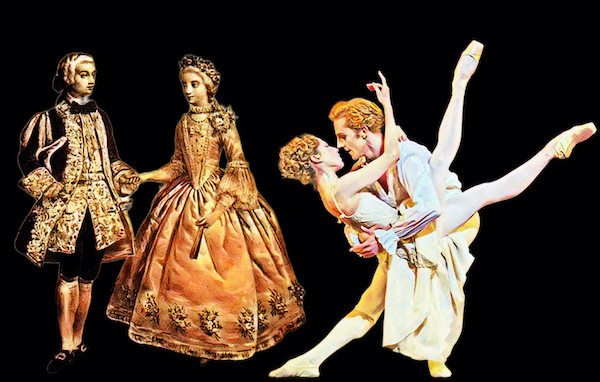
When the world aligns perfectly, the brilliants are in the right place at the right time. In 1974, Kenneth MacMillan was at his creative peak, and his keen insight into human psychology was perfectly married to his mastery of narrative choreography. His pas de deux has never been so complex, technically difficult, and absolutely inserted into the narrative of the story. With this, he created one of the ballets that stand the test of time.
As always, McMillan’s muse was the incredible Lynn Seymour, but she didn’t originate the role on stage. The muse was absent because Lynn was pregnant and considering retirement when he began working at the ballet. That’s why Manon was created for a duo that also lived in the shadow of the fame of Margot Fonteyn and Rudolf Nureyev at the Royal Ballet, the great Antoinette Sibley and Anthony Dowell. Antoinette, who was Lynn’s friend and Frederic Ashton’s favorite after Fonteyn, always highlighted her healthy relationship with McMillan’s muse, making it clear that there was no jealousy between them. If Lynn was dancing, Manon would be hers. As she wasn’t there, she went to Antoinette. “He must have seen something in me that he wanted. Manon was me, this was my ballet,” she said in an interview. Unfortunately, the official film of the work does not have the original muse. Due to difficult steps, Antoinette suffered a persistent knee injury and Jennifer Penney took her place. The last act, for example, was created entirely around Jenniffer.
At the time of its premiere, in 1974, critics did not appreciate the work. They felt the role was “a waste” of Antoinette Sibley’s talent. “reduced to a nasty little diamond digger.” Misogynistic and artistic prejudice in your veins! After all, a ballerina of Sibley’s class was only for princesses, never a young woman who liked sex and luxury. When Manon arrived on stage, with a trio of debauched heroes, there was shock and reaction across the world, something that has had a 180° reversal today. Not only are the steps complex and incredible but there is dramatic depth in every role, a rare opportunity for classical dancers. That’s right, the innocent Giselle has her crazy scene, Odette is personalized by Odile, but Manon is a young woman whose life is transformed and ends her days in the swamp of New Orleans. I really understand all the dancers who dream of playing him.

McMillan did not live to see that his work reversed the scenario from “failure” to “success” and was very hurt by the negative reviews at its premiere. Only in the 1990s did it gain a new perspective (I saw the production of the ballet at the Paris Opéra in 1998, and my friend thought it was all “very daring”), in a less chaste moment, if that’s what we think it’s best to summarize. Has Manon come to be seen as an imperfect woman? Yes. Seductive? Of course, but equally modern. The perfect picture of the extravagant and licentious Paris of the early 18th century. Remembering that Prevost was a priest says even more that he portrayed the libertine universe of the time. Manon uses sex to escape poverty by accepting to be sold by her ambitious brother, but, when trying to save Des Grieux, her great love, she condemns the three to death. In other words, Manon was an intelligent, practical, honest, and passionate woman. A heroine, never a “fallen woman”.
From the books, Manon found the opera before MacMillan translated it into ballet. His acrobatic eroticism choreography is incredible. As his wife and biographers recognize, all of the choreographer’s work is about “sexually motivated people”. Juliet included, okay? But he didn’t want to shock, he wanted more realism and modernity in classical dance. More than any other of his works, Manon is the best vehicle.
Current stars for next season include Natalia Osipova and Reece Clarke. But without a doubt, Manon’s life will expand in time and will be one of the most respected ballets of all time. Things about History, Art, and Geniuses like Kenneth McMillan.
Descubra mais sobre
Assine para receber nossas notícias mais recentes por e-mail.
 miscelana.com