
Maisie Williams will forever be Arya Stark from Game of Thrones, but her connection with the world of Fashion led her to personify the punk muse Jordan in the series Pistol, and now, she will be none other than Catherine Dior, in the series A New Look.

Catherine was the younger sister of Christian Dior (Ben Mendelsohn), the inspiration for her first perfume – Miss Dior – who, during the Nazi invasion of France, starred in a story of love and courage, fighting for the French resistance and influencing her famous brother. From what we saw in the trailer, we can be moved by this story it is still less explored by those who don’t follow fashion icons.
Born into privilege, a young woman with ideals
Born in 1917, Catherine lived a privileged life until tragedies began to mark the house of Diors. Her brother Raymond returned traumatized from World War I, suffering from PTSD. Another brother, Bernard, was schizophrenic. Her father, Maurice, lost his fortune and so she spent her teenage years with him on a farm in Provence. It was only in the late 1930s, already in her early 20s, that she went to live with Christian in Paris. He was already a fashion illustrator working for Lucien Lelong. In Paris, Catherine began to have a more active social life, witnessing the Parisian bohemia with artists and intellectuals, at the same time as Germany grew with Hitler in power.
Christian and Catherine were close friends. It helped to hide that he was gay and Christian kept a low profile regarding the fact that she was in a relationship with a married man with three children, Hervé des Charbonneries.
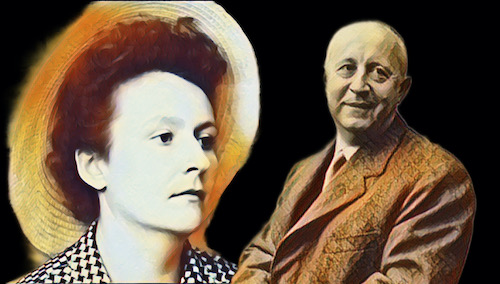
As she worked as a saleswoman and also sold flowers, Catherine was perfect for carrying out certain tasks without attracting attention, such as buying a radio so that her compatriots could listen to a broadcast from Charles de Gaulle, the leader of the Free French Forces. Like many designers in that period, Christian dressed the wives of Nazi officers, but still, Catherine used the apartment she shared with him to hold meetings and provide intelligence to British forces planning D-Day. Panic set in when, along with 26 colleagues, Catherine disappeared. Christian expected only the worst.
Heroism helped her survive, but Christian expected the worst
An undercover double agent betrayed Catherine and the Resistance members and was arrested and beaten in a Paris apartment, even before being transferred to a concentration camp. For nine months the Diors did not have a single piece of information about Catherine after she was transferred to Germany in August 1944. At this point, reports of the devastating conditions in the concentration camps began to emerge. Most likely she was dead.

Even with strong connections through his clients, Christian was unable to obtain the release of his sister, who was in the Ravensbrück concentration camp, in northern Germany. It was a period in which the designer only found hope by dedicating himself exclusively to his work and trusting the seer, Mme Delahaye, who assured him that Catherine would return alive. It was only in mid-April 1945 that any sign of life reached the designer, through a friend married to a French diplomat who located Catherine. Still, the rescue took time because the young flower girl had been transferred to the Markkleeberg subcamp in Buchenwald before they could reach her.
When the Red Cross managed to release the prisoners, there was still a long way home, and, of the group of three hundred women, eleven died on the journey back to France. The physical and psychological scars were clear and Catherine only arrived in Paris at the end of May 1945. Christian met her at the train station but did not recognize her when he saw her malnourished and injured. She was too sick to even eat, but he personally saw to her recovery.
A strong and defiant spirit that never broke
After she returned, little information emerged about Catherine’s traumatic arrest by the Nazis, as she refused to talk about what she witnessed. It is known that she was taken to work in an aircraft parts factory and remained firm and determined to resist. She would rather go hungry than bend down and pick up the food thrown on the floor by the guards. Her group was close-knit and “accidentally” made mistakes while working, actually to break factory machines.
When the Germans surrendered, concentration camp guards forced prisoners to march long distances, malnourished, to change their address. During this period, even more innocent people died. Catherine never told her family or friends how she managed to survive. Documents prove that she was liberated by Soviet troops on April 21, 1945, but there is evidence to suggest that these troops also raped women prisoners of war even when they released them, it is not certain whether she even had to experience this abuse anymore. Whatever the case, she was apparently left unable to have children after the horrors she endured when she was captured.
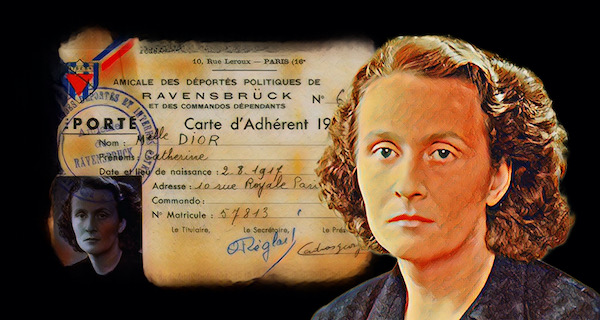
Her health was never the same: chronic arthritis, rheumatism, kidney problems, injuries to her hips, back, and feet, as well as visible scars, were constant problems in addition to insomnia, nightmares, memory loss, anxiety, and depression. For a time she preferred to remain isolated in Provence, but her love for Hervé also survived the war: they remained together until he died in 1989.
The inspiration for Maison Dior and the perfume
Although it was always a dream, it was during these traumatic years that Christian Dior began planning to become a designer on his own and that is why Catherine’s story is included in The New Look series. After all, Dior’s revolutionary collection dates back to 1947, just two years after the end of the war.
The connection is obvious. Catherine, as a florist and passionate about flowers, inspired Christian’s collection, named La Corolle, an allusion to flower petals, a design he used to create the model with a thin waist and rounded skirt. The models broke the militaristic and pragmatic fashion conventions of the time, bringing a more romantic and nostalgic aura. At 42 years old, Christian Dior became the most beloved designer in the world. Many believe it was his love for his sister that made him want to bring beauty back into women’s lives. A response to the darkness and trauma that almost destroyed her. And, if the new look is only indirectly alluding to Catherine’s flowers, the Miss Dior perfume was officially dedicated to her. The floral fragrance, for him, was “the perfume of love”.

A certain irony is that a saint at home does not perform miracles. Even living with a fashion genius, Catherine was never interested in wearing glamorous clothes. From Dior, she only had a few pieces. In general, she preferred simple designs so she could move around and work in her garden. And she never turned away from politics or lost her courage, testifying in person at a 1952 trial against the 14 people who tortured her in the Paris Gestapo office. The fact was considered a scandal because as it involved torture and sexual abuse, it was taboo.
When Christian died suddenly of a heart attack in 1957 at age 52, he left his estate to Catherine and a close friend, Raymonde Zehnacker, but appointed his sister as his “moral heir” and the person he designated responsible for maintaining the company. , which she did discreetly, even far from Paris as she moved with Hervé to the southeast of France, where she lived until she died in 2008, at the age of 91.
Unfortunately, she also experienced family disappointment in the 1960s, when her niece, Françoise Dior, declared herself a neo-Nazi and married an extreme right-wing figure. Catherine, who never again set foot in Germany or wore German products after the war, was forced to make a rare official statement that Françoise did not speak for the House of Dior. One of her rare times responding about the war period, Catherine Dior explained where she got the strength to survive: “Love life, young man. Love the life”.
Does anyone doubt Maisie Williams’ prominence with this incredible character?

Descubra mais sobre
Assine para receber nossas notícias mais recentes por e-mail.
 miscelana.com
4 comentários Adicione o seu