
Jane Austen‘s most famous books are Pride and Prejudice and Emma, but there is a favorite among the writer’s fans that is turning no less than 210 years old in 2024: Mansfield Park. Jane’s third novel only received its first public review seven years later, meaning it remained “hidden” until Fanny Price’s sweet story came to light.
Fanny is a typical Jane heroine: shy, honest, obedient, and without a physical beauty that would make her stand out more than the others. For experts, especially nowadays, it is paradoxically the weakest of them, moralistic and even futile.


Kind of like an English “Cinderella”, Fanny was just 10 years old when her parents sent her to live with her rich aunt because they were overwhelmed with so many children. In Mansfield Park, Fanny blossoms as a woman falls in love with her cousin and goes through some surprises before the always-expected happy ending. It’s a delicious book.
Mansfield Park is one of my favorite books by Jane Austen where her text is spot on in its ironies and veiled criticisms of society and human nature. For example, she never speaks ill of a character, nor even calls her or treats her as a villain. She contextualizes the situation and highlights people’s pettiness or evil with sweet words or situations in which we can see their inadequacy, almost always with Mrs. Norris, one of Fanny’s aunts.
Unsurprisingly, readers approved the book before critics as the first printing sold out in just six months. One of the things that kind of went unnoticed at the time was social themes that Jane was clearer on than any other work, including slavery, sexual abuse, betrayal, depression, and extramarital affairs. Seen as a “social comedy”, it has also been translated as moralistic because Fanny’s integrity does not succumb to any of the flaws that others cannot avoid. But, again, the irony of the text ‘saves’ Fanny because she is not without her conflicts. For these reasons, Mansfield Park was, for many years, considered the author’s most controversial novel, with greater historical and political references, as well as deeper characters.
Around Emma, it’s funny to think of Fanny as difficult
Insipid, direct, vulnerable, and independent for some, Fanny Brice is not an easy character to fit into Jane Austen‘s universe because, at the same time as she is obedient, moralistic, and chaste, she is also opinionated and determined. Even under extreme pressure, she does not change her essence, remaining faithful to her conscience, even if for some it seems like a lack of empathy. For Fanny nothing is gray: it is either right or wrong. However, when she is finally taken from the materialistic universe to what she would actually live in if she maintained her intolerance, even she gives in and almost lets herself be seduced. In other words, she is a contradictory and therefore interesting character. Fanny is emotionally and materially abused by everyone at some point in her life, which contributes to low self-esteem, and, little by little, she begins to blossom.
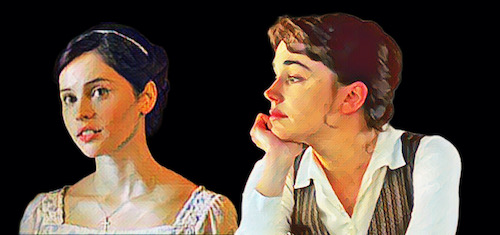

But the most delicate issue of all is the book’s approach to the delicate point of slavery and how Fanny does not confront the origins of the luxury she lives in England. Fans of the author, such as director Patricia Rozema who directed the 1999 film, dispute the version that Jane was an apologist by presenting the Bertram family as morally corrupt and degenerate, something that is not mentioned in the original pages.
Perhaps for these reasons, there are fewer adaptations of Mansfield Park for TV and cinema than Jane Austen‘s other works. The BBC has versions from 1983 as one of the first attempts, then a second in 1997. The 1999 film is perhaps the best known, with Frances O’Connor as Fanny Price and Jonny Lee Miller as Edmund Bertram, but it is the work that takes liberties with the book.
After that, it was only in 2003 that Mansfield Park returned to TV, with Felicity Jones as Fanny Price and Benedict Cumberbatch as Edmund Bertram, but the 2007 attempt was more popular in England, where Blake Ritson, our beloved Oscar Van Rihjn from The Gilded Age played Edmund Bertram.

On its 210th anniversary, this is a record of content that deserves a new analysis and once again a chance to prove the brilliance of a great author.
Descubra mais sobre
Assine para receber nossas notícias mais recentes por e-mail.
 miscelana.com