
Carmen Miranda was just 46 years old when she passed away in August 1955 in Hollywood. Her lifeless body was found in the hallway of her home in Beverly Hills, a victim of a heart attack, according to the medical report.
Brazilians have a mix of rejection and pride in her, who was the biggest international Latin star in her time, and, to this day, is one of the most famous images of the country she adopted as hers: Brazil.
Born 115 years ago, in Portugal, Maria do Carmo Miranda da Cunha came with her family to Brazil when she was just one year old, therefore, she is Brazilian. It was in Rio de Janeiro that she grew up, loving opera (hence the nickname “Carmen”) and initially working as a hat maker, in Lapa, the city center.
The nickname “Carmen” is a Portuguese woman raised in Brazil
Singing was her calling, they say she “sang all the time”, and she dreamed of the stage her entire life. In 1928, at just 18 years old, she was already playing on Rádio Roquette Pinto, recording the samba Não Vá Sim’bora, and the hits Dona Balbina, Triste Jandaia, Barucuntum and Iaiá Ioiô. But it was with the classic Taí that she became a star, selling no less than 35 thousand copies in 1930. She immediately became “the biggest singer in Brazil”.
The 1930s marked the Golden Age of Radio and Carmen Miranda was one of its biggest stars. It was a matter of minutes before it arrived in theaters, whose musicals were also at their peak. Giant on screen and radio, diminutive in her real stature, she earned the nickname “Little Remarkable” and was ready to conquer the world.
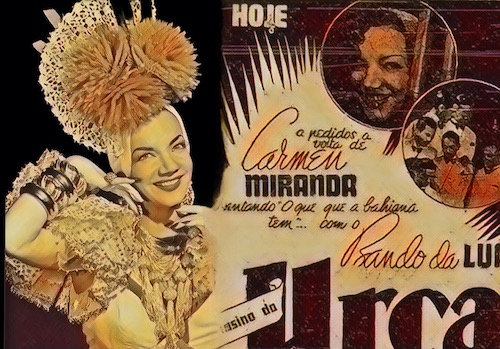
The “baiana” look, which would become Carmen’s signature, as well as her ghost, appeared in the 1939 Brazilian film: Banana da Terra, where she sings one of her signature songs, O que é que a Baiana Tem, already accompanied by the band Banda da Lua.
It was the period in which the American policy of the Estado Novo wanted to embrace South America, and Carmen (alongside Zé Carioca, from Disney), was the perfect character for propaganda and obviously, Hollywood.
How Carmen Miranda became the ‘Baiana’ with bananas and fruits on her head
It was Lee Schubert, who dominated Broadway, who saw Carmen Miranda on Brazilian stages and realized that there she had potential that the world needed to discover. It only took a little longer because she insisted that the Bando da Lua group was always with her. Shortly before the Second World War “started”, in 1939 – also the best year in American cinema – Carmen landed in Los Angeles (never to return).
The exoticism of Carmen’s clothes, gestures, voice, and songs was an immediate passion in the United States, but an embarrassment for Brazil. A Baiana woman with platform heels (to compensate for her height), with fruit on her head, lots of bracelets and necklaces, quarrelsome, and with a strong accent was not at all the image that was expected of her. With Carmen, Brazil became this caricatured and stereotypical image that persists even more than 80 years ago.
Yes, Carmen had ‘that’ strength, but that karma. When she returned for a performance in 1940, she found a cold and irritated audience, who considered her ‘Americanized’, which became her song (They said I came back Americanized). By this time, Carmen Miranda was already a Hollywood legend.
First Broadway, then Hollywood
Schubert first took Carmen to Broadway, where she became a rage. In 1940, she signed with 20th Century-Fox and basically repeated the presentation of the stage musicals in her first film, Down Argentinean Way, which was also a success at the American box office.
Down Argentinean Way was the first in the series of films from the propagandist period, which actually irritated the Latin public more than pleased it. The original name did not have an Argentine-speaking Castilian and many were portrayed as lazy, freeloaders, or dishonest. Worse still, she was a Brazilian, singing in Portuguese, who was the star. The list of problems is long, but, as it generated millions, the memory of success remains.
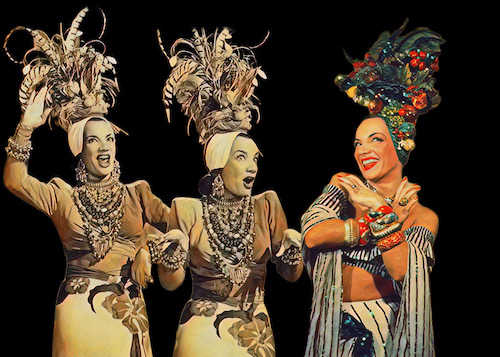
There were a few years (six) of success, but definitive. She appeared in 14 films, eight of them as a star, and being recognized as a Brazilian Bombshell. Within a few years, in 1941, Carmen Miranda was the first Latin American to be invited to place her hands and footprints on the cement in front of Grauman’s Chinese Theater.
When 1945 ended, the little singer was already among the highest-paid women in the world, earning more than 200 thousand dollars a year. But the decline was just around the corner.
Difficult times, controversy, and death
When Fox cast Carmen Miranda in black-and-white films, her star felt. Her presence was reduced, the same types of roles were named and the novelty wore off. And just as she rose in Hollywood, she quickly fell. Carmen wanted challenges, and roles different from what she had been doing, but she couldn’t get them.
Music, however, still had her as a star, doing tours and recording albums. Like many artists of her time, she constantly used barbiturates for energy but imagined it was controlled. Once in Hollywood, she became dependent.
When she returned to Brazil, 14 years after going to the United States, her personal life and film career were already in shambles. She tried to give up the medication, but without much success, after all, she amended the trip with a six-week tour of non-stop shows. When she arrived in Los Angeles, she discussed with CBS having her own weekly program – The Carmen Miranda Show – along the lines of I Love Lucy. The test was her participation in an episode of Jimmy Durante‘s show, which ended up being her last performance.
In rehearsals, she expressed tiredness and shortness of breath but thought it was fatigue. When she went up to her room at three in the morning, she was happy with her plans for the future. But, at 46, she couldn’t do it. Getting ready for bed, she apparently had a heart attack. She had no history of heart problems and only indicated that she had brief bronchitis. Either way, she didn’t survive.
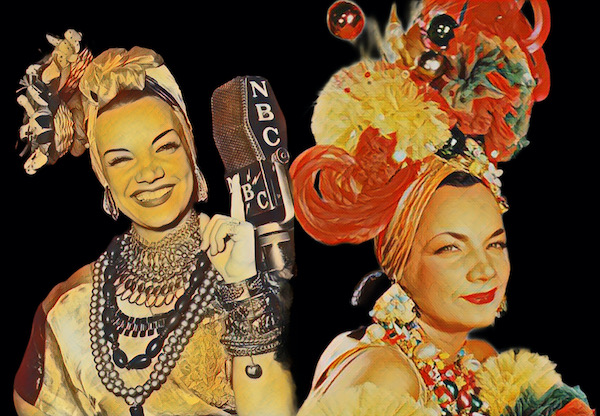
Sixty thousand people attended her wake in Rio in 1955 and around half a million people, sometimes sang her songs. attended the burial. It is still one of the largest public demonstrations in the city’s history to this day. Her museum, however, opened in 1976 at Aterro do Flamengo, is almost forgotten.
Many associate her drop in popularity with her marriage to David Sebastian, a producer who started to represent her, but who made bad deals and contracts, in addition to physically attacking her and having problems with alcohol. Frustrated attempts to be a mother also contributed to depression and personal and professional uncertainty.
In the year of her 115th birthday, a belated tribute to the star. The hope is that her biography, in some way, gains space and form for us to recover a narrative: that of a small woman, five feet tall, who, for better or for worse, is still a cultural icon today. Something certainly remarkable.
Descubra mais sobre
Assine para receber nossas notícias mais recentes por e-mail.
 miscelana.com