
In principle, The New Look could tell the story of the rivalry between Coco Chanel (Juliette Binoche) and Christian Dior (Ben Mendelsohn), but in fact, in the four episodes (that is, more than half of the series), the focus is survival.
From the first episode, the designers are confronted to explain how they survived the German invasion of France, where apparently Chanel was opposed to closing her Maison, but Dior, not so much, because he continued working for Lucien Lelong (John Malkovich). The truth is never that simple and we see behind the scenes that it was the opposite: he supported his sister by working for the Resistance and Chanel made deals with the Nazis to free her nephew and remove her Jewish partners from her brand. The designer’s involvement with the Nazis remained “just rumors” for decades until, in 2014, documents confirmed the fact.

The series insists that both Chanel and Dior made their decisions driven by love, not ideology, but history can be harsh in its judgments. In the 4th episode, there is one of the saddest and most conflicting moments of the drama: the persecution and punishment of the biggest star of the war period, the actress Arletty (Joséphine de La Baumein), one of the most famous victims of “l’épuration sauvage” ( wild cleaning), the persecution of women who, in the words of French, were accused of “horizontal collaboration”, that is, sleeping with the enemy. Unsurprisingly, Chanel was more afraid of her countrymen than the Nazis.
Who was Arletty?
Born Léonie Marie Julie Bathiat, the actress who became known worldwide simply as Arletty, was one of the biggest stars in Europe in the 1940s, starring in films by renowned French directors, such as Hotel Du Nord, by Marcel Carné, in 1939, and the most famous of all, Children of Paradise, 1945.
Coming from a working-class family, Arletty began her career as a model, moving into theater when she was just 21 years old. She sang and danced, and she was on stage for ten years until she made her film debut in 1930. She was famous, adored, and respected as an actress, being the muse of director Marcel Carné and at the time of the War, one of the highest-earning actresses in France.

Her entire career, however, was tarnished when Peace returned to Europe. As we saw in the series The New Look, Arletty was arrested in 1945, after she was denounced as a Nazi ‘collaborator’ for having a romance with the German officer, Hans-Jürgen Soehring during the occupation of Paris. According to biographers, she was said to have truly fallen in love with Soehring, but his tongue-in-cheek remark that “My heart is French, but my ass is international” did not help her case when the oppressed regained their freedom. Who wouldn’t have condemned her morally? In 1945, Arletty became the Marie Antoinette of the 2nd World War, if there had been a Guillotine, she would probably have lost her head.
Humiliation, violence, and imprisonment: example, envy and cruelty
There is no evidence – and there was none until she died in 1992 – that the actress’s collaboration was anything more than a morally reprehensible passion. All facts point out that Soehring, who was ten years younger than her, was also in love and wanted to marry her, but she refused. The problem was the impossibility of two people on opposite sides being able to love each other.
The hatred of the French gained an even greater volume because it came in proportion to her success. If strangers were almost publicly stoned, Arletty’s treatment was even harsher than average: in addition to being arrested, beaten, insulted, spat on, her hair shaved, a swastika drawn on her head, and forced to parade half-naked through the streets of Paris. , she was tried, found guilty of treason, and imprisoned for 18 months. If images of Cersei Lannister from Game of Thrones come to mind when you read this, it’s because it was something similar.

Moral betrayal: women pay more than men
It is not easy to try to contextualize the resentment of an attacked and dominated people against those who, by survival or force, had an apparent ease with the oppressors during the War. Officially, there were more than 20 thousand cases of what was called ‘Horizontal Collaboration’, a passive-aggressive term for accusing women of prostitution. The real number is believed to be much higher because there are no records or documents. It was enough to point and accuse for conviction to occur. The facts were irrelevant.
Therefore, the first years after the War became a witch hunt similar to those of the 17th century and repeated throughout Europe, not just in France. Unfortunately, between “de facto collaborators” and innocent victims, there were hundreds in the same group.
Given this, the ultra-documented experience against Arletty is considered symbolic and sad. She did form a relationship with the enemy, but even at the time, some questioned whether it was justified to attack her as they did. Or more, as Chanel asks in the series: why did only women go through this “process”? As was already known and highlighted today, many women were prostituted by force or out of desperation during the war years. However, when the Germans withdrew, they were the target of personal revenge from neighbors, friends, and strangers, men and women, in a frightening cathartic movement. Not even children escaped: if they were born from this relationship, they were considered the result of a “national betrayal”, being exiled and declared bastards by the State, without the basic rights of any other citizen. Even today countless lawsuits are asking for compensation.

Ancient custom that allows and encourages violence against women
The topic is not uncommon in cinema or TV, the scene from The New Look reminded me of the beautiful Ryan’s Daughter, by David Lean, where there is a similar fate for the film’s girl, Rose (Sarah Miles).
In the plot, the young Irish woman, unhappy in her marriage, falls in love with an English officer, but a surprising betrayal turns the entire city against her. This is because Rose, daughter of the popular and beloved Ryan, was raised by him with all the luxury and education, leaving her like a Princess among the proletariat. The women were envious and jealous, so they immediately attacked Rose – completely innocent of everything – shaving her head, hitting and spitting on her, making her stay in the city impossible. (There are more details, including who the traitor is, but if you haven’t seen the film yet, I recommend doing so immediately and avoiding spoilers).


The scenes of collective punishment of women come from an even older tradition and are even mentioned in the Bible. The proposal is the same: aggressively take away from women what is seen as their most seductive feature, their hair, in addition to allowing everyone to treat them like trash. And worse: this punishment was valid and used by several countries and cultures, and misogyny has always been universal. And if the nightmare wasn’t enough, Historians point to the existence of accusers (men, of course) attacking women to divert their own dubious conduct during the conflict.
Different weights and measures in pure misogyny
The scenes of collective punishment of women come from an even older tradition and are even mentioned in the Bible. The proposal is the same: aggressively take away from women what is seen as their most seductive feature, their hair, in addition to allowing everyone to treat them like trash. And worse: this punishment was valid and used by several countries and cultures, and misogyny has always been universal. And if the nightmare wasn’t enough, Historians point to the existence of accusers (men, of course) attacking women to divert their own dubious conduct during the conflict.
In France, which had already lived through the years of the Terror of the Guillotine centuries before, there were among the citizens those who were against “l’épuration sauvage” precisely because they realized that the majority of women attacked were either victims of the Germans and now of the French, or that they were mistaken accusations with no factual basis. In times when they were hungry, exchanging sex for food was not uncommon. Everyone was a victim, but in the end, Pain generated more violence.
For Arletty, life was always worth it
The New Look doesn’t show it, but Arletty served his prison term and obviously, his career took a hit, but he continued working until he died in 1992. At the time, most obituaries included praise and omitted his tragic war past. Those who cited the attacks claimed that “jealousy disguised as moral outrage”, aligned with “envy” motivated the attack. But letters from some readers still offended by her proved that the hurt was still real almost 50 years later. If they no longer criticized having had a romance with a German officer, they had not forgotten that she lived and ate in luxury at the Ritz Hotel while her compatriots were starving on the streets. Something Chanel is also guilty of, but by fleeing to Switzerland, she escaped responding while the national trauma was fresh.
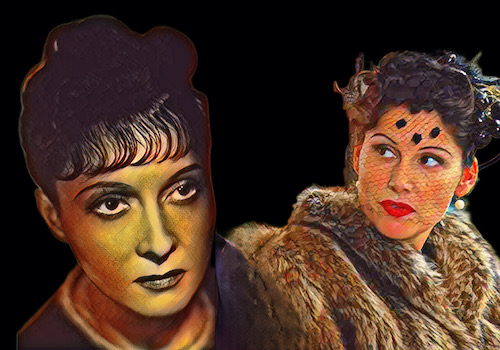
In 2015, they made a film about Arletty’s life, with Laëticia Casta playing the actress. In a final interview with Paris Match, at the age of 94, Arletty said that she had contemplated taking her own life, but that she looked back with forgiveness in her heart. “Life is never perfect. She’s wrong sometimes,” she said. “It happened. The damage is done. I have no regrets or remorse, which allows me to still smile,” she said, ending with a positive message: “Painful passages bring much more than we think. If life is sometimes not worth much, it is always worth more than nothing!”
Always important words.
Descubra mais sobre
Assine para receber nossas notícias mais recentes por e-mail.
 miscelana.com