
Until Denis Villeneuve challenged the most skeptical and rescued Dune from the memory of kitsch, it was the 1984 film, directed by David Lynch, that remained a reference for the sci-fi classic in cinema. And, interestingly, 40 years later, in 2024, Dune was one of the biggest critical and box office successes, breaking the general belief that the work was a director’s talent-crushing machine or even a book that was impossible to transport. for the cinema. Now it is simply a success.
Reaching cult status was a long and arduous road for the 1984 version, Hollywood’s biggest attempt yet. In numbers, it was a failure. It cost more than 42 million, grossed 30, and was compared unfavorably to hits of the time like Star Wars, E. T., and Alien. I say as a target audience in the year of release: I hated every minute of what I saw, to the point of resisting giving Villeneuve a chance, but giving in and surrendering to the director.

In 2021, amid the pandemic, Denis Villeneuve’s Dune was a huge success, although still under the effects of the pandemic and the fight over cinema windows and platforms taking away the expected box office numbers. With the arrival of the second part of the trilogy in theaters and the 40th anniversary of David Lynch’s Dune, I’m going to take a trip back in time and remember behind the scenes. Something I love to do!
It all started with a groundbreaking 1965 novel
Frank Herbert released his masterpiece, Dune, in 1965 and to this day it is considered one of the best sci-fi works of all time. He had written The Sea Dragon a few years earlier and when he traveled to Oregon, where he visited the local dunes, he found the inspiration for a groundbreaking saga.
The trip was because he was going to write an article about the movement of sand mountains, which could “swallow entire cities, lakes, rivers, highways”, which made him investigate research on ecology and deserts, opening up a new world. The article took years to be published. This is because Dune swallowed the author’s time and concentration.
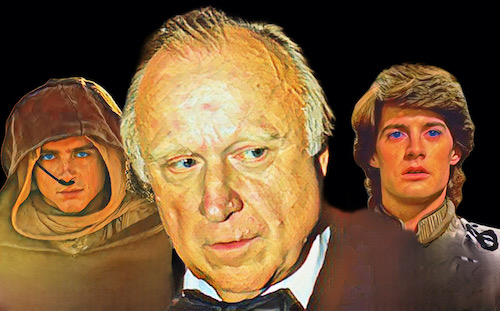
Inspired by several themes still unexplored 50 years ago, such as placing minorities as protagonists and discussing environmental impact, Dune was something unexpected and innovative. The conversation with indigenous groups, who warned that the effect of logging on local reserves would “turn the planet into a desert” like the Sahara and that this would make the world “a “great dune” was so impactful for Herbert that the scenario, therefore, it was decided.
Combining the writer’s interest in the mystique of superheroes and messiahs, as well as politics, the plot began to be drawn. After all, his survey found that desert environments historically gave rise to several important religions with messianic impulses. And of course, without forgetting that Frank Herbert planted and used “magic mushrooms” to expand and stimulate his imagination (anyone who has seen Dune understands the reference): the box would be opened unexpectedly.
Published in August 1965 as a novel, it did not explode in sales, it was even considered niche, but little by little it reversed the situation and became a worldwide craze. A great saga was born.
A sci-fi story without technology
One of the most significant milestones of Dune is that Frank Herbert deliberately suppressed technology in his universe. The focus is humanity and its future is determined by institutions led and created by themselves. From this concept was born the “Butlerian Jihad” where all robots and computers were destroyed. No blaming Artificial Intelligence for taking away our free will, the conflict is generated by religious intolerance. Let’s agree that this is a revolutionary concept even in 2024.
The novel’s narrative can also be identified in its offspring, yes, I’m talking about George R. R. Martin in his Game of Thrones and Fire and Blood, since Dune is told as if we were reading Princess Irulan’s diaries, therefore a narrative without distance (although I believe it is), with historical comments, biography, quotes and philosophy invented by Herbert and which contextualize the universe he created.
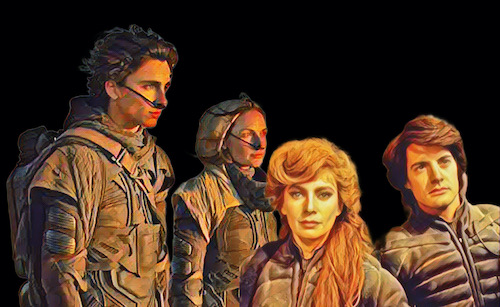
This possibility is precisely what encourages Martin and Herbert fans to frequently revisit the books (series and films), as there are open layers to justify actions and consider other possibilities that were calculated by the writers.
If there is an ecological message in Game of Thrones with the White Walkers and the Night King symbolizing the consequences of global warming (only on ice instead of desert), it is only because Dune popularized mixing the subjects. Frank Herbert‘s plan was to have an “environmental awareness manual” highlighting the dangers of deforestation, the imminent lack of water on the planet, and oil exploration, making the work what they call “the first large-scale planetary ecology novel”. And, as we see, content is dangerously current 50 years later…
The religious side of the work was also pioneering as the reference to the Middle East and Islam is undeniable throughout history, including real terms, words, and concepts in the Arabic language in the Fremen culture. When they were not authentic, the words sounded Arabic. Even today, something that Western authors keep a certain distance from.
The long road from pages to screens
An epic story, full of exotic settings and a complex heroic tale is what all screenwriters and directors love to think about on the big screen. But Dune became legendary as “impossible” to make that connection.
In 1971, film producer Arthur P. Jacobs, experiencing the height of success with his Planet of the Apes trilogy, went ahead and bought the rights to Dune, but died just two years later, in 1973, at the age of 51, without advancing the project. It’s a big question of what if because the director selected for it was none other than David Lean whose Lawrence of Arabia was visually gigantic and about the same character who influenced Frank Herbert.

With that, a group of French film producers entered the circuit, bringing in Alejandro Jodorowsky, whose creative vision is a tale in itself and did not work out. Many regret it.
The long road from pages to screens with the path “cleared”, producer Dino De Laurentis, who worked with Fellini and had several hits, as well as a reboot of King Kong, bought the rights in 1976. The problem now is that at that point the world was taken over by fever Star Wars, which rocked the box office in 1977. This encouraged De Laurentis to perceive the late 1970s as a good time for space epics and nothing grander than Dune, right?
Boldness seems to be the basic password of the work. Frank Herbert himself worked on the script (in 1978), but what he delivered suggested it would be three hours long. If it is common today, back then it was a resounding “no”. Therefore, to lead the project, De Larentiis chose Ridley Scott, whose success with Alien in 1979 seemed to indicate he was perfect for the challenge.
In the director’s view, Dune would be in the same direction as Star Wars, “but for adults” and that the book would need to be separated into at least two films. There were three drafts of the script in a slow process given the producer’s involvement at all stages, but a family problem took him away from the project definitively. From there, Ridley embarked on Blade Runner.
With that, already entering the 1980s, the producer looked to David Lynch as an alternative. Lynch was riding high on the mega success of The Elephant Man and was being considered to direct Return of the Jedi. Upon receiving the invitation to be the first to film the classic, Lynch jumped out of Star Wars. Maybe something that would change the Skywalkers saga back then and that he would come to regret.
Behind-the-scenes conflicts
After five drafts, the production landed in Mexico in 1983 to begin recording, with a cast primarily of lesser-known American and British artists. Dune marked the debuts of Sting (then lead singer of the band The Police) and actor Kyle MacLachlan, the latter in the lead role. The soundtrack was written by the band Toto, who at the time had success with the hit, Africa.
Soon the problems began. Just like George Lucas with Star Wars, special effects for intergalactic universes were risky and flirted dangerously with the cringe. One of Dune’s problems is precisely its visual “poverty”. But the worst thing is that although he wrote a script with two films in mind, Dune ended up being condensed into one, leaving it confusing and incomplete.
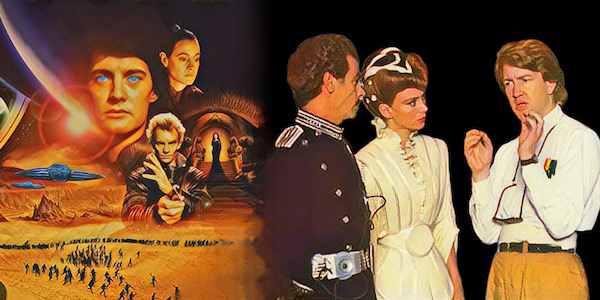
What was recorded was the sixth script, with 135 pages. Recording outside the United States helped with production costs, but this was also clear in the final result. There were 80 sets built on 16 sound stages, a team of 1,700 people involved, and more than 20,000 extras.
Actress Francesca Annis, who played Lady Jessica, recalled Dino De Laurentiis‘ constant presence behind the scenes, giving her opinion on all of David Lynch‘s decisions. “My experience working on Dune was that
Had David Lynch managed to make his own film it would have been brilliant, but unfortunately, Dino oversaw every little thing. Dino was already thinking about selling videos. David wanted to make the scenes very dark, all the underworlds very dark and looking very sinister. Dino wouldn’t allow that. It had to be well-lit so it could transfer well to video, where I think at that time things got worse. David and Freddie Francis were constantly at a standstill and I don’t think David made the movie he wanted to make,” she commented at the time of the release of the new 2021 version.
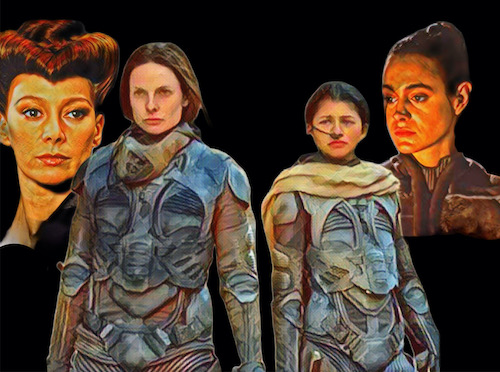
The first rough cut of the film, without post-production effects, was over four hours long. At that point, they were already on the seventh script, which was estimated to be almost three hours long. The Studio determined that the launch would only take two hours. The cuts are felt. They filmed new scenes to simplify the plot, added voiceovers, and the famous introduction by Virginia Madsen.
“I’ll tell you when I went to see the film for the first time at the premiere — and I only saw it once — as soon as Princess Irulan (Madsen) started speaking in voice-over at the beginning, explaining the story, I thought “Uh oh, This movie is in trouble. Any Hollywood film that has to explain itself in detail at the beginning is in trouble…” commented Francesca.
From hated to cult: a painful trajectory
Arriving in theaters at the end of 1984, the positive expectations for Dune were enormous. The problems were immediate with critics criticizing the final result and the public not giving the expected return at the box office.
The comparisons were relentless. Dune was one of the most expensive ever made, with a bigger budget than the Star Wars trilogy and four times more expensive than the box office sensation of two years earlier, E.T., but it grossed less than them all.
The disagreements between David Lynch and producers became legendary, with him reneging. the versions (yes there were four) released and asking for his name to be removed or changed to pseudonyms in some of them.

All of this had a passionate effect on the director’s fans, placing Dune on the level of Cult. Still, it’s a fact that the 1984 version was a disaster. For many, the worst film of the year. Uh.
From loved to cursed: TV “saves” the saga
With so many problems, Duna became synonymous with impossibility. Frank Herbert passed away in 1986, without seeing how his work would be placed on the level it was in literature.
After this traumatic blockbuster attempt, David Lynch established himself as one of the most daring and creative directors in independent cinema, with Blue Velvet and then the TV phenomenon, Twin Peaks, all with Kyle MacLachlan leading the cast.
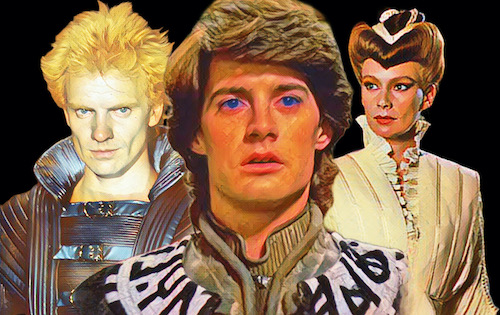
The 1988 re-release, with an even longer three-hour version, was the one that settled Lynch’s fight with the producers. To this day he refuses to talk about the film. But all of this also maintained the logic that Dune deserved a second chance.
In 1996, the film rights passed to Richard P. Rubinstein, who produced Dawn of the Dead and Pet Sematary, and four years later arrived on TV with a praised and award-winning production. The question remained: what about in the cinema? Wouldn’t it be time to try?
A visionary director passionate about his work
David Lynch only read Dune to make the film, something different with Denis Villeneuve. But his path to the saga began in 2007 when a group of Spanish students released a four-minute trailer for a fan-made version of the work. It took seven years to produce, but it was impossible to watch because it was removed from YouTube and never reached theaters.
The reaction, now with social media as a thermometer, made Paramount decide that it was time for a new adaptation of the novel. In 2008, Peter Berg and Pierre Morel (from Taken) were cast, but after four years of going back and forth, they dropped out. Just when a documentary about Jodorowsky’s first attempt at making Dune was a success at the 2013 Cannes Film Festival.
Three years later, Legendary Films acquired the film and TV rights to Dune, bringing a passionate fan, an expert of all trades to lead what is considered the most successful attempt of all: Denis Villeneuve, who was successful in 2016 with the film Arrival. “Dune is my world” he summed up. And it is.
Between 2017 and 2021, when his first part hit theaters, Villeneuve was closely followed by strict fans. That elevated Dune to the level expected for 50 years: a masterpiece.
A trilogy that has everything to be legendary
It’s easy to compare Denis Villeneuve with Frank Herbert with what Peter Jackson achieved with J.R.R. Tolkien: a specialist so profound in the work that he is finally able to translate it into images. Interestingly, after his great success in the United States, Arrival (2016), for which he was nominated for an Oscar as Best Director, it was precisely the sequel to a classic by Ridley Scott – Blade Runner 2049 – that solidified Villeneuve as a director of great films and visual and philosophical. Knowing that Scott left Dune to make Blade Runner, it is almost karmic that the Canadian director is the director who broke the “curse”.
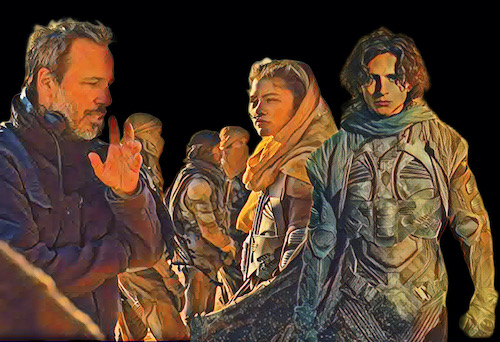
Following in the footsteps of George Lucas and Peter Jackson, Villeneuve turned Dune into a franchise, with two films initially, but now with the appearance of a trilogy. This was because he felt that Herbert’s novel was too complex for a single film, as the 1984 production proved. Furthermore, without criticizing Lynch or Jodorowsky, he preferred to ignore their films and scripts and turn to the books alone.
What Dune now has as an advantage is the advancement of technology that allows, even using few effects, the story to be realistic and visually beautiful, and 50 and 40 years later, the themes covered in the books are easily identifiable today.
A decision that shows intelligence and boldness is to eliminate the internal monologues and epigraphs used in the book, as well as simplify the dialogues, part of the political plot, in addition to concentrating the first part around Paul and Jessica.

The first part of Dune went on to make over $435 million, the best of Villeneuve’s career but fell 62% the following week because it was made available on platforms due to the pandemic. Even though almost two million Americans were seen in the first three days, the strategy interfered with the numbers and Villeneuve endorses the group of directors who defend not shortening the cinema window for streaming.
It’s almost certain that we will even have a third film (based on Dune Messiah), and we know that there is also a series, Dune: Prophecy, being developed for television. The series would focus on the years before what we see in the films, centered on the Bene Gesserit and has Travis Fimmel announced as part of the cast. The problem? Production is temporarily on hold… with all of Max’s focus on House of the Dragon, will we have our Dune series? I hope so!
Descubra mais sobre
Assine para receber nossas notícias mais recentes por e-mail.
 miscelana.com
1 comentário Adicione o seu