
The Rhaenyra we saw in the first season of House of the Dragon is very different from what is described in the book Fire and Blood. This space given by George R. R. Martin is important because it gives us another perspective on his decisions: wrong or not.
With the confirmation that the second season will debut in June, which means that there is a maximum of three months left before the second teaser, it is worth remembering the character from the book a little, thinking about where she can differentiate herself or confirm herself in the series.
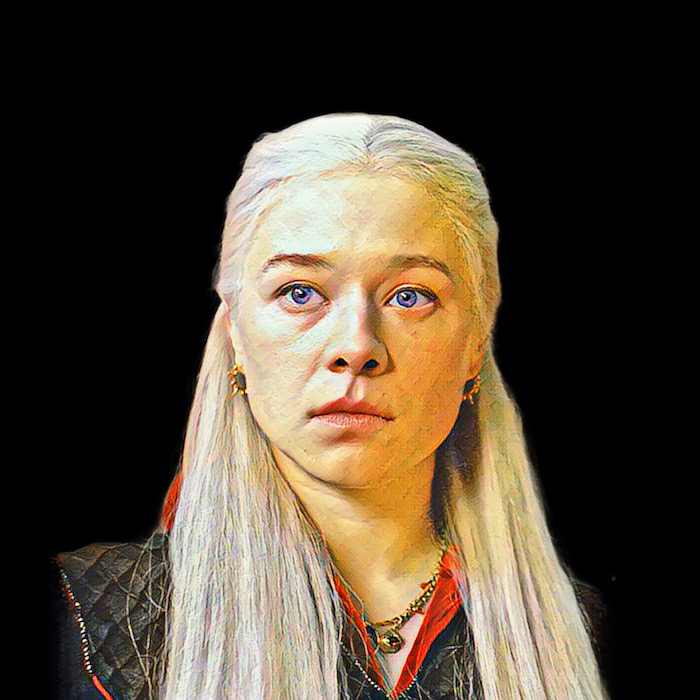
Within the A Song of Ice and Fire saga, Rhaenyra is a significant character in both Fire and Blood and the history of the Targaryen dynasty, particularly due to her role in the civil war known as the Dance of the Dragons. Her trajectory is complex, violent, and full of ‘legends’, which makes us curious and anxious about the series.
Aemma Arryn’s influence
Rhaenyra (was the eldest daughter of King Viserys I Targaryen (Paddy Considine) with his late wife, Aemma Arryn (Sian Brooke). In the book, we know that Aemma died trying once again to have a son to inherit her husband’s crown, but he died during childbirth, leaving a pre-teen (in the series) and vulnerable Rhaenyra (Milly Alcock) traumatized and hurt by his death.
Although in the series she only appears in a few scenes in the pilot, Aemma’s influence is decisive and everything. Her influence is significant in the education of the princess, who has a strong personality and receives affection and love from her parents, being included in their relationships and not treated with detachment.

The love she received from her mother in life served as an example and basis for the relationship that adult Rhaenyra (Emma D’ Arcy) will have with her own children, as well as being important in determining her relationship with Power.
Rhaenys and Aemma: the female role models for Rhaenyra
Growing up in Westeros, only a firstborn and a Targaryen, Rhaenyra is aware of the female role in society, something that Aemma constantly prepares and highlights. As a woman, she is expected to provide male heirs, but will not have priority for the Iron Throne if there is an official male heir before her.
It was that she saw her cousin-aunt Rhaenys (Eve Best) live before her. Jaeherys’ Crown should have belonged to Rhaenys’ father, who died before becoming King with only one female daughter. She was then disregarded and the Crown was promised to Viserys I’s father, who also died before becoming king. Machismo was so strong in King’s Landing that Rhaenys, now married to Corlys Velaryon (Steve Toussaint) she then asked for the heir to be her son, but in a vote, the Nobles of Westeros elected Viserys I, whose youth would prove to give him time to father a male heir.

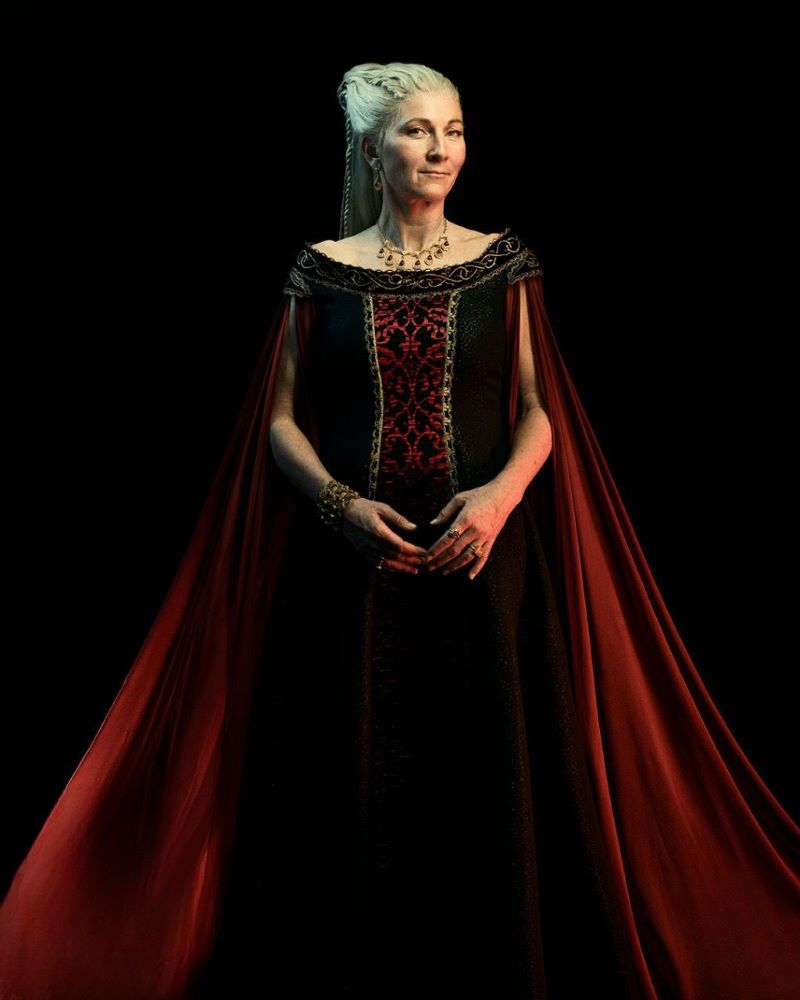
This commitment and expectation created traps for the Targaryens. Even without the initial expectation that his daughter would one day be Queen, Viserys included her in his Council meetings, and had her around constantly, and with that, she was able to observe and learn what the position of a monarch was like. On the other hand, Rhaenyra saw Aemma have several miscarriages, leading her to consider never becoming a mother one day, but learning from her mother that motherhood was one of the most dangerous and important battles in the Kingdom.
Tragedy struck when Aemma gave birth to a son who survived only a few days and caused his mother’s death. Suffering both losses, the princess’s drama was just beginning.
All of this in the book is less explicit on the pages than in the series, with great work from the entire cast.
Grief keeps father and daughter apart but creates a succession impasse
In the book, unlike the series, Viserys I is a more sensitive man and shaken by Aemma’s death. In his guilt for having insisted on the son and the decision to have an emergency cesarean section that killed Aemma, Viserys kind of distances himself emotionally and physically from Rhaenrya, who was very similar physically to his mother.
Another problem unfolds behind the scenes, with Otto Hightower’s (Rhys Iphan) ambition. He has held the position of Hand of the King since the time of Rhaenyra’s great-grandfather and has had great influence over Viserys.

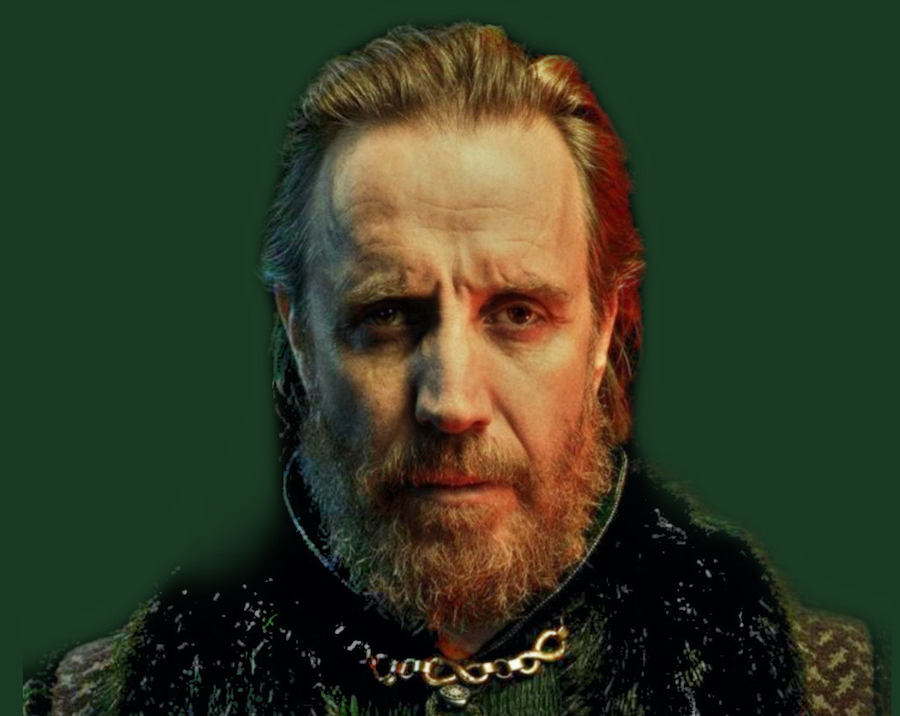
Intelligent and cunning, or ambitious and bad character, if we want transparency, his ability to navigate the complicated seas of court politics makes him both a valuable ally and a powerful enemy. Manipulative, he wants to put his family on the throne, and little by little he deciphers how to achieve his goal.
The hand of fate, forced by politics
Without a son, everyone assumes, including Rhaenyra, that Viserys’s controversial heir will be her younger brother, Daemon Targaryen (Matt Smith). Unstable, impulsive, and arrogant, Daemon is popular with soldiers (and women), but less so with the Nobles in Westeros. Above all, it is extremely unpopular with Otto, who, partly due to political divergence, and largely due to personal animosity, wants to avoid this happening at all costs.
Daemon is charismatic and ambitious, he has affection for his brother and his niece, but he judges the Targaryens above all other houses. For Otto Hightower, Daemon’s assertive personality and thirst for power are potential threats to the stability of the kingdom and even the authority of King Viserys. He tries to undermine the brothers’ relationship as best he can and succeeds when he is informed that Daemon toasted his nephew’s death because he is now first in the line of succession. Otto has a plan and acts quickly.

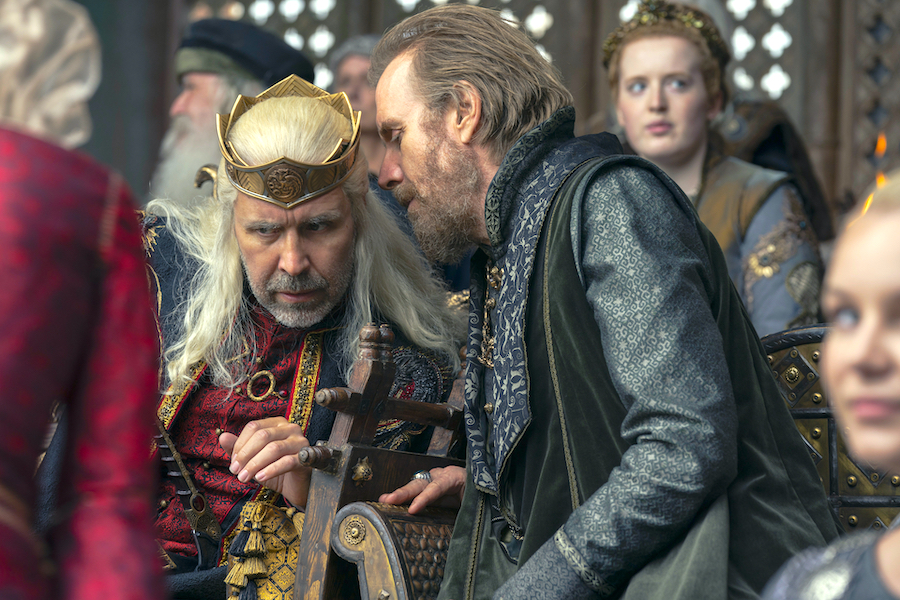
As we know, Otto’s true objective was to bring his daughter, Alicent (Emily Carey) closer to Viserys, but, to buy that time, he convinces the King to break an ancient tradition and name Rhaenyra as his heir, despite being a woman. , which was unusual in Westeros succession laws.
Daemon revolts, but Otto wins this match.
As future Queen, Rhaenyra isolates herself
The differences between the series and the book gain greater importance at this stage of history because, as expected, the decision was not well received by many nobles who preferred male heirs. Known for her beauty and friendliness, Rhaenyra rode the dragon Syrax and remained close to her father, but now, feeling even more so when she is not involved in the Kingdom’s matters or even listened to.
It doesn’t help that Viserys is pressured to remarry and chooses Alicent Hightower (in the book older than Rhaenyra and in the series her best friend). For the princess, it was a betrayal, and their separation, which in Fire and Blood happens later, in House of the Dragon, is immediate. For Otto, Alicent is not only his daughter but an important piece solidifying her position at court and increasing her influence.

When Alicent and Viserys’ children are born – three boys and a girl – Otto begins to pressure the King to return to tradition, but now he is determined to make Rhaenyra a queen. Influenced by Otto and trying to break her father’s isolation, the princess becomes involved in dangerous gossip and ends up marrying her cousin out of convenience, which becomes a recipe for more problems.
Passions and children, conservatism in favor of enemies
From a personal point of view, Rhaenyra appears to be a strong and determined woman. Part of her problem as an adult is the romantic relationships that will determine her trajectory.
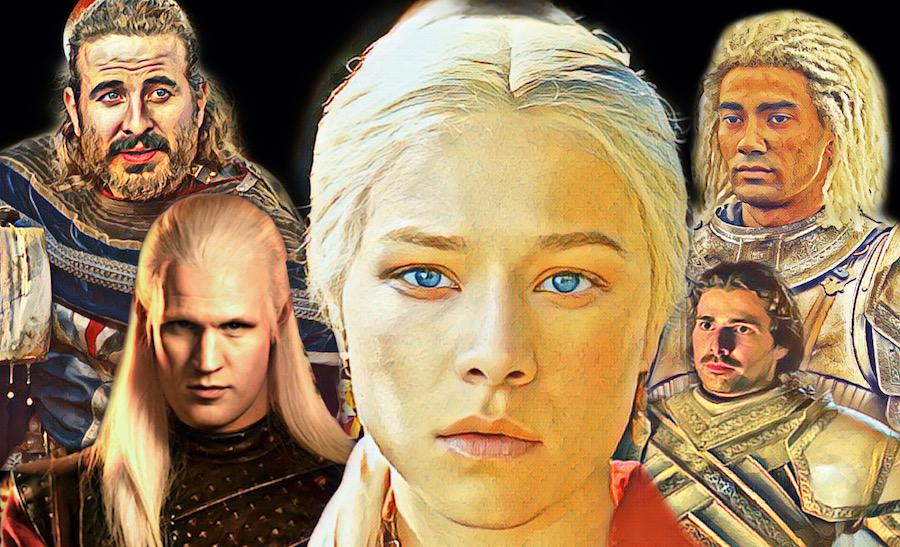
Daemon, provoking and perhaps considering a political advance, awakens the sexuality of his niece, who seduces her bodyguard, Ser Criston Cole (Fabien Frankel), but marries his gay cousin even though Criston dreams of her running away with him. This enmity will cost the princess dearly when she inherits the Crown.
As an adult, Rhaenyra has a romance with Ser Harwin Strong (Ryan Corr), who is the father of her three children, although they are officially Velaryons to maintain the facade of their marriage. When her first husband “dies”, Rhaenyra already feels that her position is more vulnerable, but she remains focused on becoming queen, which is why she gets closer to her also widower Daemon, and the two get married in the family tradition of incest.

The niece and uncle’s relationship began as a political alliance but became deeper with a strong partnership. They have two children together (and lost a girl), becoming the best definition of a power couple.
As expected, Daemon’s marriage to Rhaenyra deepens the division between the prince and Otto Hightower, because it precisely places Daemon in the position of potential power, which the Hand of the King always wanted to avoid.
At this point, relations between Alicent and Rhaenyra are going from bad to worse, also reflecting on the relations of the queen consort’s children with Viserys’ successor and her children as well. Fights often break out between them, some violent, which makes Rhaenyra move away from the capital and stay in Dragonstone, waiting for the moment to be crowned.
Hostility sowing the Civil War
The relationship between Rhaenyra and Alicent is extremely tense and hostile, highlighted by the opposite way they both deal with society and politics. Alicent, conservative, obedient, and obstinate, saw motherhood as an obligation, has a certain distance from her children, and a lot of resentment of what she considers Rhaenyra’s advantages, which is not following the rules and not dealing with the consequences.
Even under pressure from her father, she does not interfere so that Viserys reverses the succession order, which is Alicent’s merit, but she refuses to make political alliances between her children and her stepdaughter because she knows that they are not legitimate.


Two misunderstandings are the trigger for the drama. Misinterpreting a conversation with Viserys, who thinks Alicent is Rhaenyra, the Green Queen challenges her husband’s official decision to pass the Crown to his eldest daughter, claiming that in his last moments, he decided that the Iron Throne should be occupied by his eldest son with Alicent, Aegon II (Tom Glynn-Carney). Rhaenyra obviously won’t accept it.
The second was that Rhaenyra’s half-brother, Aemond (Ewan Mitchell), without controlling his dragon Vaghar, ends up killing his nephew, Lucaerys Velaryon, irreparably breaking Rhaenyra’s heart.
It is the beginning of the civil war known as the Dance of the Dragons.
Rhaenyra’s reign
As we saw in the series, Daemon supports Rhaenyra in her claim for the Iron Throne, but their relationship is already full of ups and downs. They are allies, but at times they will almost seem like adversaries. Daemon is Rhaenyra’s military strategist but believes in violence to reclaim his wife’s usurped Crown. With so many hurtful personal relationships driving political decisions, it will be very complex to criticize both sides.
The violence of the clashes will bring tragedies to all Houses in Westeros, but with each loss, Rhaenyra’s fragility – at least in the books – will become greater and greater.

The Dance of the Dragons is one of the most fascinating sections of the Targaryens Saga precisely because of its complexity inspired by real historical facts from a misogynistic and adverse period for women. Rhaenyra is notable for her claim to the Iron Throne, all the more significant because she is a woman who attempts to rule in her own right, in a world where power was generally held by men.
Hence the book’s description of a paranoid and jealous woman does not match the profile of the female narrative, there is room for the second season of House of the Dragon to address the problem with another context. One of them placed Rhaenyra as overweight and envious of Alicent’s beauty, something superficial given everything that is at stake. Mothers seeking revenge will make more sense than female competition.
But until June, we’ll have to rely on Fire and Blood, which reports that Rhaenyra’s reign, when it finally begins, will be marked by suspicion, paranoia, and cruelty. The Queen will have those she considers traitors executed, even without a fair trial, so she will end up being consumed by her desire for revenge.
How to evaluate Rhaenyra as Queen?
Rhaenyra will end up isolating herself and losing the people who help her reign, one by one, whether in battles or political disagreements. All of this will start to happen in the second season.
Queen Rhaenyra embodies many of the characteristics associated with the Targaryen family: ambition, a sense of entitlement, and an occasional capacity for cruelty. However, she also demonstrates courage and determination, qualities that can be admired even when her actions are often questionable.
Overall, the trajectory of this iconic Targaryen Queen illustrates well the destructive nature of civil war and power struggles, as well as the high personal cost of seeking and maintaining power. Furthermore, her story can be a warning about the dangers of ambition and the desire for revenge overcoming reason and, above all, Justice.
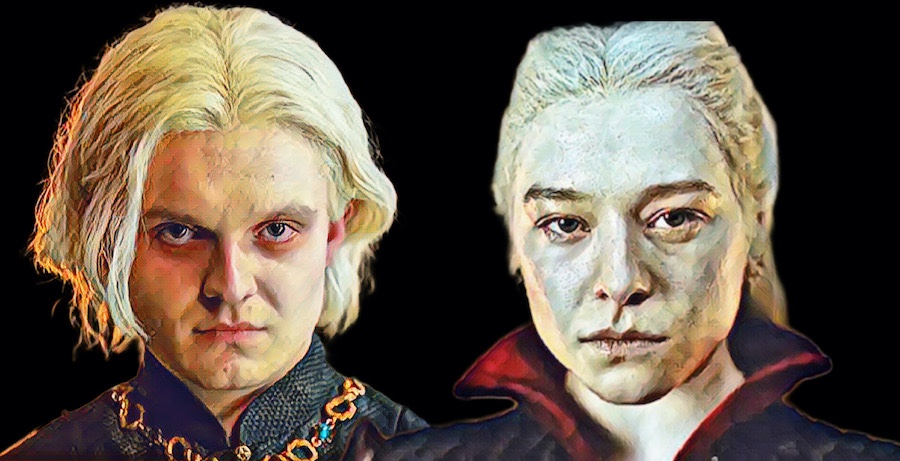
With great loss of life on both sides, Rhaenyra’s death will also be traumatic even more so as she will be fed to Aegon II’s dragon, Sunfyre, marking a tragic end for the first Targaryen Queen (the previous ones were consorts). Yet another example of the conflict of power and tradition, and how dangerous the Iron Throne is.
We look forward to the new trailer coming soon!
Descubra mais sobre
Assine para receber nossas notícias mais recentes por e-mail.
 miscelana.com