
I’m TWO years late because Killing Eve was hidden on Globoplay and I “missed” the conclusion of the series when it aired, still in 2022. It was so off the radar that I even tried to find out what had happened, but I wasn’t impacted by the big revelation and change in the series, thanks to supervillain Carolyn Martens (Fiona Shaw). Now that the series has arrived on Netflix, I can finally complete the story.
I really liked Jodie Comer‘s performance as Villanelle, the sociopath in love with an MI5 agent, Eve (Sandra Oh), but it was the suspicious, articulate, and practical Carolyn who always enchanted me, with her calculated words, her mystery and unpredictability. Honestly, she was more interesting than the two protagonists, growing with each season until reaching the end – not so much unexpected, but still a surprise (I know it’s paradoxical!) – where both a continuation and a spinoff for Let us deal with your youth. It would be a great series!
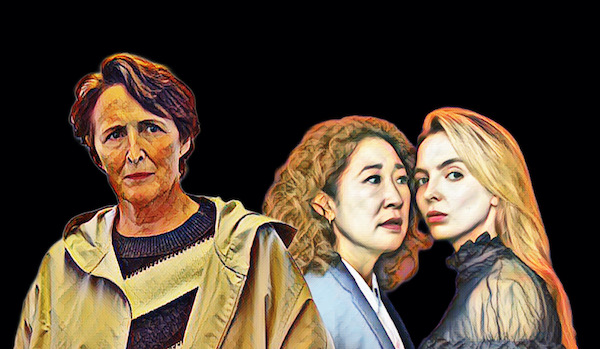
Spy: pure evil or dedication to the cause?
Carolyn’s life is somewhat mysterious and fascinating. One of the best spies of the Cold War and the daughter of a great spy, she circulated in cold, exotic, and banal scenarios, killing and avoiding dying with a skill that made us often question whether there wasn’t a sociopathy in her too.
In the final season, in 2022, it was reported that the ACM channel was working on a spinoff that would cover Carolyn’s youth and the latest episodes of Killing Eve gave us an idea of what it could be.
As head of MI6’s Russian department, Carolyn has always shown herself as a strategic and ruthless leader. She had – as she recalled at the end – several skills: 1) identifying each person’s true talents, whether for killing or investigating (or both) and 2) knowing how to calculate exactly how each person would react and act, gaining an advantage in the game and rarely being surprised.
With strikes and market changes. it is uncertain whether the project is still under consideration. The fact is that as the great villain of Killing Eve, Carolyn managed to both achieve her personal revenge against her enemies and eliminate her criminal adversaries in the Twelve.
Villanelle’s mistake in sparing the British woman in a rare moment of sociopath empathy confirmed Carolyn’s superiority in the series’ evil deeds. She used Eve and Villanelle to do her dirty work but sacrificed them both without a second thought. Who is the sociopath anyway?
A female series in a male universe
Although the series is written by Phoebe Waller-Bridge, Killing Eve is a loose adaptation of a book, Codename Villanelle written by Luke Jennings, where, unsurprisingly, the top position was occupied by a man. It was the showrunner who turned this boss into Carolyn Martens.
Yes, espionage on TV and in the movies (or both) had female characters as agents (Nikita, by Luc Besson, and Alias, by J.J. Abrams) and in the 1990s, James Bond’s boss, “M”, was the brilliant Judi Dench, but in general, it is a patriarchal context. Slow Horses also flirts with the theme, occasionally.

Killing Eve, however, differs from the others by having protagonists antagonists, and suspects always in strong, unpredictable female characters and this is one of the key elements of the series’ success. The biggest inversion, perhaps, is seeing the series’ violence – which is bloody, physical, and morbidly funny – using women instead of men killing, fighting, and winning.
The homosexuality of Villanelle, open and assumed, and Eve, contradictory and resistant, is not the usual thing that men find sexy. Still, it is part of the essence of the feminine universe. Interestingly, they are played by two straight stars while Fiona Shaw, who is gay, plays the straight Carolyn Martens. Sex is not what matters here, but Fiona has always suggested that the success of the series is because the three characters form the “sacred triple”, which unites the oldest woman, the very young woman, and the middle-aged woman as protagonists, something little explored in series and films. Furthermore, Killing Eve navigates a dark, violent, and unexpected world.
If there is an emotional and physical cat and mouse between Eve and Villanelle, we realize that the biggest cat of all is the inscrutable Carolyn Martens, hunting something that only becomes clear in the final season. Yes, since we discovered the existence of the Twelve we suspected she was involved. Like everything in Killing Eve, it’s more complex than that.
Casting Fiona Shaw in the role of Carolyn Martens made all the difference. Award-winning theater actress, who was one of the first to question genders (she played Richard II on stage 20 years ago, when equity was not even a word considered necessary), was one of those who realized that in addition to dealing with the world of espionage, something essentially masculine in literature or cinema, it gained deeper feminist tones in Killing Eve.
The manipulative Carolyn Martens
In theory, the show revolves around Eve Polastri (Sandra Oh), an MI5 agent who inadvertently becomes the target of sociopath Villanelle (Jodie Comer), a ruthless and perfect assassin, who travels the world on missions to kill bad guys. or corrupt. Her psychopathy makes the crimes a fashion show and violence, an attraction in itself.
Eve is recruited by Carolyn (Fiona Shaw) to work in a secret department of MI6, to not only locate and arrest Villanelle but also to investigate a powerful organization – the Twelve – that hires Villanelle and others for dirty jobs. Villanelle’s mentor is Russian Konstantin (Kim Bodnia), with whom she has a bizarre relationship, both family and professional.
While Villanelle and Eve continue in the cat-and-mouse dynamic (inverting what was traditionally lived by man/woman) it is Carolyn who awakens the greatest curiosity in us. She and Konstantin share a past as spies during the Cold War and even in the present, they find themselves on opposite sides.

Carolyn is mysterious, elegant, cold, and quick to adapt strategies. She brings Eve’s wit into a web of secrecy, espionage, and murder where no one can quickly be trusted, not even, much less, Carolyn herself. Villanelle’s psychopathy is terrifying (although Jodie Comer brought empathy to the character), but she, as we see, is manipulable. Eve, not so much, but her obsession is equally predictable. It’s easy for super spy Carolyn Martens to move easily among them.
Discovering Carolyn’s present and past is complex. She has two children, but it is Kenny Stowton (Sean Delaney), her youngest and favorite, who changes everything in Killing Eve. We know him as a clumsy and shy assistant, whom she treats coldly, so when the relationship is revealed, it’s a shock.
Unfortunately, Kenny is killed and this death changes everything in the series. It starts to push Eve and Carolyn towards not the same goal, but apparently opposite ones. They both want to destroy the Twelve, but we quickly understand that there is something different in understanding what they really say, especially, of course, Carolyn. When she is removed from MI6 it is even worse for her: she knows this universe better than anyone, what now?
In Carolyn’s past, the series’ future
It doesn’t take us long to realize that Carolyn has a personal connection to the Twelve, but how she effectively wants to dismember them is what confuses us because, like Eve, it seems like she is the head of the organization. I finished the series with the same conviction. And in the important flashbacks of the final season, I reinforced my theory.
In 1979 Berlin, we see that Carolyn, or Karolina (Stacy Thunes), was undercover and infiltrated the founding members of the Twelve, using the false name “Janice.” She was even the one who named the group of terrorist anarchists with that name. The leader, Johan (Siggi Ingvarsson) is her lover.

Carolyn was working with her father Dickie (Nigel Cooke), also an MI6 agent, but he is murdered by a member of the Twelve, one of her lovers, Karl (Louis Bodnia Andersen). The shock for us is that Karl is Konstantin (Kim Bodnia), posing as a German. And in the general context, knowing that Konstantin and Carolyn love each other, but that he killed Carolyn’s two other loves – his father and her son, of whom Konstantin could even be the father – is uncomfortable and dense.
Going back to the 1970s, Johan suspected Carolyn and Karl, and so together, the couple believed they were killing him. When in the present Carolyn stumbles upon Johan alive and using the name Lars (Ingvar Sigurdsson), she goes after him. We now understand that Carolyn’s obsession with the group was not so professional: she wanted to eliminate evidence of having participated in its creation.
Obviously, it’s still gray why, if Lars knew about both Carolyn and Konstantin, he continued working with the Russians and didn’t try to eliminate the British spy. Hélène (Camille Cotton), on the other hand, acted to erase this loose end.

Explaining the ending of Killing Eve
Carolyn Martens’ life was her career at MI6. There was or was nothing beyond it. From the moment she ‘lost’ her position, more than avenging Kenny, she wants to return. And to do that, she needs to attack the Twelve. No one is better than her.
In a nutshell: Carolyn made a promise to MI6 that she would destroy the Twelve in order to return. This would personally help her with two things: avenging Kenny and erasing her past. After all, like Karolina or Janice, she began her career investigating the root causes of the anarchist terrorist movement in communist Germany. She did so well that she was able to be the founder of the organization and rise through MI6. To maintain her mission, she sacrificed her father, and later her son.
She knew Eve would discover the truth and use it for her own game. And Villanelle? Well, the psychopath was the perfect weapon created together with Konstantin. There would be no way to change her murderous nature, but, as we see, Carolyn knows how to use it perfectly. Pam (Anjana Vasan) would be the replacement. In the farewell letter, I believe Konstantin presents it and warns that the time has finally come to kill Eve and Villanelle. Pam decided, to Carolyn’s surprise, not to feed her murderous nature.

Fiona herself corroborates my version because in an interview she commented that no, I’m sure their deaths were a “request” from MI6, but “she has to prove that she’s willing to do anything to return” and “everyone in the world of Killing Eve knows they can die and no one is innocent.” Furthermore, she remembers that “Villanelle would certainly kill Carolyn. That’s the game they play. Eve was dying to see Carolyn come to a sticky end because she had been angry with her for a long time. I don’t think it’s that strange that someone would kill them,” she added.
In other words, Carolyn fulfilled her deal with MI6 and eliminated, or thinks she eliminated, the last two people who could link her to the Twelve. The fact that Eve survived leaves the story open-ended.
What do you think?
A wish
It would be so curious to see Carolyn Martens (Fiona Shaw) coexist with her contemporary and imaginary MI6 colleagues Diana Tarnever (Kristin Scott Thomas) and Ingrid Tearney (Sophie Okonedo), from Slow Horses, wouldn’t you agree? The coolness, intelligence, class, and audacity of this trio would take your breath away! A world where women are powerful and decisive over life and death. I would see!
Descubra mais sobre
Assine para receber nossas notícias mais recentes por e-mail.
 miscelana.com