
In 1994, the French-Italian superproduction Queen Margot took Cannes and the world by surprise, costing millions and generating many more at the box office, being the biggest success of the year in Europe, winning awards and, without exaggeration, creating a classic.
Starring at the time the biggest French star, Isabelle Adjani, the film innovated in terms of narrative, and soundtrack, and even 30 years later, it remains spectacular. Historical series like The Serpent Queen (which is close to the historical period), for example, would be impossible. The perfect mix of boldness, creativity, and genius.

Alexandre Dumas’ version
Writer Alexandre Dumas was very fond of the non-fiction genre, using historical characters for his grand stories of adventure and romance. The Three Musketeers, from 1844, and The Count of Monte Cristo, from 1845, are examples of the successes he published. Still, in 1845, he released Queen Margot, a historical novel set against the complex and traumatic political and religious conflicts of 16th-century France. It was so successful that it was almost immediately translated into English.
Obviously, the historical context – full of liberties on the part of the author – caused a certain reaction at the time. The story has as its backdrop the French religious wars between Catholics and Protestants facing the bloody St. Bartholomew’s Day Massacre, the mass murder of Huguenots (French Protestants) that began in Paris on the wedding night of the then Princess Margot ( Catholic) with Henry of Navarre (Protestant). The violence left Paris and spread to other cities, remaining to this day one of the most shameful historical events in history.

Dumas’ precise text explores the religious tensions and political maneuverings of the French Valois royal family, as well as the international implications of these conflicts. The problem lies in the use of propaganda “rumors” against the Valois, placing inventions as facts, all to highlight the impasse between love and duty. Although she gives the work its title, the Queen is almost a supporting character in her own story when it focuses on the friendship between the Protestant La Môle and the Catholic Coconnas.
The real Margot, whose biography is often complex (I read more than one with conflicting images of her personality and role in the drama), is described as “trapped” between her duty to her family and her love for La Môle. Out of obligation, she has to marry Henri, who would later be King Henry IV of France, the son of an enemy of her mother, the Serpent Queen, Catherine de Medici. However, the Valois’ true plan was different and a minor mistake triggered the order of the massacre, leaving everyone, including Margot, at serious risk.

Because of her union with Henri, she is Queen of Navarre, but in fact, as much a prisoner in Paris as her husband. Strong and intelligent, she navigates the treacherous waters of the French court with skill and grace, seeking her independence and freedom. The Valois, Catholics, are the antagonists and Henri de Navarre is portrayed as a cunning and pragmatic leader who prioritizes the well-being of his people, the opposite of the greed and evil of his mother-in-law, Catherine de Medici.
A story little explored in cinema or TV
Although it is one of the mandatory chapters in all History courses around the world, cinema has never retold Queen Margot with the same frequency as The Three Musketeers or The Count of Monte Cristo. There were only TWICE: in 1954, with Jeanne Moreau as Margot, and in 1994, with Isabelle Adjani. That is, 50 and 30 years ago. The personal conflict between mother and daughter, who never got along, would in itself be incredible material to explore!
Marguerite de Valois would perhaps be left out of the pages of History if it weren’t for her claim that marriage is such a violent weapon of religious repression. Known only as Margot, she technically became Queen of France, but it was so brief that it barely counts.
The only daughter of Henry II and Catherine de Medici, she was never close to the two who cared most about their children, Francis II, Charles IX, and Henry III. The political wedding that triggered the Saint Bartholomew Massacre already started badly because the bride aggressively chose Valois red for the ceremony and became mute, needing to be pushed (literally) by her brother to grunt a noise that was considered a “yes”.

How she tried to pacify both sides, but only displeased both. She never managed to bear her husband a child and was known for collecting mistresses outside of marriage (La Môle was actually one of them). She lived in exile for 20 years and when her husband converted to Catholicism and became king, he asked for and obtained a “royal divorce” which was the annulment of the marriage. Margot was compensated with generous compensation, so she is not one of the French Queens we remember with alacrity.
She was the first princess to write an autobiography, she was considered elegant and cultured, but these qualities were omitted by Alexandre Dumas, who portrayed her as a nymphomaniac and incestuous, a common version after the Valois fell from Power. The film slightly alleviates this insinuation, placing true love for La Môle as the motivation for moving away from his relatives. Problematic, but still the smallest of the work’s defects.
French divas like the fiery Queen
The 1954 version, starring Jeanne Moreau, was sold abroad in a revealing way: A Woman of Evil. That’s right, the “Queen Fatale” with scenes exploring Jeanne Moreau‘s nudity. It was considered luxurious at the time because it had strong colors, a bold script, and a beautiful score by Paul Misraki.
Here, the impetuous Margot (Jeanne Moreau), daughter of Catherine (Françoise Rosay) and sister of Charles IX (Robert Porte), marries the Huguenot prince (Andre Versini) but on the night of the massacre of the Protestants, a handsome count stumbles Margot’s room and the two fall in love. Considered a classic in France until the 1994 version.
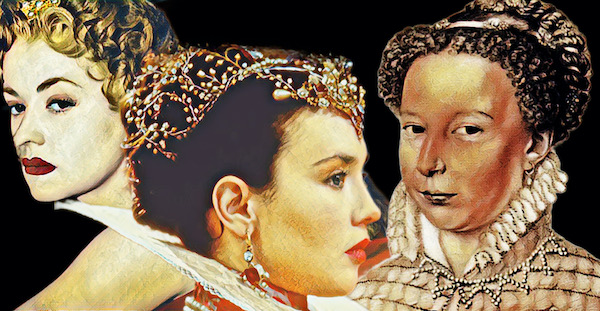
Forty years later, Isabelle Adjani saw Dumas’ book as a potential project to record with her boyfriend at the time, Daniel Day-Lewis. That’s right, the proposal was to have an English version with the two of them, even though she, at over 40 years old, was at least three decades older than the character.
When Day-Lewis dropped out (he was recording The Last of the Mohicans) he was replaced by Vincent Perez and Queen Margot became an essentially European co-production. If today it is trivial to have sex and violence with modern music in period stories, in 1994 it was still new and when the rich production, directed by one of the most famous filmmakers in the country, Patrice Chereau, premiered at Cannes it was a scandal.
Queen Margot‘s realism and grandeur compensate for the fact that her sexuality is explored in an almost uncomfortable way for today (although she is modern seeking sex with strangers on the streets of Paris, she is portrayed as a sexual object when she is sexually abused by her brothers incestuous in front of her husband), at a pace that allows us to follow the plot even if we have already forgotten much of the story.
The St. Bartholomew Massacre sequence (the inspiration for Game of Thrones‘ Red Wedding) is so graphic and bloody that it never fails to shock, even 30 years later. With gigantic performances from everyone – Virna Lisi was awarded for her Catherine, Isabelle won the Caesar, etc. – makes Queen Margot epic, exciting, and still perfect. And better, in a direct, sequential narrative, without major script effects to contextualize religious intolerance.

The Serpent in charge of the tragedy
The fascinating and controversial story of the woman responsible for the entire tragedy is just one unexplored detail in Queen Margot as Catherine de Medici was for many years a hated and feared Queen, so much so that she earned the “nickname” Serpent.
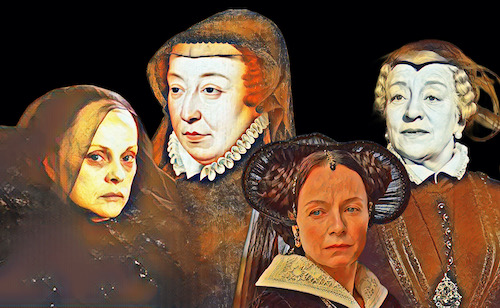
The Italian Virna Lisi is more than perfect in the role, she is unforgettable. Her performance should have put her at the Oscars as it is a lesson in delivery and sensitivity. Better yet, she is the only true Italian to play her countrywoman. Although Samantha Morton is spectacular in the series The Serpent Queen, she is English. And in 1954, it was Frenchwoman Françoise Rosay who brought the sinister regent to life. A suggestion? Devour the Lionsgate Plus series before reviewing Queen Margot, it’s another context to understand what Catherine endured and did to get where she is.
A “lost” Oscar in the year with the greatest competition
One of the most undeniable highlights of Queen Margot is the costumes, designed by the German Moidele Bickel, whose work of period reconstruction with subtly modern touches is breathtaking.

Just as Queen Margot was left in the shadow of the craze that was Pulp Fiction in 1994, the film’s costumes lost the Oscar to the incredible and very original models in Priscilla, Queen of the Desert. How can we talk about injustice in this case? Impossible.
Time to retell Margot’s journey?
The entry of young Margot into the plot of The Serpent Queen may bring new oxygen to the character, but as she antagonized her mother in life, there is no way to expect a positive outlook from her. The young Philippine Velge is the “new” Margot, closer in age than her predecessors, but still far from being a star.

In the 40 years since the last visit to such a fascinating story, the dream remains that they will rescue with greater affection and care the story of this fascinating woman who awakens so many legends, but who has not yet been properly portrayed on screen. Will she still have a chance?
Descubra mais sobre
Assine para receber nossas notícias mais recentes por e-mail.
 miscelana.com
1 comentário Adicione o seu