
A few months before the premiere of the second season of House of the Dragon, it is worth reviewing some important details that the series changed between the book and TV. Some of these changes were significant and interfered with what, in theory, was already canon for fans.
The period of the Civil War between the Targaryens – The Dance of the Dragons – is one of the bloodiest and most interesting in the book Fire and Blood, whose conclusion is tragic: several Targaryens die (including Rhaenyra) and the dragons become extinct. In theory, there is no way to change, for example, the tragic fate of Rhaenyra (which Joffrey celebrates in Game of Thrones), but, as the series reversed some important details, even this can be feared.

The fear is not unfounded (we’ll highlight it later), but, in general, what House of the Dragon did was present more elements of what was inconclusive in the book, to divide us into the crowd between Green and Black. We will have to choose a side, as they warn. Nothing better than looking at some of the most significant changes in the series.
1- The connection between Alicent Hightower and Rhaenyra Targaryen
The main change between the book and the series includes bringing enemies Alicent Hightower (Olivia Cooke) and Rhaenyra Targaryen (Emma D’Arcy) closer together in age and relationship. The change increases the drama between the two, of course, but it also reduces the crux of the issue, which is the mutual hatred between the brothers and their fight for the Crown after the death of Viserys I.
The distance of almost 10 years between the two that exists in the book gives Alicent a more powerful dimension, leaves us intrigued about her nature, and also gives her greater meaning than she had in the series, even though she is the protagonist.
In Fire and Blood, it is insinuated that Alicent was used by Otto during the period of Jaehaerys’ reign, and she is much more active alongside her father from the beginning. Her relationship with Rhaenyra starts out cordial and gradually deteriorates, until the moment they antagonize – using their colors as a test of loyalty in the kingdom – we are genuinely on one side or the other.
By confusing the relationship between the two, bringing them together as confidants from an early age, and creating personal betrayal as a reason for the fight, it kind of fell into the patriarchal trap that every George R.R. Martin plot has conflict with. That’s right, in the beginning, the works made clear the oppressive universe in which women circulate without recognition or security, but when they started wanting to bring female protagonism, they didn’t get it right because neither Game of Thrones nor Fire and Blood are stories from a feminist universe.
Every change that the series makes to balance the issue and contextualize it with current culture compromises other characters, generally ruining them (Jon Snow, Tyrion Lannister, etc.). GOT was caught at the height of this cultural change when it was already on the air and HOTD was already published, so the showrunners were left with a mess to sort out. In my opinion, they did the best they could under the circumstances, but women realize that it is men trying, and it is not women telling the stories. The complexity they tried to bring to Alicent and Rhaenyra is another example of this masculinized view of what female friendship is.

In the series, Alicent is “humanized” as a young woman trying to please, play by the rules, and be correct in an ugly game, as her father warns her. She changes when she realizes that Viserys and Rhaenyra are not honest with her, but even so, there is a change that we don’t see in the transition from the actresses who play young Alicent and Rhaenyra to the adults.
Emily Carey and Milly Alcock played Alicent and Rhaenyra, respectively, one sweet and shy, and the other self-confident and extroverted. Olivia Cooke and Emma D’Arcy reversed the dynamic: after 10 years as Queen, Alicent is strong, authoritative, and faces Rhaenyra without compromise, but the princess is now sweet, fearful, and insecure in front of her former friend. Does it make sense under the circumstances? Yes! It was a good change, but it also excludes the essential thing that is Rhaenyra’s rivalry with Alicent’s children, something that they carried over to the next generation.
2- The alliance between Rhaenys and Rhaenyra Targaryen
Another “different” relationship in the book is that of Rhaenys and Rhaenyra Targaryen, for several reasons.
One of them is that in the book, after she is passed over as heir because she is a woman, Rhaenys still tries to place her son in succession instead of Viserys, and it is not clear how she reacted when she was unable to do so. The series explains this in the pilot, but also places her as a candidate again. From then on, Rhaenys’s cynicism as “the queen that never was” is wonderfully shown by Eve Best, but kind of in the background. It is up to her husband, Ser Corlys Velaryon (Steve Toussaint), to explain her frustrations and ambitions.

What’s different is how she and Rhaenyra almost don’t get along from the beginning, something that seems to be the opposite in the book. Seeing that the princess had a father who fought for her as a successor, it is understood that Rhaenys had sisterhood and, even more so, defended her cousin’s rights as her own, being one of the first and most important allies when the Greens staged a coup. In the series, Rhaenys is indecisive, flirting with the possibility of siding with the Hightowers until she finally embraces Rhaenyra’s cause at the end of the season.
The arc may have made sense, but the friendship between the two that appears on the pages and that was not in any episode is more beautiful. It makes sense, however, for other reasons. By choosing inclusion and placing the Velaryons as black (in the skin), what is a doubt (whether Laenor and Rhaenyra’s children are his) becomes much clearer in the series, to the point of even being a narrative flaw. We’ll talk more about this later. In this way, Rhaenys’ resentment in the series is plausible and expected, because although she knows that her son is gay, her grandchildren are not his.
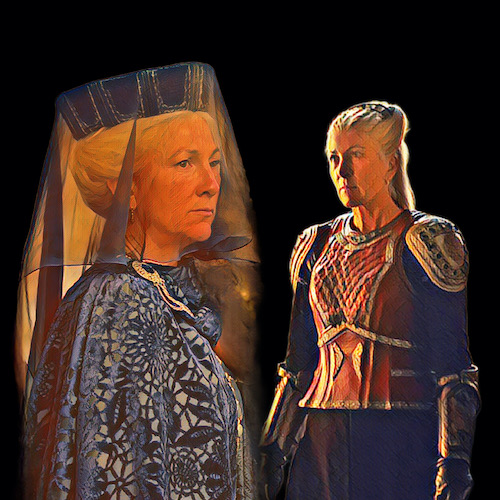
If this humiliation wasn’t enough, he suspects that Rhaenyra had Laenor killed so she could marry Daemon (Matt Smith), but in fact, the Queen of the Blacks made a deal with her husband and faked her death, so she could run away and live with her husband. lover far from Westeros. If he had known about Rhaenyra’s act of love, perhaps Rhaenys would have had a different attitude, but, as she didn’t even suspect it, the change gave another dimension and justified the initial uncertainty on which side she would take. I wish she somehow knew Laenor was okay, but it’s unlikely.
3- Alicent’s complex relationship with her children
In the series, maintaining coherence with the sad reality of Alicent, who was prostituted by her father to seduce the King and elevate the Hightowers in the game of Power, she obeys and does what is expected of her, but has an almost conflictual relationship with the children, often without patience with them.
In the pages of Fire and Blood, it is not clear how she relates, but it is implied that she gets along well with her children and is proud of them. This change was very interesting and contrasted with the affection that Rhaenyra shows her children, taking care of them and being happy with her offspring.
4- Rhaenyra’s romances
In fact, it is not a change, but an explanation of what is only suggested in the book. Of the men in the Queen’s life, they all end up influencing the crisis that provokes the Greens’ coup against her, directly or indirectly.
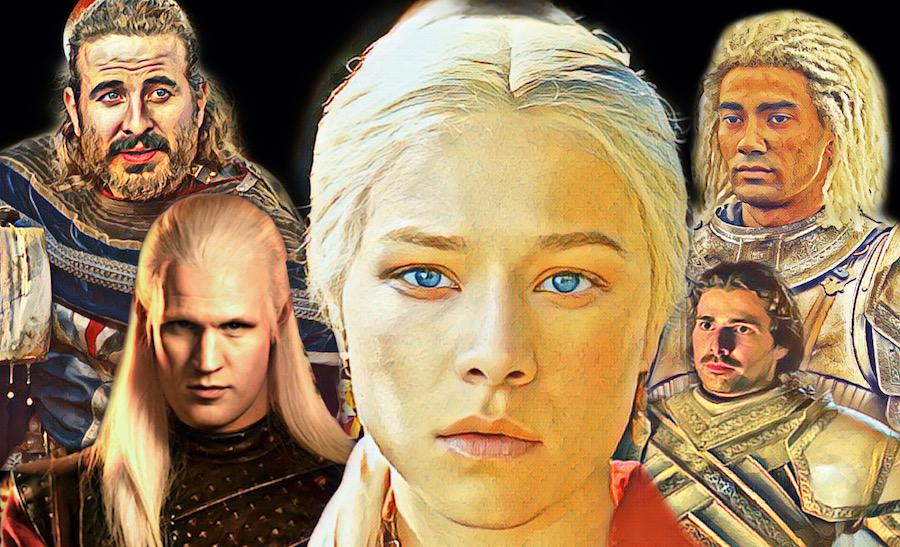
First, Daemon’s seduction, which initiates her sexually, follows what is mentioned in Fire and Blood; therefore, there is fidelity and confirmation of an important and questioned relationship.
Then, she clarifies that the proximity to Ser Criston Cole (Fabien Frankel) really has to do with a romance, but it reverses what was expected. The book’s narrators – men – suggest that Rhaenyra was rejected by Cole and that he was offended by her attempt to seduce him. In fact, his hatred for her remains, but we know that what changed was the fact that Rhaenyra was reckless with her bodyguard’s feelings, that she seduced him, but never considered him anything more than a lover. He therefore felt used and despised, wanting to destroy her. I personally find it hilarious that in the following years, he continues to look at her angrily, and Rhaenyra barely remembers her existence.
Rhaenyra’s marriage to Laenor was as harmonious as possible, but he was unable to even fulfill his role of producing a legitimate heir. Therefore, it is normal that she found someone else who wanted her sexually, but the fact that she had three illegitimate children with Ser Harwin Strong (Ryan Corr) is one of the most serious problems for her succession.


Just like in the printed story, the romance between the two is a known fact throughout the Court, but it is not mentioned how Ser Corlys or Rhaenys dealt with it. It seems like they don’t judge her because they know that Laenor is just her friend. In the series, Ser Corlys’ ambition is so blind that he ignores the fact that ‘his grandchildren’ are white and treats them as legitimate. I think that’s great of him, even if the reason is crooked. Rhaenys, on the other hand, treats children well but is more distant.
Unfortunately, we saw little of the love between Ser Harwin and Rhaenyra, but with three children and more than ten years together, he was certainly a great love of hers.
5- The fate of Laenor Velaryon
The main change from House of the Dragon, for me, is the worst one, too. By providing a happy ending for the gay couple, it alters one of the most sensitive issues of the war. In the book, Laenor is killed by her lover, and there is an unidentified burned body. The question is whether Rhaenyra had him killed or whether it was Daemon, who was also widowed at the same time and could finally marry his niece.
Daemon and Rhaenyra’s marriage shakes Westeros, but it is a legitimate union that produces legitimate heirs. Placing Rhaenyra as a bigamist reinforces the Green team, who point to her sexual conduct as another obstacle to being Queen (the main problem is that she is a woman).
That Jacaerys, Lucerys, and Joffrey were illegitimate was ok, but the fact that both Aegon III and Viserys II, Daemon and Rhaenyra’s children, are also illegitimate. As a supporter of the Queen of the Blacks, I was sad to reject the showrunner’s affection for Laenor, but he would serve better dead than alive.
6- The connection between Mysaria and Otto Hightower
It’s not exactly a change, but it was never clear in the book how Otto Hightower found out about the toast in the brothel made by Daemon when Viserys was widowed and lost his son, but House of the Dragon showed that the rebellious prince’s mistress played a double game. Mysaria (Sonoya Mizuno) was Otto’s main informant, but we ended season 1 with her definitively turning against the Greens when her establishment in King’s Landing was set on fire in a clear attempt to kill her.
Mysaria will be the Master of Whispers for the Blacks, rivaling Ser Larys Strong (Matthew Needham) to maintain the most agile and revealing informant network in the two kingdoms. This clash will be worth watching.

What effectively changed about Mysaria is that, in the book, she was actually pregnant with Daemon and wanted to marry him, but as the prince was already married, she was sent to Lys and lost the baby on the trip, generating resentment from both her side and Daemon’s.
In House of the Dragon, not only was she not expecting her child, but she also argued that she didn’t even want to get married or be a mother. Either way, now that she’s been attacked, it makes sense to support Rhaenyra against the Greens, who tried to kill her.
7- Vaghar kicking off War
The sequence of Aemond tormenting Lucerys and causing her death is one of the most terrifying and emotional pages in the story. Turning the attack into a moment in which Aemond lost control of his dragon took away a lot of the drama. If it weren’t for the charisma of Ewan Mitchell, who nailed his character’s dark and exaggerated attitude, this moment in which he tries to stop Vaghar from attacking would have ruined the series.


Now the mystery remains as to whether he will clarify the truth or whether he will receive fame without deserving it. He wanted to scare his nephew, but he wasn’t going to kill him. Now it’s too late. Rhaenyra’s hatred and desire for revenge will be ‘justified’ and change the entire scenario of the conflict.
8- The Velaryons
One of the most radical changes, but which went through without problems, was to place Ser Vaemond Velaryon (Wil Johnson) as Corlys’ brother instead of nephew. Vaemond is arrogant, like in the series, and offends Rhaenyra by calling her children bastards, but having him try to remove Lucerys from the Driftmark line of succession created an interesting impasse.
Ser Corlys was sick, almost dead, and with that, Rhaenyra gained an additional problem when Vaemond decided to claim his brother’s titles. Corlys, who was ashamed of her son being gay, placed her “grandson” Lucerys as her successor, which offended Vaemond because everyone knew that Laenor was not the boy’s father. However, the series places this turn as Rhaenys ignoring her brother-in-law, who wanted what was hers in marriage, and advocating that the title go to her granddaughter, Baela, daughter of Daemon and Laena Velaryon.
Of course, it’s nice for Rhaenys to defend her granddaughter and try to establish a woman as heir, but she, better than anyone else, knew it was an impossible cause. Furthermore, by always warning Rhaenyra that Westeros would not accept a female Queen, Rhaenys knew the importance of swallowing her anger and supporting her grandson officially, even to maintain the memory of her son. It seems subtle, but it’s not.
In the end, Daemon executes Vaemond, and a dying Viserys once again bolsters Rhaenyra as successor, but it is a close call.
9- The prophecy of Fire and Ice
The script’s hand was heavy in trying to tie up things that Game of Thrones seriously messed up. Inserting “Aegon’s dream” about the white walkers and placing the Targaryen invasion as an initiative by Aegon the Conqueror to “save Westeros” was childish.


It is also an additional detail that does not resolve the problem that neither Jon Snow (Kit Harington) nor Daenerys (Emilia Clarke), much less Jon, would be the Prince That Was Promised. Even using Aegon’s dagger, it was Arya (Maisie Williams) who killed the Night King and not his heir. Honestly, they should let it go and forget the whole Long Night issue.
10- Viserys’ personality
Viserys in the book is fat, good-natured, and a weak king, without awakening great leadership. Paddy Considine brought to the monarch a docility and depth that changed the way we saw the King. A good man, focused on Peace and Diplomacy, without being taken seriously by the warlike lords who aspire to Power and combat. It was a brilliant performance from start to finish and an adaptation that enriched the story.

Descubra mais sobre
Assine para receber nossas notícias mais recentes por e-mail.
 miscelana.com
1 comentário Adicione o seu