
Note: This article was also published in a special version for Bravo magazine in August 2025. You can read it here.
“He left a corsair’s name to other times,
Linked with one virtue, and a thousand crimes.”
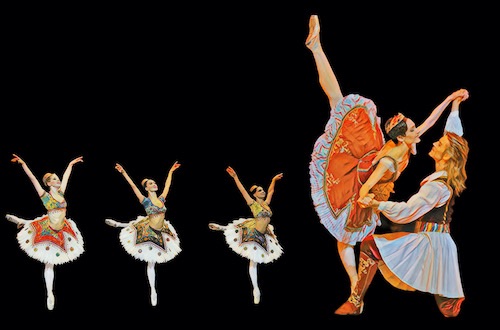
The phrase from Lord Byron’s poem, written in 1814, reflects the inspiration for one of the ballets with a popular pas de deux but a complex plot. Le Corsaire has as its protagonist the beautiful Conrad, dark and attractive, as well as repulsive at the same time. In a story full of adventure, love, betrayal, danger, shipwreck, and escape that you wouldn’t imagine could turn into a ballet, but the choreographers thought differently. In the 1820s, some productions appeared using Le Corsaire as a basis, but it was the Parisian production of 1856, which recreated the shipwreck on stage, that caused a sensation at the time. And of course, when it came into the hands of Marius Petipa, it became a classic, but the road was long.
Success as a book, inspired by a real pirate?
Many believe that the privateer in the poem is inspired by the legendary pirate Jean Lafitte, who operated in the Gulf of Mexico in the early 19th century, and who worked with Napoleon and other leaders of his time.
The 180 pages of Byron’s text are written in verse, dedicated to the Irish poet Thomas Moore, and it’s divided into sections. It tells the story of the privateer Conrad, who, in his youth, was rejected by society precisely because of piracy and who was later condemned for his “war against humanity”. Excluding, of course, his romantic conquests, he was the typical romantic hero of the time: lonely, mysterious, and an anti-hero. The publication was so popular 210 years ago that it sold ten thousand copies on its first day alone, gaining popularity and inspiring operas, music, and ballet, including composers such as Giuseppe Verdi, Hector Berlioz, Adolphe Adam, and Edward Elgar.
Petipa took the work he created in Paris to Russia
Le Corsaire has music by Adam, who had already had success with Giselle, and is divided into three acts, using Byron’s poem more as a basis than literally faithful. The first choreography was by Joseph Mazilier in 1856. This was erased from memory. It was only when Jules Perrot took the work to the Imperial Ballet in Saint Petersburg that it became popular, but it is Marius Petipa‘s vision that serves as the basis for all others since.
The first production was in Saint Petersburg in 1858 and had the still young Marius Petipa in the role of Conrad. Therefore, the French choreographer knew the work deeply. Thirty years later, he would produce his own.

One of the attractions of Le Corsaire precisely hindered its complete production outside of Russia for years. This is because there are paintings that are so technically brilliant that they are more often presented “loosely”, such as the famous pas de deux, which has music by Riccardo Drigo and is one of the most famous in classical dance.
The long road to fame
Petipa liked Le Corsaire so much that he put together four different versions of the work, adding technical difficulties to each revision. The first, in 1863, had his wife, Maria Surovshchikova-Petipa, as Medora and Christian Johansson as Conrad. The production premiered in 1863 and included an extra score by Cesare Pugni.
The second, in 1867, was staged in Paris, in honor of that year’s Universal Exhibition, with Adèle Grantzow as Medora and a new piece exclusively for her with music by Léo Delibes. The following year, still with Adèle in the lead role, Petipa took the ballet to present to the Russian Emperor Alexander II. This time, Cesare Pugni composed the music for new dances.
Perhaps due to the cost of editing, the third version only premiered in 1880, with Eugenia Sokolova as the star. Nine years later, the definitive version, with a stellar cast that brought together Pierina Legnani, Olga Preobrajenskaya, and Pavel Gerdt, premiered at the Mariinsky with great success. Not even other companies’ versions came close to Petipa’s vision.

Later, Alexander Gorsky‘s version remained in the Bolshoi Theater’s repertoire until 1927, but, somehow, the public began to forget the complete ballet, only maintaining the connection with the famous pas de deux. It was only in 1992, when Konstantin Sergeyev revived the complete ballet, that the public came to know the work as it should.
The plot has several soloists and is difficult to follow
In Act 1, Conrad plans to attack Pacha Seyd and confiscate his assets. Conrad’s wife, Medora, tries to dissuade him, so Conrad sails to attack the pasha on another island.
In the 2nd act, the attack takes place. With Conrad and his undercover thugs. When the pirate hears the screams of the women in the pasha’s harem, he decides to free them and ends up being captured. But Gulnare, the pasha’s slave, warns Conrad that she will try to save him.
In the 3rd and final act, we learn about Gulnare’s plan. She tries to trick the pasha into freeing Conrad, but is discovered and soon she and the pirate are sentenced to death. The only option left is that Conrad kills Seyd, and he demands that, to do so, it has to be in a fair fight. Gulnare then kills the pasha herself and escapes with Conrad. However, upon returning home, Conrad discovers that Medora died of sadness, believing that he had been executed. Therefore, the work ends with a reference to the verse, “He left a corsair’s name to other times, Linked with one virtue, and a thousand crimes.”, with Conrad leaving everything behind and suffering for Medora.

The Pas de Deux
The most famous piece, generally known as a Pas de deux, is in the complete ballet, a Pas de Trois. Ultra technically challenging, it is presented alone to highlight the virtuosos.
It enters the 1st act, danced by the three protagonists: Conrad, Medora, and the enslaved Ali, revised by George Balanchine’s teacher, Samuil Andrianov, in 1915. But the person who “created” the version of the pas de deux that we know was Agrippina Vaganova, in 1931, with music by Riccardo Drigo. The legendary pedagogue transformed Andrianov’s pas d’action into a special piece for the graduation performance of her student, star Natalia Dudinskaya, who danced with her future husband and company director, Konstantin Sergeyev. From that year onward, it became known as Le Corsaire Pas de deux and was the graduation piece for others later on, such as Alla Sizova and Rudolf Nureyev, for example.
Today, more than the couple’s part, it is the male solo that is a piece loved by male dancers, thanks to the technical challenges of jumps and pirouettes. Mikhail Baryshnikov and Rudolf Nureyev‘s versions were immortalized on film.
With the retirement of Marius Petipa in 1904 and the Russian Revolution of 1917, Le Corsaire became less popular as a complete work, being one of the most revised and reworked ballets of the 20th century.
The productions by the American Ballet Theatre, the Bolshoi, and the Paris Ballet keep the tradition of more than 200 years alive. Equally keeping life, the legend of Jean Lafitte was idealized by Lord Byron. The English poet’s work was considered important for including social comments and criticism of British society, but even more so for its rich language with skillful use of meter and rhyme. Something that fits perfectly into the world of ballet. In dance, O Corsário combines poetry and ballet, as it should be.
Descubra mais sobre
Assine para receber nossas notícias mais recentes por e-mail.
 miscelana.com
1 comentário Adicione o seu