
Four years after the conclusion of Vikings, the cast has been celebrating on their social networks the new impetus that the series gained in 2024. This is because – in the United States – it entered the Netflix collection, which means being “discovered” by a new generation that without access to the History Channel still doesn’t know one of the best TV sagas of recent years. It’s about time!
For us, in Brazil, it was precisely the fact that Netflix had all the seasons that made the series popular, and better late than never for Americans to catch up with the rest of the world. After all, inspired by real events, like the current hit Shogun, Vikings mixes facts with imagination and incredible characters.
The origin of the project
Following the phenomenon that Game of Thrones was already in 2012, the History Channel embarked on a project – associated with MGM – to invest in historically based drama series, an initiative planned by executives Nancy Dubuc, at the time GM of History, and Roma Khanna, president of the television group at MGM Studios. With this, Vikings was born, an international Ireland-Canada co-production led by Michael Hirst, who already had the success of The Tudors and the film Elizabeth, covering the non-fiction genre well.
At the time, 12 years ago, it was considered a bold initiative by the channel, until then with a collection of documentaries and reality shows. When launching the miniseries Hatfields & McCoys, a critical and award success, starring Kevin Costner and Bill Paxton, it seemed that the path was to eventually compete with the big ones, like HBO and FX. The series debuted in April 2013 and ended its run in 2020, with a passionate number of fans around the world.

Why Vikings?
Since the adaptation of Lord of the Rings for cinema, at the turn of the 2000s, medieval dramas have gained new momentum among consumers. HBO’s investment in Pillars of the Earth (which didn’t go well) and then Game of Thrones (a craze) are just two examples. The story of the legendary Norsemen of medieval times who invaded and dominated Britain before unification was just perfect for the History Channel.
“People think they know about the Vikings – we see references to them all the time in our popular culture, from television adverts to football teams – but the reality is far more fascinating and complex, more vivid, visceral and powerful than the legend popular,” Nancy Dubuc told Hollywood Reporter in 2012. “We will explore the mysteries of the Vikings, the adventures they had, and the people who led them. And we will begin to understand a past that is now part of our collective DNA.”
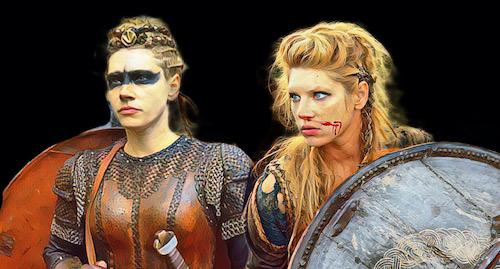

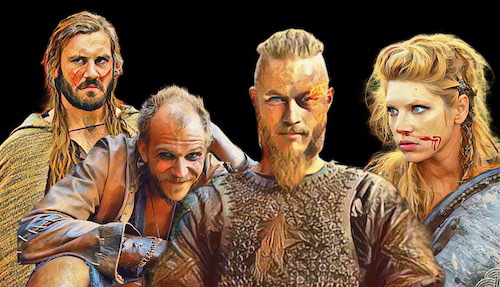
In fact, we learned years later, that Michael Hirst‘s proposal was to tell the story of King Alfred, the first of unified England, but as he dealt with the Vikings, he came across some iconic Norse figures whose history was not so well-known, but even more fascinating. Characters like Ragnar Lothbrok and his sons, or like Lagherta and Rollo, existed and are part of Norse folklore. In this way, Vikings took historical liberties but took on the format of a family drama, narrating the exploits of Ragnar Lothbrok and how he was one of the most popular kings of the Viking tribes.
A bet that was always meant to be a Saga
In Hirst’s – correct – vision, the saga of the Lohtbroks begins with Ragnar, the visionary and daring farmer who leaves Kattegat and gains fame by invading England, then France, and eventually becomes a Scandinavian king.
The role found in actor Travis Fimmell is the perfection to balance charisma, sensitivity, and wit for a role that is often dubious but quickly adored by Vikings fans. Even more fascinating than Ragnar’s rise is the sequence of the story with his sons, who also adventure through Scandinavia, Kyivan Rus, the Mediterranean, and even North America.

The revenge for Ragnar’s execution (sorry for the spoiler!) was extremely violent on English soil, led by his heirs, but then the civil war between his sons – with Bjorn Ironside and Ivar the Boneless on opposite sides – also put Nordic dominance in check. There are political machinations, religious conflicts, romances, betrayals, alliances, and battles, all with a strong historical basis. It’s simply fascinating from start to finish.
Michael Hirst used as a basis for the scripts the tales of the Norsemen of medieval Scandinavia, dating from the 13th century and which are based on oral tradition, as they were only written around 200 to 400 years after the events they describe and are therefore considered partially fictitious. He also found crucial information in the 12th-century Saxo Grammaticus Gesta Danorum. In this way, the true records of the Viking attack on Lindisfarne, for example, which are portrayed in the second episode of the first season, lend credibility to the series.
Travis’s transformation into Ragnar
Before starring in Vikings, Travis Fimmell was known as a Calvin Klein model and star of a quickly canceled updated version of Tarzan and The Beast, among other titles. As Ragnar, he conquered the world and proved his charisma to lead a large cast.
Because he was not a star, Travis was one of the last hired and, as legend has it, just a week before recording began. Michael Hirst liked the actor’s test, which made no effort to sound or look like a Viking, and recorded part of it in the kitchen of his family’s farm in outback Australia. With this, he beat better-known actors precisely for choosing a less aggressive and clichéd vision for the role.
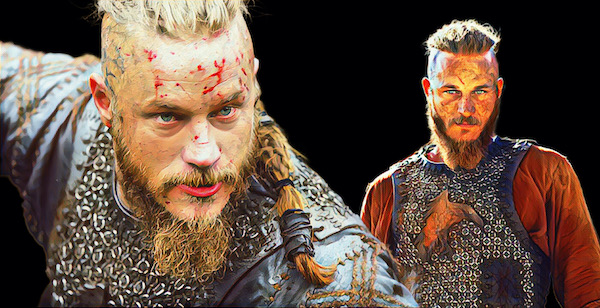
“When he came to Ireland and we cast him, a lot of people were apprehensive, but he’s perfect,” defended the showrunner.
Travis starred in the series for four seasons, leaving at an older age when Ragnar was captured and killed in England. For fans, the Vikings lost a lot with his departure, but it was always planned.
In addition to him, other highlights of the first seasons were Alexander Ludwig, Katheryn Winnick, Gabriel Byrne, Gustaf Skarsgard, and Linus Roache.
Family and religious conflicts
Two narrative pillars were notable in Vikings, the religious and the family, with Ragnar navigating between them. Respectful of pagan and Christian spiritual beliefs, the character is a skeptic with a logical and curious mind, which Travis Fimmell captured brilliantly.
The strategy of invasion and expansion was always based on Ragnar’s curiosity, whose cunning is the emotional engine of the entire saga. He knows how to use it to his advantage when he needs to appeal to faith and legends, as well as observe his opponents.
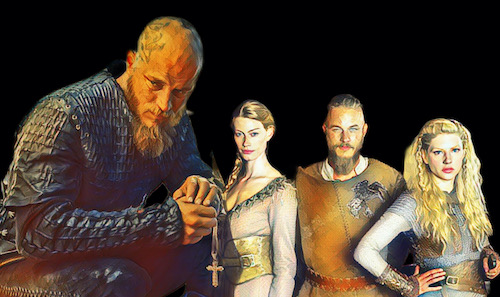
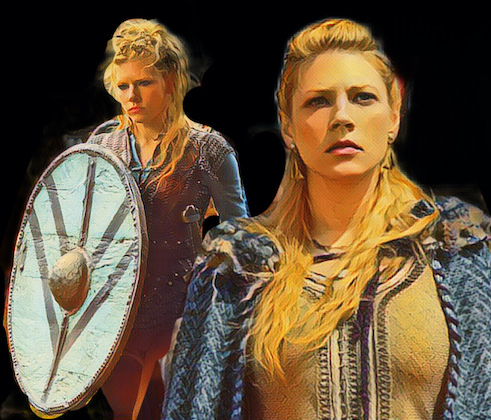
On the other hand, like every saga, the envy of his brother, Rollo, is a big problem for Ragnar throughout the series, even though the two love each other, they are often on opposite sides. His marriage to Lagherta, mother of his firstborn, Bjorn, also succumbs to religious beliefs and he ends up marrying a woman he does not love, but who gives him his children, whom he also knew he would have due to prophecies.
Of Ragnar’s six sons, only four reach old age, with Bjorn Ironside soon gaining heroic fame similar to his parents. Of the children with Aslaug, Ubbe, Hvitserk, and Ivan are also incredible, especially, of course, Ivan, who stole the series in the last two seasons.
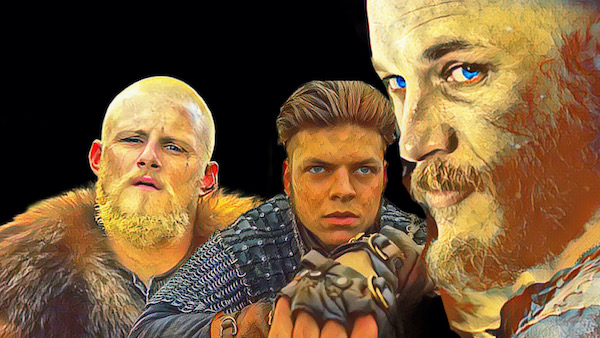
Ivan, known as the Boneless, is even more legendary than Ragnar, as he entered history as a sadist, intelligent, and violent, as well as unstable, narcissistic, and religious radical. Brilliantly played as an adult by newcomer Alex Høgh Andersen, he was born with a birth defect that rendered his legs useless and left him powerless. His military cunning is unbeatable and he is a popular antagonist, with layers that never let him be simple.
The origin of the nickname is not unanimous as the translation of “Ívarr beinlausi” could be either “Ivar without legs”, “boneless”, or impotent. Biographers suspect he suffered from the skeletal condition known as osteogenesis imperfecta, and Alex brings this constant physical pain to the drama in legendary fashion.


When Ivar and Bjorn dispute who will succeed Ragnar, the series takes the side of the civil war between the brothers, with incredible turns in the narrative until the true – and final – invasion of England led by Ivar.
The chance of lost popularity
One of the biggest problems with Vikings was precisely that it was shown at the same time as Game of Thrones, but on a platform with a smaller reach than HBO, so even with brilliant performances, the entire cast was virtually ignored in the awards at the time.
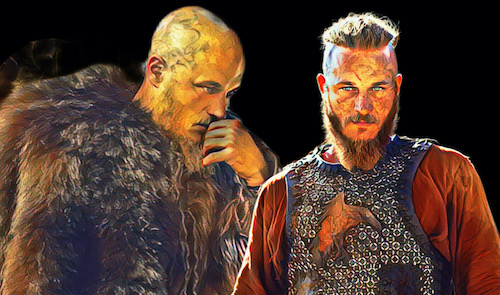
The late arrival on American Netflix will clearly contribute to the growth of the fan base, but it will be impossible to regain the prestige it deserved during the period it was in production, unfortunately. Both Travis and Alex, including Gustaf Skarsgard, deserved to be at least nominated for an Emmy (and even win).
The success on the platform outside the United States was so significant that with the end of the History Channel’s production, Netflix invested in the spin-off Vikings: Valhalla, which, although great, is not as good as the original. If Vikings‘ popularity grows in the US, a lot could still change for the current production. For us, all that remains is to marathon the six seasons, still available on the platform.
Descubra mais sobre
Assine para receber nossas notícias mais recentes por e-mail.
 miscelana.com