
Anthony Minghella introduced us to an opera-loving Tom Ripley (Matt Damon) in the 1999 film The Talented Ripley. But, in Steven Zaillain‘s adaptation of Patricia Highsmith‘s book for Netflix, the mysterious psychopath (Andrew Scott) is obsessed with Caravaggio, influenced by Dickie Greenleaf (Johnny Flynn), who praises and recommends studying the painter.
The Ripley series goes further and draws parallels between the two, something paradoxically interesting and offensive, even though the story of the genius painter is marked by very violent paints. It’s so ‘forced’ that in the conclusion, it places the two – Ripley and Caravaggio – living ‘similar’ dramas. Would it really be possible to compare a psychopath to a tormented artist?
Who was Caravaggio
Michelangelo Merisi, who became known as Caravaggio, the name of the small village where he was born in 1571, was an Italian painter considered the most revolutionary artist of the Baroque style, partly due to the expressiveness of his works, the unparalleled use of light and shadow and the violence of the images.
His works are in museums and churches, with images of ordinary people, very different from what one would expect at the time. Fatherless since he was 11, at just 13 he went to Milan and worked with big names like Simone Petrazano and Ticiano. His individual work gained prominence in 1592, when he went to Rome.
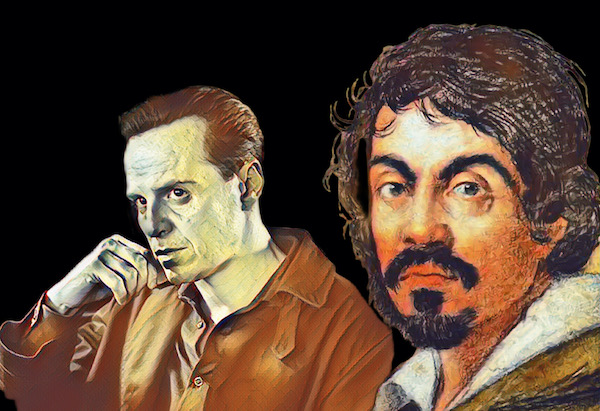
It wasn’t just painting that would quickly become associated with Caravaggio’s name: his violent and tempestuous character would put him in fights and bloody scandals throughout his life. After all, he was a notorious frequenter of Rome’s underworld, finding his role models among musicians, street vendors, gypsies, and prostitutes.
Caravaggio was involved in several fights, duels, lawsuits, and attacks during his life, a reckless man eternally in debt and often described as drunk. His outbursts of violence are iconic. He castrated and killed Ranuccio Tommasoni in a fight, which led to a death sentence for murder and so he had to flee to Naples, where he established himself as one of the greatest painters of his generation. He received a papal pardon in 1607.
Two years later, returning to Naples, he was involved in a new violent confrontation where his face was disfigured and rumors circulated of his death, which only really happened the following year, after a severe fever when he was on his way to Rome. He was 38 years old.
Although for many years the circumstances of his death were uncertain, with some suggesting that he was murdered or poisoned by lead, in 2018 tests were carried out on his DNA and they confirmed that he died of septicemia as a result of a sword cut that occurred a month earlier. Vatican documents, released in 2002, support the most popular version that the cut was made in an attack, at the request of the wealthy Tomassoni family, in revenge for the murder of Ranuccio. The painter’s body remained unknown for centuries until they were identified in 1956 at the cemetery in San Sebastiano.
Ripley’s obsession with the tormented painter
In Ripley, we see that Tom is not yet very educated and that he only becomes really interested in painting when he meets Dickie Greenleaf. Yes, he knew the monetary value of an authentic Picasso, however, he only hears about Caravaggio when Dickie tells his story, praises his Art, and suggests that he visit Churches and Museums to see the paintings up close, something that Tom Ripley quickly decides to do.
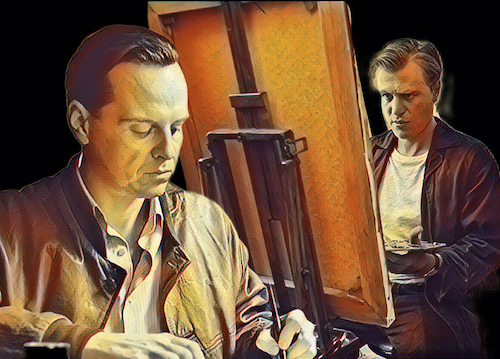
As is quickly explained in the series, one of the painter’s “signatures” was the violent realism of his paintings, with blood and severed heads in many images, but the masterful use of light and shadow also stands out, which explored a deep drama. Ripley’s black and white photography is the declared use of highlighting the use of light in beautiful images. Another feature used as a parallel in the script and image is the “tenebrism” style created by Caravaggio: in the main scene, characters were in the foreground and under a spotlight that made them stand out from a very dark background. Exactly what Ripley’s soul is like and how he acts, in the darkness, worshiping objects and luxury, taking for himself – with violence – what he wants materially.
Caravaggio’s story, with its violent outbursts, enchants the psychopath who indirectly follows his route through Italy. Rome, Naples, and Sicily are in the series for several reasons and one of them is because Ripley is obsessed with knowing and seeing the painter’s works. Throughout the story, until the final episode that opens with a reproduction of Tomassoni’s murder with an image of Caravaggio mixed with that of Tom Ripley, director Steven Zailain insists on the parallel, although the emotionally unbalanced painter can in no way be compared to psychopathic coldness of Patricia Highsmith’s character. I mean, in my opinion!
Frameworks that have an impact on Ripley
Even though Caravaggio is the biggest highlight in Ripley, other paintings help with the narrative. In New York, Tom Ripley observes Sir William Orpen‘s painting Augustus John as a reflection of his admiration for Dickie. The painting is in the window of an antiques store and catches the psychopath’s attention, signaling what is to come, with the symbols of wealth that enchant him so much. When he meets Dickie, Tom is enchanted by his class and mannerisms, secretly copying him.
Of course, we have the painting Guitarist, by Pablo Picasso, a cubist masterpiece that also interests Tom. It is within his reach, on the wall of a house so isolated and with open doors, an oversight that kind of surprises the psychopath. We immediately see that Ripley wants the painting which makes clear the financial opportunity this trip provides him. When his saga begins, Tom keeps the painting in Rome, but we don’t know what he will do with it. A secret for the last minute of the series. For some, Picasso’s cubism is a metaphor for how Tom deals with reality: with originality in pieces that do not seem to complete each other, but form the total work.

Only with Dickie and in Italy did Caravaggio enter the circuit, but definitively. The first painting by the painter that impacts Ripley is The Seven Works of Mercy, which Dickie takes him to see in Naples. When he hears the painter’s violent and tragic trajectory it is just confirmation of what he falls in love with: violence, darkness, and beauty. The painting’s theme is acts of human kindness, but Caravaggio inserted expressions of panic and tension, highlighting the moral battle of all men, even more so, of Tom Ripley.
Another painting that impacts the psychopath is The Martyrdom of Saint Matthew, which he sees in the Contarelli Chapel, in San Luigi die Francesci. There are two others, but he is enchanted by the image that shows Christ summoning the disciple, portraying the focus of a long journey of sacrifices. Experts debate which of the images Caravaggio considered to be Saint Matthew: the bearded man who is pointing at himself or the boy with his head bowed at the end of the table? An ambiguity that Ripley understands better than others.
Of course, one of the painter’s most famous paintings could not be left out and we see David with the head of Goliath, one of the last painted by Caravaggio which reflects on death and destiny. Interestingly, the artist preferred to place his self-portrait on the Giant’s severed head, with fear and aggression mixed in his gaze. There is in David, who could be Ripley thinking about Dickie, a look of sadness and disgust as if he feels sorry for Goliath. Really? As scholars claim that David is a younger version of Caravaggio, we can see that he recognizes that his past actions condemned him to death and that he is sad about it.
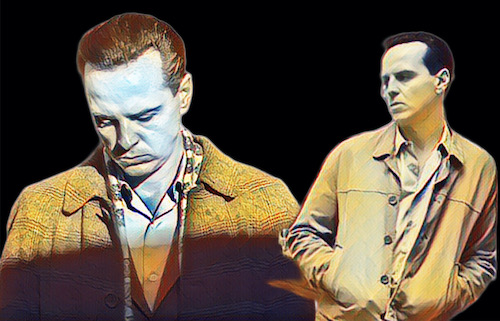
The painting seen on a trip to Palermo, Sicily, the Nativity with Saint Francis and Saint Lawrence, is a hint in the series that Ripley is ready for yet another reinvention, now as Richard Fanshaw. The biblical scene that shows the birth of Jesus is the theme of the painting and here is another curiosity. What is public is a replica. The original was stolen in 1969 and was never recovered. Who stole? The biggest bet is the Mafia. Another well-known painting, The Crucifixion of Saint Peter, shows the parallel between Tom and Caravaggio, reinforcing Zaillian’s view that Ripley’s crimes are like works of art. I’ve already given my opinion on this, and the image shows Saint Peter being killed by the Romans, insisting that he was not worthy to die like Jesus and that’s why his cross is upside down. A complex image given everything Ripley has done and is still doing.
Finally, Madonna and Child with Saint Anne is the image of the triumph of good over evil, which is exactly the opposite in Ripley. The psychopath is represented by the snake in the painting, but since he runs away with money and Picasso, how can he plot a happy ending? I don’t agree with subjectivity here, it’s a very tragic ending.
A future of strong paints
If there is a second season, in London, I believe Ripley’s taste will evolve. However, then yes, the victory is ours, to become more cultured, even if tortuous. The picture painted in the first season is faithful to the original work, it is sublimely photographed and interpreted and yes, it leaves us wanting to know more. Let’s follow?

Descubra mais sobre
Assine para receber nossas notícias mais recentes por e-mail.
 miscelana.com