
When we complain about the artistic freedoms of an adaptation of a book into a film, it is precisely because it creates confusion years later. For example, a good example is the problems “created” by Anthony Minghella when he directed his excellent The Talented Ripley, in 1999. To create greater audience empathy with a minimally dubious protagonist (more on this later), he invented characters, reversed some situations, and left an open ending completely different from what author Patricia Highsmith imagined in 1955. And because of this too, the Netflix series Ripley has generated lists of comparisons between film and series, even more than the book. Well, if you think Saltburn is more similar, you’re not alone.

Tom Ripley from the book
In 1955, writer Patricia Highsmith created Tom Ripley, the protagonist of the title The Talented Mr. Ripley, in an attempt to force the reader to empathize with a completely amoral person.
Tom – in the book – is a likable con man, also a serial killer, who is always on to some scheme or crime, but also living a life of luxury. Sophisticated, he is always studying languages, painting, or taking care of the garden, supporting himself with everything he steals from his victims. At some point in the five books that tell his adventures, he admits that, sometimes, he “regrets” his first murders (Dickie Greenleaf and Freddie Miles) because he considers them a mistake of youth, he doesn’t even know the right number of people who come to kill. Doesn’t really care.
In the books, Ripley’s sexuality is not explicit, but readers believe that Highsmith has given hints that he is gay or bisexual, although she has denied it in interviews. What no one doubts is that Tom Ripley is, in fact, a monster.
Tom Ripley at the movies
In just five years after the first book, cinema discovered Tom Ripley, with the face of Alain Delon in the film Purple Noon, an adaptation by director René Clément. In 1977, Win Wenders also explored the character in the film An American Friend, with Dennis Hopper, but it was in 1999, with Anthony Minghella‘s film, that he reached a wider audience.

Played by Matt Damon – closer in age to the character in the book – Tom Ripley gained a more vulnerable interpretation in some aspects, more “empathetic” which confused those less familiar with the book. It’s a great performance and for 25 years it has remained the most memorable of all. In 2002, John Malkovich (yes, who is in Ripley), played the sociopath in the film Ripley’s Game. But now it is Andrew Scott‘s face that promises to be the definitive Tom Ripley, in the Netflix series written and directed by Steven Zaillian.
The main differences between Minghella and Zaillian
In 1999, purists didn’t like the liberties Anthony Minghella took in The Talented Ripley, but I kind of agree with them. By having a young cast, empathy was almost guaranteed, but it “distorts” what is very faithful in Steven Zaillian‘s version: the coldness and the fact that Ripley was always a calculating criminal, as wonderfully played by Andrew Scott, was not being “led” to commit crimes, as was the case in the version with Matt Damon.
In Minghella’s version, some characters do not exist in the book (such as Meredith Logue (Cate Blanchett) or Peter (Jack Davenport)). The ending, therefore, is completely original. Therefore, the Ripley series is the “true” one, there is no point in doubting what you thought you knew over the last 25 years.
To facilitate the narrative, Minghella also changed Tom Ripley’s criminal origin, placing him as an opportunist and yes, a “victim” of circumstances created by himself, but, somehow, we root for the killer. The same cannot be said about the version with Andrew Scott, who is evil, a scammer, and dark from the first scene.
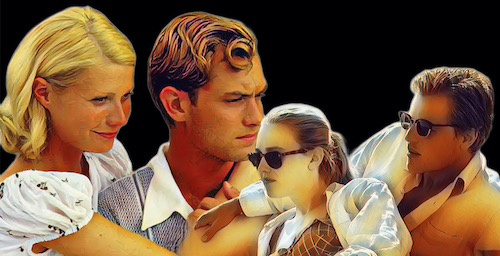
The biggest difference, even more than Andrew Scott when compared to Matt Damon, is in the couple Marge and Dickie, who were notable for a Gwyneth Paltrow at her peak, an inspired Judd Law (he was nominated for an Oscar) and who don’t have the same energy with Dakota Fanning and Johnny Flynn. The even more complex comparison is that of Freddie Miles, whose brilliant Philip Seymour Hoffman was unforgettable.
And there’s nothing wrong with either of them, but somehow it was easier to understand the charm of Judd Law‘s infectious, unforgettable Dickie than Johnny Flynn‘s mysterious, observant one. Just as the sweetness of Gwyneth Paltrow‘s Marge prevented her from distrusting an obvious scammer like Tom Ripley, like Dakota Fanning‘s version, who was never wrong with Andrew Scott.
A colorless, timeless, and perfect series
The film The Talented Ripley is long, but it needs to speed up to reach the conclusion, and the suspense loses a little as a result. In the Netflix series, photographed in black and white with stunning beauty ( I miss the colors that Italy would bring to the story), there are eight long episodes to calmly develop Ripley’s sociopathy. And with that, Andrew Scott is undeniably spectacular.
Ultra faithful to the first book, The Talented Ripley, the Ripley series follows a protagonist exactly as Patricia Highsmith describes, that is, age aside. Andrew conveys with frightening perfection the murderous energy of Tom Ripley, a man who lies and kills in cold blood.

The slow pace contributes to the feeling of claustrophobia and that anguish that mixes the curiosity of how he will get rid of the police with so many lies provoking others. It’s incredible how Ripley never misses any of the stories he comes up with. Our forced intimacy with the sick mind of a psychopath is one of the series’ greatest strengths, but it only works thanks to Andrew Scott, with long silences where we can follow his thoughts through expressive looks, controlled gestures, and lots and lots of charisma.
Andrew Scott‘s Tom never relaxes and never stops having a plan B up his sleeve. His powers of observation help him to always be one step ahead (and climb stairs! How many does he climb each episode?), but at the same time, he has to deal with the setbacks of cleaning up (more than once) a crime scene. , which can be hard work and frustrating. Luccio the kitten (whose bloody footprints are the only color in the entire series) is the witness who survives.
Malkovich’s participation hints at season 2
One of Ripley‘s big surprises is the quick appearance of John Malkovich as Reeves Minot, a character who helps the protagonist and who appears again in other books, one of which is Ripley’s Game, to create even more irony.

And why do we think that? Because after pretending to be Dickie for half the story, Tom returns to using his original identity and is discovered by Ravini (Maurizio Lombardi), but with the help of Minot, he changes his name, city and country. The official line is that Dickie killed himself. Marge almost becomes another victim of Tom and comes close to the truth when she finds her dead boyfriend’s ring, but without knowing exactly what happened to him, she doesn’t reveal anything to anyone. In other words… the path is clear for Tom, now Timothy Fenshaw, to finish the series by going to England.
I hope there’s more!
Descubra mais sobre
Assine para receber nossas notícias mais recentes por e-mail.
 miscelana.com