
Every historical series nowadays, or rather, every biographical series or film nowadays generates a series of “truth or lie” posts, necessary in the face of “artistic freedoms” that confuse people unfamiliar with the themes. Franklin is no different.
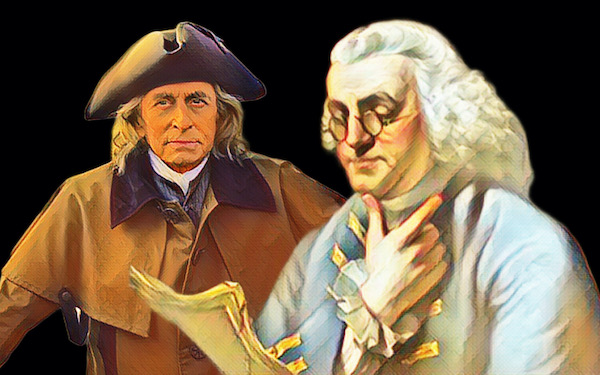
The excellent Apple TV Plus series condenses the years that Benjamin Franklin (Michael Douglas) lived as ambassador in Paris so that it seems like mere months have passed. If so! With so many fantastic twists and turns it is almost impossible to question whether everything happened as they are showing. Let’s try to answer some questions!
Franklin’s popularity in Paris
Although Franklin was not the first to lobby for France’s support in the American War of Independence, he spent no less than eight and a half years in Paris and was the one who secured the European country’s financial and military support. Popular and cunning, he circulated among the nobles and popular, always treated as a celebrity.
Rivalry with Adams, friendship with Vergennes
Yes, Benjamin Franklin and John Adams clashed publicly and the second American President was not a popular figure, but they understood each other. As for the French Minister of Foreign Affairs, Charles Gravier, the Count of Vergennes (Thibault de Montalembert) actually refused to negotiate or speak with Adams, but he remained one of Franklin’s great friends for the rest of their lives.
Were there really attempts on Franklin’s life?
Although there is no proven fact that they tried to kill Benjamin Franklin, he knew he was surrounded by spies and enemies and historians agree with the author of the book that generated the series, Stacy Schiff: A Grand Improvisation: Franklin, France and the Birth of America, which shows at least one serious attack that could have killed the American inventor and diplomat.
Was there Wentworth and was there betrayal near Franklin?
Yes and yes.
Just as we see with Franklin, one of his closest confidants, the American doctor Edward Bancroft, passed information to the British under the code name Edward Edwards. He conspired with spy Paul Wentworth, with whom he had been friends since their time in Suriname. Although some biographers suspect that Benjamin Franklin knew about Bancroft, the truth is that he didn’t even suspect his involvement, in fact, no one did. It was only revealed posthumously, late in the 1880s, when letters from him became public.

The women in Franklin’s life
Part of Benjamin Franklin’s diplomacy came from his skill and friendship with the women of the Court, especially two of them, Madame Anne Louise Brillon de Jouy (Ludivine Sagnier) and Anne-Catherine de Ligniville, Madame Helvétius (Jeanne Balibar). He tried to transform his connection with Anne Louise into something more, without success, but, with the widow Madame Helétius, he went further. The letters exchanged between the two women, even after their return to the United States, prove the relationship.
Temple: the grandson who had a European soul
William Temple (Noah Jupe) was the illegitimate son of Franklin’s illegitimate son and because he arrived in France as a teenager he was impacted by French culture beyond repair, some argue. His grandfather even tried to arrange a marriage between him and the daughter of Madame Anne Louise Brillon de Jouy, but it went no further. Anne Louise ended any potential involvement between Temple and her daughter, cooling her friendship with Franklin for a time.
The fact is that returning to the United States, Temple never felt “at home”, always wanting to return to France, which he did at the end of his life, but he died without a fortune or a name in history.
Descubra mais sobre
Assine para receber nossas notícias mais recentes por e-mail.
 miscelana.com