
As I grew up in the 1970s, Françoise Hardy‘s voice, for me, is that of La Question, the title song of the album of the same name that she released in 1971, in collaboration with the Brazilian Tuca. By this time, she had already been a global star for over 10 years, a fashion and pop icon. The song was on the soundtrack of the soap opera Selva de Pedra and had everything to do with the culture in Brazil, a kind of bossa nova, romantic and simple.
Françoise was proud of her work – “It’s my best album”, she said when asked about it – but for many years La Question was considered a “failure” in her career, a strange work, rejected by French radio stations and fans, and, even for that reason, almost no of the compilations in her collection included none of his songs (I know this because when I lived in France I struggled to find La Question). After 53 years, close to the singer’s death, in June 2024, the world began to agree with her. Today, her work as a singer and songwriter is more revered and respected.

A bossa-nova touch for the anxieties of a complicated love
La Question is an almost acoustic album, heavily influenced by Tuca‘s guitar, which combined perfectly with Françoise’s soft tone. At this point, with an established career and a big star, the shy Françoise was experiencing what she considered the greatest love of her life, an unstable and complex relationship with guitarist Jacques Dutronc.
Although they met in 1965, when he wrote Le Temps de L’Amour for her, Françoise lived with photographer Jean-Marie Périer. It was only in 1967 that she and Jacques began dating. They would have a son, Thomas, in 1973 and marry in 1981, separating permanently in 1988 and remaining close friends until the end of her days. As she admitted, her love songs were almost all written for him and yes, that was the case with La Question.

In the early years of what would come to be known as a turbulent and unstable relationship with Dutronc, Françoise Hardy traveled to Brazil to serve as a judge at the International Song Festival in Rio de Janeiro. As she already liked MPB (Brazilian Popular Music) – she had recorded a version of Sabiá (La Mésange), by Chico Buarque, and A Transa (Rêve) – she decided to record something that had the Brazilian accent, but without being obvious.” bossa nova”.
The qualities of La Question
At the turn of the 70s, her love life was messy, as was her professional life. With the cultural change, Françoise’s light songs from the 1960s were becoming outdated, it was time to reinvent herself. Upon returning from Rio to Paris, Françoise met Tuca, whose name was Valeniza Zagni da Silva, through mutual friends. The guitarist and composer had left the country due to the Military Dictatorship and she and the French singer hit it off immediately, “love at first sight, personally and artistically speaking”, as she would later confess.
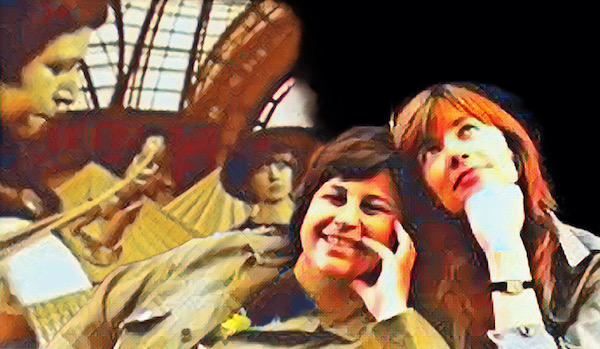
There was no romance between them, Tuca was also experiencing unrequited love (with the Italian actress Lea Massari), therefore she was aligned with Françoise in pain. Unfortunately, their collaboration only ended on this album. Tuca returned to Brazil in 1974, and died in May 1978, of a cardiac arrest, at the age of 34.
Critics identified La Question‘s unique quality immediately. All were composed and rehearsed before entering the studio, it was an easy and smooth production. In the lyrics, what always prevails is the uncertainty and absence of the loved one. As she sings in the title track “I don’t know why I stay in a sea that makes me drown/I don’t know why I stay in air that will choke me/You are the blood of my wound, you are the fire of my burns/You are my unanswered question, my silent crying and my silence.”
Well, for many years fans wanted the “answer to the song”, even though the lyrics state that there is none. And who was it written for? they asked. “Ah… for Jacques”, Françoise confirmed years later in an interview. “Always for Jacques.”
Descubra mais sobre
Assine para receber nossas notícias mais recentes por e-mail.
 miscelana.com