
When they announced that they were going to make House of the Dragon and that it would focus on the civil war between the Targaryens, we all celebrated because it is one of the best moments in the book Fire and Blood. At the time, due to her family protection and a certain aura of mystery, everyone compared Alicent Hightower and Cersei Lannister.
However, when they announced that Olivia Cooke would be the actress who would play the Greens in the older version, and the younger one would be Emily Carey, we were a little surprised. After all, Lena Headey, who gave us a spectacular antagonist for 10 years, was in her 40s at the time (she is 51 today) and Olivia will turn 31 at the end of 2024, so there would be differences in maturity. Still, there was no doubt that Alicent would be the antagonist.
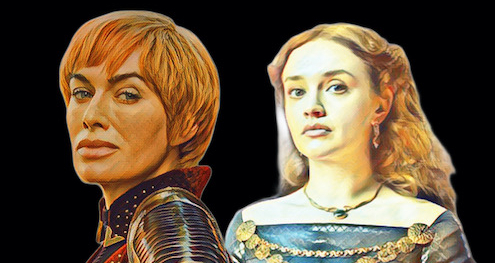
As a fan of Lena, and appreciating her work as Cersei, Olivia initially celebrated the comparisons but soon began to highlight the differences. “I think they are really different and I limited the amount of wine I drank in scenes because I didn’t want the comparison to be too transparent. What Lena Headey did with Cersei was so brilliant,” she said in an interview with Variety in 2022. That means it was still in Season 1!
The actress went further, “Alicent suffers a lot more from anxiety and doubt, and I don’t think Cersei has that. She completely believes in every blow she throws. I don’t think Alicent has that. She’s been so defeated by the patriarchal system she’s in, by her children, by endlessly trying to fix things and walking such a narrow, straight line,” she explained.
Indeed, Alicent Hightower would like to be a Cersei Lannister, but no one is like Cersei! Cersei, we can argue, managed to defeat Daenerys Targaryen (Emilia Clarke) by taking her to the extreme, killing her best friend and advisor, killing one of her dragons, and never submitting or giving the pleasure of showing a reaction to the Targaryen queen’s power. Not to mention that Cersei literally blew up ALL of her enemies on a single occasion, without ever being accused of any involvement. After defending two sons – one crazy and the other weak – Cersei simply took the Crown for herself and sent the patriarchy to that place. And she summed up the best strategy of all: “When you play the game of Thrones, you either win or you die.” In my book, she won before she died.
But let’s compare the Queens who became consorts and changed the trajectory of History in Westeros.
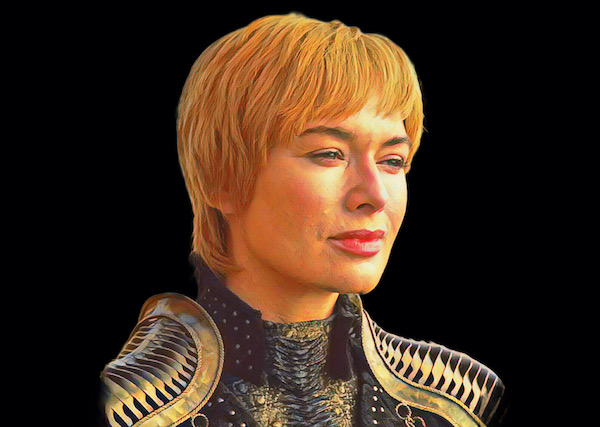
In Game of Thrones, Cersei always wanted to be The Queen
As one of the main characters in A Song of Ice and Fire. Born into the powerful and wealthy House Lannister, she becomes queen by marrying King Robert Baratheon, but she always dreamed of being the chosen one of Prince Rhaegar Targaryen, who married Ellaria Martell instead (and later left his wife by Lyanna Stark).
Cersei is known for her excessive ambition and desire for power, often using cruel and manipulative methods to achieve her goals. On the other hand, she – like Alicent before her – was seen and used as a political pawn by her father, Tywin Lannister (Charles Dance). The difference between the two starts with her role awareness and what she could do to help her house. Cersei NEVER embraced house Baratheon as her own. Robert was King, but she always saw her union with him as an upgrade to House Baratheon.
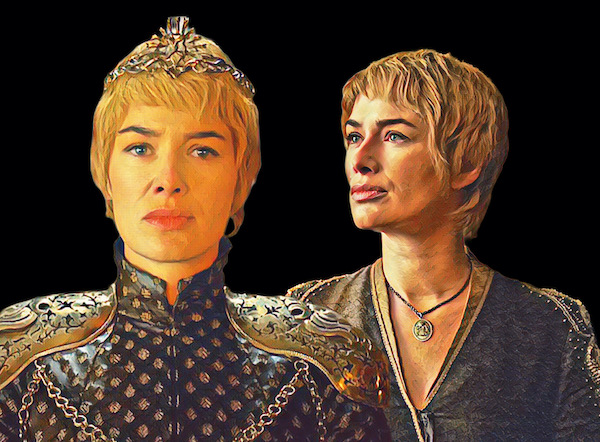
Although the marriage was a political arrangement, Cersei says she harbored a passion for her husband early in their marriage. But, as she reported to both Catelyn Stark (Michelle Fairley) and Ned Stark (Sean Bean), Robert always despised and humiliated her, preferring other women and declaring his love for the late Lyanna, never being affectionate with her. An extra resentment in a relationship that also included physical abuse.
After the death of their firstborn, the other children were born from his incestuous relationship with his twin brother, Jamie (Nicolaj Coster-Waldau), a secret that cost Ned Stark his head in the 1st season of GOT.
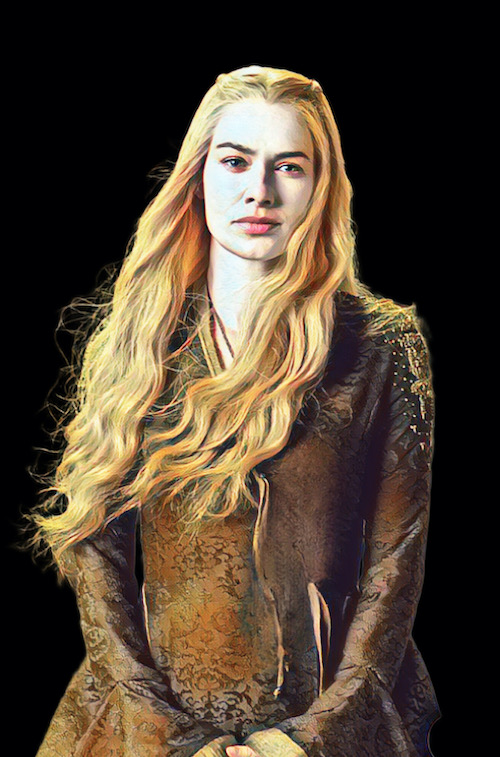
Throughout the story, Cersei is deeply motivated by love for her children and protection of her power and status, a lethal combination of vulnerability and cruelty. Her paranoia and distrust often lead her to make impulsive and destructive decisions, some with personal consequences (such as when she was forced to pay penance by parading naked through King’s Landing), others definitive for her enemies (when she exploded the sept).
With each death, first of her husband, then her son, her father, and her other son, Cersei assumed more and more power, with an arc marked by the constant struggle for control and survival in a world dominated by men, where she believes she needs to be more cruel and merciless than anyone to maintain their position. Would it be wrong? I do not think so.
Alicent: victim of the game and limited strategist
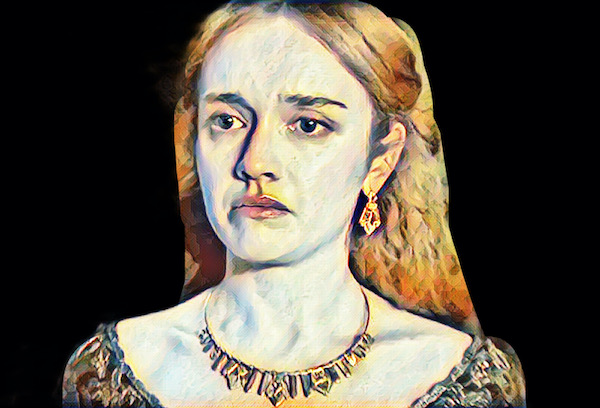
The Alicent Hightower that we saw in House of the Dragon is very different from the queen in the book, in everything, including age, but also in her personality.
From a young age, we see that Alicent suffers in silence. She no longer has a living mother, because she is shamelessly used by her father, Otto Hightower (Rhys Iphans). She was planted in the Targaryens’ inner circle even before the opportunity to marry Viserys I (Paddy Considine) was created. However, she always felt inadequate and suffered because of it.

Often depicted as more traditional and conservative compared to other female characters in the series, Alicent is motivated by a desire to protect her children’s interests and ensure her family’s continued power. However, if in literature she is seen as a figure who navigates the complex politics of the court with a mixture of diplomacy and cunning, in House of the Dragon it is very different.
The series shows that her career is marked by rivalry with Rhaenyra Targaryen (Emma D’ Arcy), one day her best friend and the next her stepdaughter. Envious, with resentment and a serious dose of lack of intellectual or emotional preparation, Alicent hindered Otto’s plans by taking a long time to embrace them, only changing her position when her father was removed from his role as Hand. She spent 10 years making Rhaenyra’s life hell, always trying to expose that the princess’s children were bastards, without succeeding.
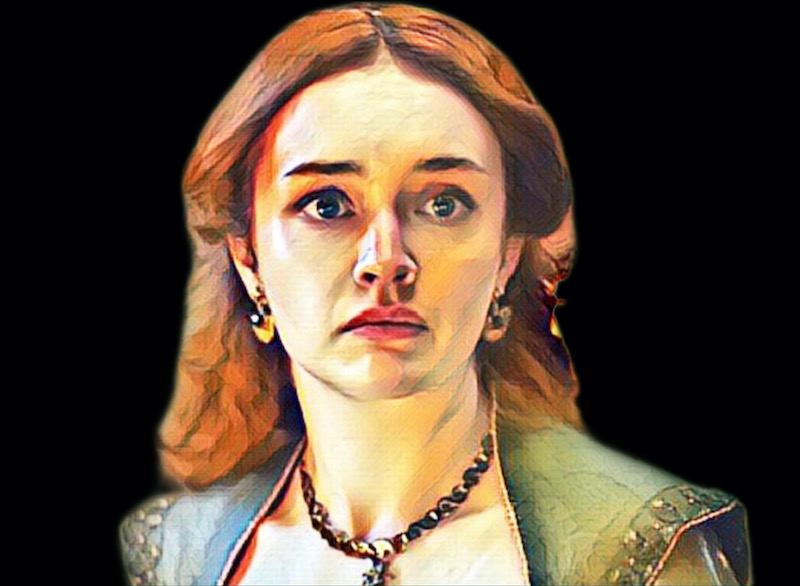
When she embraces the Hightower cause and defends her children, Alicent does more to harm Rhaenyra than believe in her children’s rights, so much so that she never prepared Aegon (Tom Glynn-Carney) for his position. Cersei genuinely liked her children, on her best days Alicent is indifferent to hers. This intellectual limitation in the political game accelerated the tragedy we are witnessing.
Where the two follow opposite paths
Among the various differences mentioned between Cersei and Alicent, already mentioned here, others influenced the bloody conflicts that marked their reigns.
The first difference is that when seeking Power for her family, Alicent never considered taking the Crown and leading the Hightowers, while Cersei always wanted and managed to be the protagonist. Of course, her autonomy was greater after Tywin’s death, but until he was murdered she was also facing him.
As a consequence of this attitude, while Cersei often uses more direct and brutal methods to achieve her goal, Alicent tends to try to be more subtle and diplomatic, although equally ruthless when necessary.

The two queens operate in extremely complex, unstable, and dangerous political contexts. Alicent is at the center of a devastating civil war, where members of the same House begin to persecute each other. Cersei, on the other hand, sailed to maintain Power with her children in the War of the Five Kings, fought with the wave of religious fanaticism during Tommen’s reign and when she assumed the Throne, she found herself threatened by Daenerys Targaryen and Sansa Stark (Sophie Turner), who was alongside Jon Snow (Kit Harington) when the North proclaimed itself independent again. The War of the Queens period culminated in the deaths of Daenerys and Cersei, devastating Westeros and seeing a new monarchy being established with Bran Stark (Isaac Hempstead Wright).
With everything we know today, we would never compare Alicent Hightower and Cersei Lannister again because what we see most is that Cersei is superior to Alicent. If I had to, I would say that Alicent today is more similar to Sansa Stark than other queens, but that’s a topic for another post! What do you think? Who would win the Game of Thrones: Cersei or Alicent?
Descubra mais sobre
Assine para receber nossas notícias mais recentes por e-mail.
 miscelana.com