
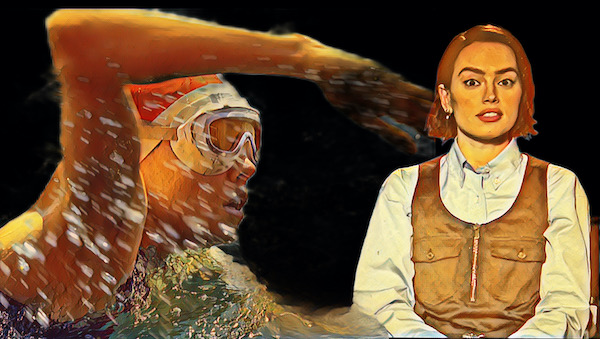
The film Young Woman and the Sea quickly passed through cinemas to reach what seems to be its best format: digital platforms. The biopic of swimmer Gertrude ‘Trudy’ Ederle, starring Daisy Ridley, retells the incredible story of a determined, daring woman who managed to break records, expectations, and limitations imposed on women in the 1920s, in a saga and daring crossing of the English Channel.

With EVERYTHING that Trudy achieved – and it wasn’t little – the potential for a great story of overcoming seemed to be guaranteed, but what is on screen is very small in comparison, even with good performances from the cast. The problem lies in the script, which is so formulaic that it seems lazy, an uninspired direction by Joachim Rønning that uses great music in such a cheesy way that, instead of moving us, it distracts us and almost becomes a spoiler, forcing us to know the moments of overcoming as if not even he found it exciting enough.
The arrival of Young Woman and the Sea is calculated to be alongside the Paris Summer Olympics in 2024, with a beautiful story about an Olympic swimmer whose record was unbeaten by men or women for 35 years. The project is part of Disney’s initiative to bring stories of inspiring women to the public and is an adaptation of the book released in 2009 by Glenn Stout, Young Woman, and the Sea: How Trudy Ederle Conquered the English Channel and Inspired the World. Even the title is boring.

And that’s unfortunate because we have a fit Daisy Ridley, struggling to give vivacity to a cold, almost boring script. The film portrays the difficult childhood of Trudy, the daughter of German emigrants, whose fragile health brought her to the brink of death due to measles, which she overcame due to her impressive vital force. Because of her, the swimmer developed hearing problems and soon became determined to learn to swim like her sister Meg and the athletes who train at Coney Island. However, with the fear that she could still be contagious, she cannot enter the pool and it is her father who ties a rope around her and takes her to the Atlantic Ocean to teach her alone before she finally gains her place and can swim.
The Ederles’ loving strength is the fundamental piece so that Trudy can, almost immediately, be extremely competitive and daring. Sucarina is not spared even so that the suffering life of the slum is less glamorous than what we see on screen. Unsurprisingly, we see her overcoming each challenge: managing to be coached by Charlotte Epstein, who founded the Women’s Swimming Association, amateur swimming competitions, and her great victory, 100 years ago, at the 1924 Paris Olympics, where she won a medal for gold in the relay and two bronze medals.
Trudy actually swam more than 25 kilometers from Lower Manhattan to Sandy Hook, New Jersey, and in doing so decided to be the first woman to cross the English Channel, first fighting to secure funding for her mission and then the challenge itself, which turned out to be even more complex. The first attempt, in 1925, failed because it was sabotaged by his own coach, Jabez Wolffe. The second attempt was not immediate like in the film, but the superficial script is in a hurry. In fact, she did so a year later, in 1926, when she began to be tutored by Bill Burgess, the second man to swim the English Channel and Wolffe’s rival, and he taught her to swim with the tides, not against them, which added twice as much distance to the intersection.

Fundamental for Trudy was the presence of her sister, Meg, who was more than her encourager, she was creative. She patched up the holes in her goggles with candle wax, and even more, she invented the two-piece bikini to reduce drag in the water and alleviate Trudy’s irritated skin.
Tides, temperature, jellyfish, and other obstacles such as sea mines inherited from the First World War, a few years earlier, are not explored. Likewise, Trudy’s determination is not three-dimensional. She completed it successfully in 14 hours and 31 minutes, beating the men’s record by 2 hours, but we knew it would just be a matter of the first stroke.
Everything is so obvious that only women will understand how the men behind the production seem to be precisely all the offended male figures on screen: they minimize an astronomical victory by turning it into a fairy tale. The real Trudy deserved so much more.
Yes, you will think soon, and, Nyad was more realistic in everything to tell the feminist endurance swimming drama. The two films only have 12 months between them, but while the Netflix one explores the suspense and drama of how difficult it is to sail the ocean for hours on end, the Disney one wastes Daisy Ridley‘s performance in one family-tv-film type of movie. I only recommend it because having inspiring women is never too much. But like she said, she deserved better.
Descubra mais sobre
Assine para receber nossas notícias mais recentes por e-mail.
 miscelana.com