
How can we contextualize Daenerys Targaryen in the House of the Dragon and Game of Thrones sagas? In the books, she is different from the series and, without a conclusion, it is difficult to have a “correct” answer, so what serves as the basis for defending or attacking the character is in feelings: how one feels about the Daenerys that we project from the book or that we saw and analyzed in the series.
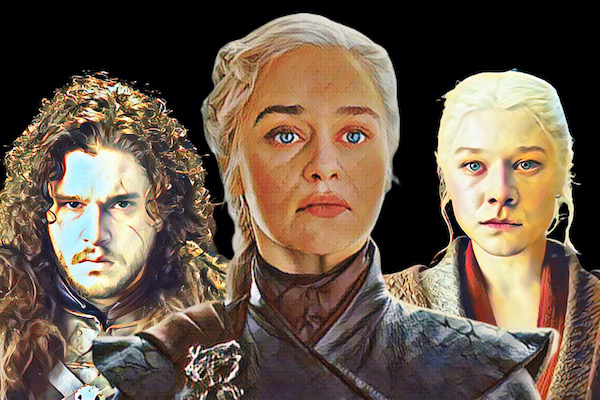
Daenerys is a central character in the Game of Thrones series and in the books A Song of Ice and Fire, by George R.R. Martin, but not the sole protagonist, as her passionate fans claim. To understand her role in the saga, it is necessary to understand both her development throughout Game of Thrones as well as the references to her in the historical background provided in House of the Dragon.
All this becomes more important in light of what will come after the second season of the series, whose leaks six days before the broadcast bring new information: according to the vision of Daemon (Matt Smith), who sees the White Walkers and Daenerys (Emilia Clarke) as part of the Prophecy (no sign of Jon Snow (Kit Harington)!), she is now officially the Princess Who Was Promised, and not Jon or her alongside her nephew. Would this then be confirmation that the entire Saga is only about her?
A princess outside the succession who became a messianic leader
As the youngest daughter of King Aerys II Targaryen, also known as the Mad King, who was deposed during Robert’s Rebellion, we meet Danny when she is still very young and exiled in Essos, a land far from the continent of Westeros, where her family ruled. Throughout the series, Daenerys goes through a significant transformation. Initially a vulnerable young woman under the thumb of her brother Viserys (Harry Loyd), she quickly grows in strength and determination. She becomes the Mother of Dragons after hatching three dragon eggs, a feat that sets her on a path of conquest and leadership. Driven by a strong sense of justice and a want to free the oppressed, with whom she identifies, she feels compelled to conquer several cities in Essos, not only to gain funds and men to support her cause of regaining the Iron Throne but also to abolish slavery.

This diverts her original goal of restoring House Targaryen to power for a long time. Although tempted to use the strength and power of dragons, Daenerys only uses the Force to respond to “injustice with Justice”, but those who are closest to her and do not feel indebted to her (like Missandei (Nathalie Emmanuel) or Grey Worm (Jacob Anderson)) or are in love with her, like Ser Jorah Mormont (Iain Glen), realize that there are signs of narcissism or even messianic delusions, something that we can equally project onto the audience. As Tyrion (Peter Dinklage), who is equally in love with her, says, “wherever she went, she killed bad men and was applauded for it”, but some innocent people were collateral in her “justice”, without ever acknowledging it.
A controversial and historic turn
To Daenerys’ great surprise, when she arrives in Westeros, she is rejected by everyone: commoners and nobles alike. Those who support her do so not out of ideology, but out of revenge against the Lannisters, and everyone seems immune to her charm, her history, her leadership, or even her claim: no one wants a Targaryen back in power. Not even the dragons, which cause fear, are enough to impress.
To make matters worse, Danny’s bruised ego is gradually losing her fans, I mean, advisors, and she becomes physically and emotionally isolated. Her intense passion for Jon Snow, whose family and vassals despise her for being a foreigner, is the last straw in an extreme situation, as he reveals himself to be not only her nephew, who as a Targaryen is even more passionate about her, but Jon is effectively the legitimate heir to the Throne, before her because he is a man and the son of the heir before her, her older brother, Rhaegar.
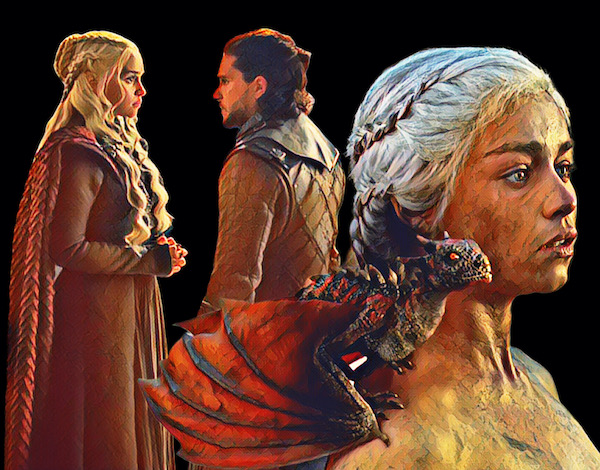
The sum of all this destroys Daenerys’ mental health, in an atypical and violent outburst, after violently defeating her enemies, decides to destroy the capital King’s Landing, killing innocents at random while focusing on killing the defeated Cersei Lannister (Lena Headey). After the massacre, Danny shows himself to be even more ambitious and remorseless. From there, he goes to the North, where Sansa Stark (Sophie Turner) is, to tame his sworn enemy, who happens to be Jon’s cousin, raised as his sister. Forced to choose, Jon kills Daenerys, is exiled, his first cousin Bran (Isaac Hempstead-Wright) is elected King, Sansa becomes Queen of the North and everyone except anyone with Targaryen blood lives happily ever after.
This confusing and controversial ending has been rejected and commented on since 2019 and directly affected the adaptation of House of the Dragon.
The Future reDefining the Past: The Daenerys Effect
Of all the wrong or questionable decisions in Game of Thrones, Daenerys Targaryen’s death is the one that divides its supporters the most. In truth, no one wanted her dead, even if they didn’t want her on the throne. That’s why when House of the Dragon aired, it was impossible to avoid the comparisons: of her clothes, her leadership, everything. The opening credits warn that the story takes place almost 200 years BEFORE Daenerys Targaryen, making her, alongside Aegon the Conqueror, the most iconic Targaryen in the saga.
House of the Dragon specifically explores the Dance of the Dragons, a civil war within House Targaryen that involves Danny’s direct ancestors. This series provides a historical context that is crucial to understanding the ancestry and traditions of House Targaryen, including their connection to dragons and their history of governance.
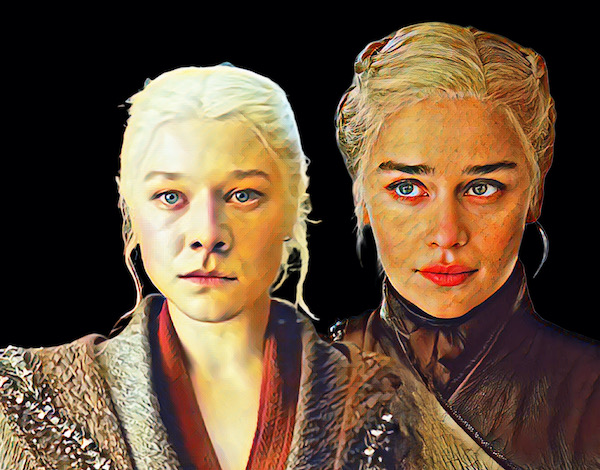
While Daenerys does not feature in House of the Dragon, the series offers insight into the Targaryen dynasty, its complex family dynamics, and the power struggles that shaped its legacy. This helps to contextualize Daenerys’s obsession with dragons and her vision of restoring her family’s glory; after all, her journey in Game of Thrones reflects both the high ideals and the tragedies of her family’s history. Like her ancestors, Daenerys struggles with dilemmas of power, loyalty, and justice, and her ultimate fate is influenced as much by her own choices as by the historical legacy of her house.
The Problem with Prophecies and Their Interpretations
In A Song of Ice and Fire, we hear about the prophecy of “The Prince That Was Promised” or “Azor Ahai,” which is mentioned several times throughout the books and has several interpretations, but is part of the return of a legendary hero who will save the world from darkness. In Game of Thrones, she also plays a relevant role, as it was thanks to her that Rhaegar Targaryen fell in love with and married Lyanna Stark, Jon Snow’s parents, as he believes that one of his sons will be the Prince That Was Promised.
The problem is that when the prophecy became a determining factor in the series’ story, the world was going through the Me Too movement and feminism gained a space where male protagonists began to be rewritten or reevaluated, something that directly affected Jon Snow’s imagined trajectory, reinforcing on the other hand the strength of Daenerys, embraced as a symbol of this new cultural movement. So, the prophecy, which spoke of a prince, began to have a gender-neutral translation, raising the possibility that this leader would be Daenerys instead of Jon.
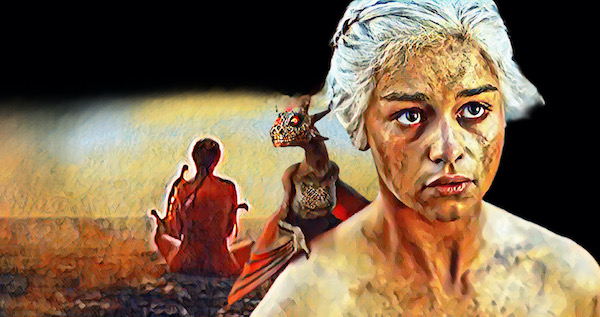
The prophecy of Azor Ahai includes several important elements used throughout Game of Thrones:
Born among salt and smoke
The promised child will be born in a place where salt and smoke are abundant. This is often interpreted as a reference to a place of great suffering or a catastrophic event. Both Daenerys and Jon were born during the war led by the Baratheons.
The Flaming Sword
Azor Ahai will forge a sword called “Lightbringer,” which will shine like fire and will be used to fight the forces of darkness.
Here’s the confusion: the flaming sword was not seen with either Jon or Daenerys but with Beric Dondarrion (Richard Dommer). So what?

The Long Night
The prophecy is closely linked to the “Long Night,” a period of darkness and extreme cold that occurred thousands of years before the events of the books. Azor Ahai is expected to return during a new Long Night to fight the White Walkers and save humanity.
Rebirth under a bleeding star
The prophecy also mentions that Azor Ahai will be reborn under a bleeding star, which can be interpreted as a red comet or other celestial phenomenon.
Characters like Melisandre (Carice Von Houten), the priestess of the Lord of Light, fervently believe in this prophecy and try to find who the Prince That Was Promised is. In her case, she initially believes that Stannis Baratheon (Stephen Dillane) is Azor Ahai reborn, but the evidence in the books suggests that Jon Snow or Daenerys Targaryen are them. In the series, until the turn of the final seasons, we were blatantly led to believe that he would be Jon.
If all this were not enough to be confusing, House of the Dragon came with ANOTHER prophecy and one that calls into question the entire conclusion of Game of Thrones. In the first season, Viserys I (Paddy Considine) explains to Rhaenyra (Milly Alcock) that Aegon I, the Conqueror, had a vision before invading Westeros. He believed that the union of the Seven Kingdoms was necessary to face a future threat that would come from the North, a threat that can only be fought by a Targaryen on the Iron Throne. And she called this prophecy A Song of Ice and Fire.
This secret was only passed down from legitimate heir to legitimate heir, so only she knew it and neither Aegon II (Tom Glynn-Carney) nor Daemon knew, but she had already passed it on to Jacaerys (Harry Corlett).
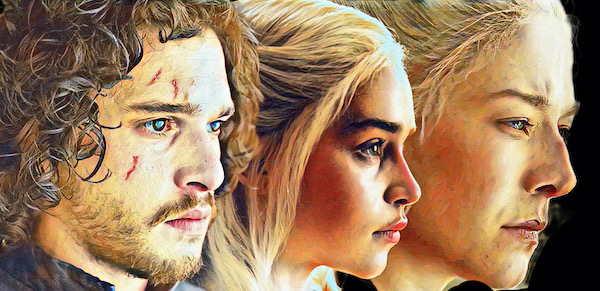
Daenerys had no idea about this prophecy, and neither did Jon (in fact, he didn’t even know he was a Targaryen), because unfortunately she will die with the characters in House of the Dragon, or so we think. Daenerys, who was born after the deaths of Rhaegar and Aerys, was not in the succession and only began to claim the Throne because she thought she was the last living Targaryen.
The prophecy is passed down from generation to generation within the Targaryen family, symbolizing the responsibility they feel to protect the kingdom against this future threat, and so it is necessary to make sure that the lineage is directly linked to Aegon I.
In any case, A Song of Ice and Fire, which is also the title of George R. R. Martin‘s book series, is the basis for both Game of Thrones and House of the Dragon and refers to the battle between ice (the White Walkers and the Night King) and fire (the Targaryen dragons). There is also the reference to the union between the Starks (from the frozen North) and the Targaryens (fire), with Jon literally being the union of ice and fire, potentially the hero born to face this threat of the undead. But no. Now we know that it was always Daenerys. And both Jon and Daenerys are descendants of Aegon I.
And what does the “confirmation” of Daenerys as the Princess That Was Promised mean?
First: who is determining that this is a confirmation is the fans. The image of Daenerys in Daemon’s vision only confirms that yes, she would bring back magic to Westeros by being able to rebirth the dragons.
Second, knowing that Daenerys did not unite the seven kingdoms to fight, this is still Jon’s only undeniable victory in the series, and she did not kill the Night King (nor Jon, for that matter). So, if House of the Dragon intends to confirm that Daenerys is the true princess that was promised, it would mean that she would be the chosen one, destined to play a crucial role in saving the known world. We can’t deny that yes, she was crucial because without the dragons they would have no chance. In other words, the vision involves several interpretations and, in the end, both prophecies make little sense in the series.

Subjugating the other houses to serve him claiming that he is “uniting” the continent does not change the fact that Aegon INVADED, THREATENED, and DOMINATED Westeros, without ever warning or effectively doing anything against the White Walkers.
The prophecy of the Prince That Was Promised was so evasive that it justified Rhaegar changing wives and abandoning his first two sons to be murdered, confusing Melisandre who convinced her that the bland Stannis would be the messiah, leading him to burn his own daughter alive for a victory that he did not achieve. Later he decided that it would be Jon, but left the door open for Daenerys. Very, very confusing! But, it is THE topic that once again divides the sensitive and aggressive GOT universe. What is your opinion?
Descubra mais sobre
Assine para receber nossas notícias mais recentes por e-mail.
 miscelana.com