
Every four years we are enchanted by athletes who, for a few weeks, become Gods on our screens, enter our hearts, and move us with their stories of overcoming. Some have become legends, like Nadia Comaneci and now, Simone Biles. But there are others whose glory can be forgotten, although it shouldn’t be. Olympic champion Elena Mukhina is one of them.

I am ashamed to say that because I was very young when I was enchanted by Nadia, who affected generations with her image of 14 years winning the unattainable perfect 10, it partly overshadowed the story of Elena, who was meant to be her great rival in 1980, if tragedy had not prevented her.
Elena’s story reinforces the strength of spirit of Simone Biles, who “dared” to withdraw from five of the six events at the 2021 Olympics, to rank her mental health and protect herself from an accident. For those who criticized her for her decision, it is worth remembering the story of Elena, who, because she lived in more oppressive times for women and people in general, did not have the same choice because, in times of the Cold War, the well-being of an athlete would never be a priority.
Who was Elena Mukhina: from average to Nadia’s “rival”
Born in Moscow, Elena Mukhina was orphaned at just five years old, when her parents died and she was raised by her grandmother. From an early age, she showed an interest in gymnastics and figure skating and was discovered by a “scout”, who took her to the Central Sports Club of the Soviet Army.
Her medal dreams seemed to be somewhat “bold” but until 1975 she was considered just ordinary, being ignored by coaches who were obsessed with the glory of medals at a time of Romanian dominance. Elena did not qualify for Montreal and the legendary performance of Nadia Comaneci, who took all the Golds that year, was considered an unacceptable defeat by the Soviets.
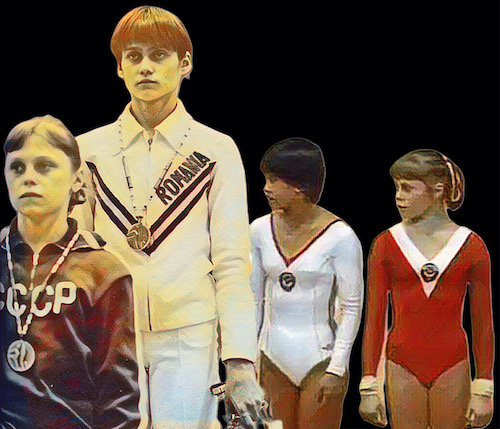
The one who “paid” initially for Romanian superiority was Elena’s coach, who was at once removed from the team and indirectly defined the tragic curve for her pupil’s path, who began to be trained by the male coach, who was much more severe in his instructions. At first, everything seemed wonderful, under the command of Mikhail Klimenko, Elena went from being average to one of the most spectacular gymnasts of her time, also making history.
In 1978, just two years after Nadia’s show in Canada, Elena dominated the World Championships in France, winning gold and defeating the favorites: the Olympic champion herself, Nadia Comăneci, as well as the top-ranked Soviet gymnast Nellie Kim, among others. She was the most talked about and awarded that year, taking gold in the final on floor exercise, and silver on the balance beam and uneven bars.
Today it sends shivers down my spine to mention that she also made history by creating a dangerous and incredible move, the Korbut full spin on the bars, which is a double backflip on the beam (still used today) and coming off the beam with a double backflip with a full spin on the floor, which was named after her, “Muchina” (an allusion to the machine in English because it resembles Elena’s last name, Mukhina). What’s more, Elena’s charm was her difference: she brought classical ballet movements to gymnastics and was so the greatest hope and star of the 1980 Summer Olympics in Moscow. It was not to be…
The pressure, the tragedy, and the blame game
For the Soviet Union, hosting the Olympic Games was a unique opportunity for propaganda and to prove its superiority against its “enemy”, the United States (which boycotted the competition). But, in Women’s Gymnastics, it was the chance to confirm who would be the best: Romania or the USSR, since Nadia Comaneci was coming to defend her Gold from the earlier competition and Elena would face her directly, something that did not happen in Montreal. The pressure was stratospheric.
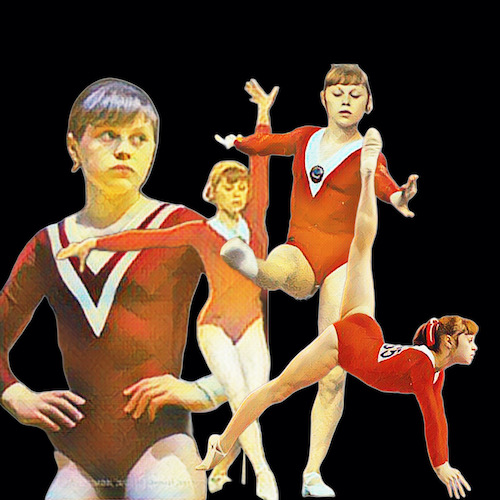
At the end of 1979, during training, Elena Mukhina suffered a broken leg and lost the chance to be at the World Championships in Fort Worth, Texas. As the Soviet team lost again to their arch-rivals Romania, it was decided that Elena’s recovery should be “accelerated”, even against her will. After surgery, with her leg still unhealed, she returned to training.
In pain and with reduced performance, it was discovered that the fracture had not healed properly and so the athlete was rushed to surgery again. And once again, as soon as she stood, she returned to training. When she expressed her displeasure with what was happening, she was considered “too sensitive and lazy”, even though she had trained daily for up to 8 hours before getting injured.
“A human life was worth little compared to the prestige of the nation”
Elena Mukhina
Two weeks before the start of the Games, the tragedy that had been announced came true: during training, while insisting on the Thomas vault movement, one of the most dangerous and now banned from competition, Elena fell on her chin and broke her spine. She became quadriplegic at once. The dream of glory was made impossible forever by the greed of, ignoring the physical and mental health of the athlete who had her life destroyed.
The truth about the accident was kept secret by the Soviet Gymnastics Federation, keeping Elena secluded and with few opportunities to discuss what had happened publicly. The press and Soviet authorities used false information that minimized the severity of the injury, changing the reason and describing the athlete’s condition as “a temporary problem”.
To make matters worse, when the truth came out, the blame for the injury was placed on Elena, with articles claiming that it was she who insisted on the difficult movement, disregarding her coach’s orders. This did not happen, she warned several times that she was not ready, but she was ignored, with no one taking responsibility for the incident.
“A human life was worth little compared to the prestige of the nation…”, she commented in an interview with a Russian magazine.
What is the “Thomas Vault”?
The Thomas vault, now banned and removed from the Code of Points after several serious accidents, especially that of Elena Mukhina, was ‘created’ by the American gymnast Kurt Thomas, at the Montreal Olympic Games in 1976.
Extremely difficult and dangerous, it was performed during the floor exercise in artistic gymnastics and consists of “a 1½ backflip in a tucked or piked position with 1½ twists or a 1½ backflip in a layout (straight) position with 1½ twists”. In short: a somersault that spins and impresses, but is also a shortcut to tragedy.
This mix of athleticism and exhibitionism was introduced by Thomas, who is a legend in the United States with several medals. He also created the “Thomas Flair” on the pommel horse. He passed away in 2020.
The truth and perseverance
The cover-up campaign not only ruined Elena’s life but also her legacy, as one of the versions of the International Gymnastics Federation (FIG) at the time claimed that she “disappeared” because she decided to retire. Unaware of the truth, fans began to demand her return, indirectly contributing to the effectiveness of the gymnast’s justifiable mental health. The USSR did not highlight her at all in sports references and people began to forget her.

The gaslighting was even worse: by blaming the victim, by creating the narrative of an ambitious and irresponsible athlete, it became even clearer when Soviet officials stated that Elena was easily replaceable. According to the report at the time, “traumatized” by not having qualified for Montreal, Elena wanted to include the most difficult step to guarantee her presence on the team, but “fell and hurt herself”. Since she was 20, which was the age limit for competition, she felt she had to quit.
Paralyzed from the chest down for the rest of her life, Elena saw her dream and the only thing that gave her purpose in life taken away from her. It reminds me of the sad story of ballerina Tanaquil Leclerc, who was also confined to a wheelchair until her death. Unsurprisingly, Elena found herself deeply depressed and lonely as she tried to adapt to her new reality. In line with the false narrative that she had dug her own grave, she was virtually abandoned by her friends and colleagues, isolated and treated only by her grandmother. But, little by little, she regained her positivity and reason to live. She was one of the most vocal advocates for denouncing bullying and mental health risks in the Soviet system. She died of clear complications from quadriplegia in 2006, at the age of 46.
The importance of remembering Elena
Elena Mukhina’s story only came to be deservedly shared after 2021, when Simone Biles refused to compete to avoid taking irreversible risks due to not being emotionally ready for the competition.
A New York Times article introduced her to generations who had never heard of Elena, or no longer remembered her (in my case, out of painful shame). The opening recounts how the gymnast tried to be heard, but was forced to obey and try her best, despite the pain and risk, when her coach listened to her pleas with disdain and stated that “people like her don’t break their necks”. She understood that the Soviet Government expected even more, that her recovery trajectory in a short time would make her legendary.
“I really wanted to justify the trust placed in me and be a hero”, she said in an interview years later. But, as soon as she fell and at once lost all feeling from the neck down, she thought: “Thank God, I won’t go to the Olympics”.
What pain.

Elena’s tragedy had an immediate effect on those who knew the truth and who still Today, she is defended because she is so young and vulnerable to pressure. As soon as she regained her freedom to speak, the gymnast endorsed the campaign to rank the mental health of athletes and not reinforce the illusion of heroism, which, unfortunately, is still a favorite narrative of the media.
“Fans have been trained to believe in the heroism of athletes — athletes with fractures return to the football field and those with concussions return to the ice rink,” she said. “Why?”
“Thank God, I won’t go to the Olympics”.
Elena Mukhina
Because we project our want to overcome, the proximity of the divided and the unreal, unfortunately.
Elena received the Order of the Badge of Honor of the Soviet Union in 1980 as relief for her injury, as well as the Silver Medal of the Olympic Order in 1983, which is more prestigious than an Olympic medal and reserved only for athletes who have left a legacy greater than sports. This is certainly her case.
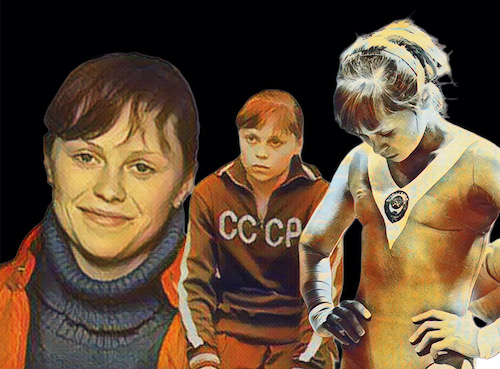
Elena refused to play the victim and always admitted that coaches and officials were also victims of the ruthless system and brutal environment that was common in those years. She hoped that her experience, although sad and tragic, would be a positive reference for other gymnasts to know how to draw the line, just as Simone Biles did 41 years later.
The Paris 2024 Olympic Games are still taking place as I write this remembrance. A tribute and respect to the gymnasts who are making history. Never forgetting those who paved their way to the podium.
Descubra mais sobre
Assine para receber nossas notícias mais recentes por e-mail.
 miscelana.com
1 comentário Adicione o seu