
You know what’s curious? As fanciful as the adaptation of Catherine de Medici‘s biography in The Serpent Queen is, it’s still a real story and seems much stranger than the fiction of Game of Thrones or House of the Dragon. If in the first season we followed the “Daenerys” version of Catherine, rising against all the forces against her, her “Cersei” management, in the second season, is no less interesting.
I haven’t reviewed episode by episode, as I did before, and in part, it’s because Amazon Prime Video practically hides the best of what it has on its platform.

The second season anticipates the tragic St. Bartholomew’s Day Massacre, the days in which the regent Catherine suffered to give autonomy to her son, Charles IX. Weak, unstable, and potentially incestuous, he falters between such openly opposing and influential forces as the Guises and the Bourbons, both families using the opposing religious shield to gain more Power. In their midst is the skeptical Catherine, who, despite being a fervent Catholic on the surface, is in favor of tolerance where the subjects will be French first and foremost.
A utopia yet to be resolved in the 21st century, let’s imagine in the 16th century. Thus, this second season is less “fun”, and denser and brings a SHOW of interpretations from all sides. Those who follow the logic know that The Serpent Queen zones characters who were never in the same room as well as dates, but it works. Examples: Charles V would already be dead and Elizabeth I was never personally in the same room as Mary of Scotland or Catherine de Medici. What does it matter?

As part of her strategy to keep the tenuous religious balance so that her son can rule, Catherine is outwitting everyone by wanting to build the Louvre as a distraction, and, unfortunately, to do so, she leaves her children long enough for everything to fall apart. When she returns, still upset about discovering she has a half-brother, she has to resolve everything by pretending not to be involved. She loves him, we would be lost.
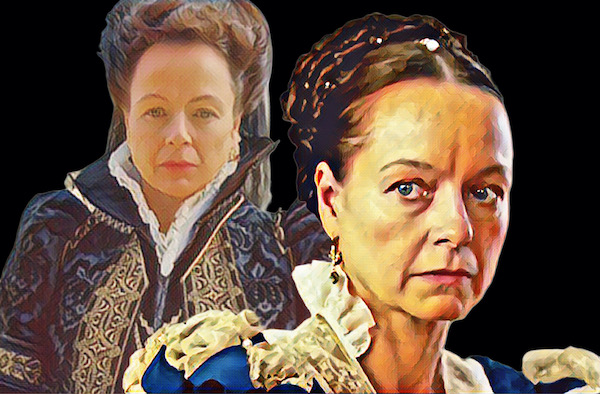
Samantha Morton plays a bored and threatening woman with a whispered voice like few others. I would be terrified of bumping into someone like her. Secretly a follower of religious syncretism, Catherine knows that she will lose almost all of her children, she just doesn’t know the order or which one will survive. Hercules, the most innocent of them all, is the first to go, leaving the queen devastated and her brothers shaken. In fact, he would only die 12 years later, but that’s okay. And even if her cause of death was malaria, using the stone of a Protestant peasant next to a false prophet who never existed also works to expose the behind-the-scenes tricks of the Throne.
Here we have a Catherine who understands that seeking “justice” for Hercules is more than delicate, it can divide the country and cost the heads of nobles who need support. Furthermore, it is important not to create a martyr. But the fact that everything is in chaos only makes everything worse: everyone has opposing personal interests and everyone is ready to betray each other.
Charles wants to kill Edith because he is Catholic and she is Protestant; Anjou wants to kill Edith because of Hercule’s death and Charles V wants to kill Edith because she is causing problems for the Catholics. Aabis wants to kill Edith to save his apprentice and Angelica wants to save Edith so that she can leave Diane de Poitiers’ service and return to the Court. While they are the ones who define the life or death of the annoying Edith, she believes that it is God who is dictating her fate.
For those who have followed the story of Queen Margot, this one is closer to the truth. Her bad relationship with Catherine, her intelligence, Henry of Navarre flirting with his future wife, and the princess’s passion for the Duke of Guise. As we know, we are heading towards one of the worst massacres recorded in History and this preview is tense and very interesting. What a shame that The Serpent Queen is so far off everyone’s radar. It is one of the best series of the moment. With the best soundtrack too!
Taking advantage of the quote from Saint Jude Thaddeus, the saint of impossible causes: let there be a third season!
Descubra mais sobre
Assine para receber nossas notícias mais recentes por e-mail.
 miscelana.com