
With so much talk about Snow White, it’s impossible to avoid returning to the subject of the actress who inspired the designers to create the feared and iconic Evil Queen. We have Gal Gadot in the role that had stars like Julia Roberts (Mirror, Mirror) and Charlize Theron (Snow White and the Huntsman), but the original was a group of divas.
Although it’s possible to understand why for many years the rumors were that Greta Garbo was the model, officially, it was Joan Crawford, whose deep voice and theatrical gestures were equally absorbed by the character. Even her green eyes were captured! And in the year in which we remember the 120th anniversary of her birth (in March), it’s worth revisiting this legendary actress whose career spanned several decades, from the silent film era to television.


Born Lucille Fay LeSueur on March 23, 1904, Joan grew up in a family where her father left home when she was less than a year old, leading to several marriages for her mother and a tough childhood. Little Lucille soon became fascinated with vaudeville performances and decided to become a dancer. As soon as she was able, she began dancing in the chorus lines of traveling shows until she caught the attention of producers and was taken to Broadway. Determined, she was focused on getting her big break at stardom: she recorded a video test and sent it to MGM, who quickly signed her. Still as “Lucille LeSueur,” she made her film debut in 1925, as a stunt double for Norma Shearer, at the time the studio’s biggest female star. She changed her name on the recommendation of MGM’s head of publicity, who thought it sounded fake or even tacky. The final name came from a contest called “Name the Star,” where readers voted for their favorite. The first was “Joan Arden”, but since there was already a namesake, it was changed to “Crawford”.
As stardom was slow in coming, the ever-determined actress once again set out to find success, attending parties to be seen or the most popular places. It worked. Little by little, she received more job offers and effectively became the leading lady. The fact that she was in the shadow of Norma Shearer, who was married at the time to MGM’s production chief, Irving Thalberg, only made Joan consider her more of a rival than a friend. In fact, Joan Crawford’s life and career were full of rivalries and competition with other actresses, notably Bette Davis among them.
When silent films were annihilated with the arrival of sound, Joan was ready because not only did she have a good voice, but she could also sing and dance. She worked hard to improve her diction and lose her accent. She quickly went from being one of MGM’s most famous actresses to a worldwide star, more than once, paired with Clark Gable and considered equal to Norma Shearer, Greta Garbo, and Jean Harlow.
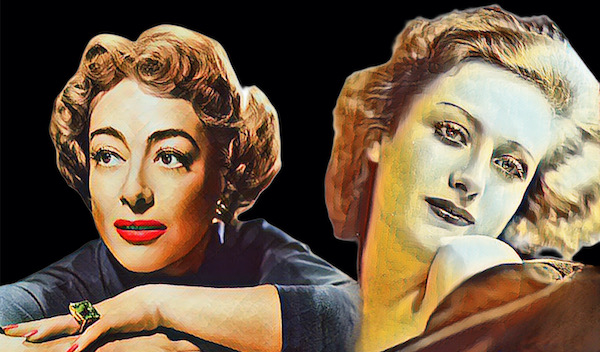
Joan Crawford’s career changed with the film Grand Hotel, where she was alongside the greatest and received more acclaim. However, until then, she had been in light films and wanted to be known as a dramatic actress, something she only achieved in the late 1930s, but, precisely with a decline in her popularity, she managed to reverse it in 1939, playing the role of the seductress and bad character who “steals” Norma Shearer‘s husband in The Women. Following on from her acclaimed work, her performance as the facially disfigured blackmailer in A Woman’s Face yielded one of her most acclaimed performances.
In the 1940s, she left MGM for Warner Bros. and began to pursue an Oscar. Her famous commitment and determination to get what she wanted was important when she decided to film Mildred Pierce in 1945. The director wanted Barbara Stanwyck and although it was unexpected that a star of her stature would agree to audition, Joan swallowed her ego and agreed, landing the role. And how about that? Yes, she won the Oscar for Best Actress.
In the 1960s, with TV already gaining prestige, Joan Crawford made the transition to the medium, starring in films and soap operas, and even though it was because she no longer had offers in the cinema due to being “old”, she continued working. One of her last great successes, What Happened to Baby Jane, co-starred Bette Davis and the series Feud showed the disputed behind-the-scenes filming, with the two famous enemies coming together to make a hit. Which was the last.
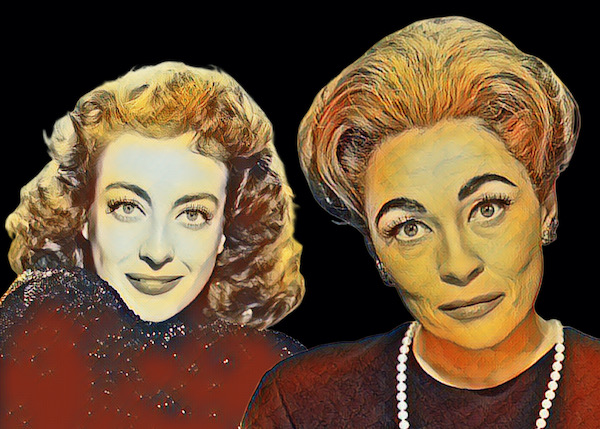

Married four times, to important men such as Douglas Fairbanks Jr. and Alfred Steele (owner of Pepsi Cola), Joan adopted their four children, the first of whom, Christina, was the subject of a complex relationship over the years.
When the 1970s arrived, Joan finally retired. She had already published two autobiographies (the last one was in 1971) and her last public appearance was 50 years ago, in September 1974, at a launch party for Rosalind Russell‘s book. Three years later, she suffered a massive heart attack in May 1977, which left her slumped in her apartment. Officially at the age of 69.
The drama that tarnished Joan’s legacy came right after her death when she disinherited her two oldest children, Christina and Christopher. In what many consider revenge based on spite, she released the book Mommie Dearest, which destroyed Joan’s reputation for younger generations and was never able to be reversed.
As the New York Times obituary accurately defines it, Joan Crawford was “an epitome of timeless glamour who personified for decades the dreams and disappointments of millions of American women,” easily adapting to changing times and tastes. They literally don’t make stars like her anymore.
Descubra mais sobre
Assine para receber nossas notícias mais recentes por e-mail.
 miscelana.com