
Films aged for many years, even decades, but not as much as they do now. Given the significant cultural changes of the last 15 years, especially the last 10, it is difficult to mention or contextualize Hollywood “classics”. Divas like Marlene Dietrich starred in films that are laughable from start to finish today, but 88 years ago the reaction was completely different. One of the best examples is the film The Garden of Allah, from 1936.
The production, which won an Oscar for cinematography, was one of the first color films in history, an investment by David O’Selznick to take advantage of the “new” technology and enchant audiences around the world. And he was right: with the exotic setting of the Moroccan desert and foreign stars (Marlene was German and Charles Boyer was French), the melodrama was the third remake of a best-seller of the time, whose two silent films before the sound and color version had already been successful. The grandiose music by Max Steiner (who would later work with O’ Selznick on Gone with the Wind) was also nominated for an Oscar but did not win. It all seems like a big rehearsal for the film that would make history three years later, Gone with the Wind.

It is simply unbelievable today to understand how the reviews for the release of The Garden of Allah were so positive. In Brazil, it was such a success that the canal that separates Ipanema from Leblon was named after the film, how about that? Newsweek said that Boyer and Dietrich gave the performance of their careers (God!) and the New York Times described it as an “enthusiastically acted film”. Exaggeration is what best describes the work as a whole.
In literature: religion and exoticism determining the story
The original novel, by Robert Hichens, was first published in 1904 and was a great commercial success for bringing up issues of exoticism, mysticism, eroticism, and Faith. The story follows a young Englishwoman, Domini Enfilden, who travels to North Africa to escape her troubled past and find spiritual renewal. Rich but lonely, she feels unfulfilled and seeks deeper meaning in life, betting that the exotic and austere landscape will provide her with the solace and spiritual awakening she desires.
In the desert, Domini meets Boris Androvsky, a man with a mysterious past who is also seeking redemption and a new beginning. What she does not realize is that Boris is a former monk who has abandoned his vows and is tormented by guilt and internal conflict. Still, they fall in love and decide to get married.
The relationship, initially happy, is under constant threat because of the secret between them. When Boris is forced to confront the truth, their love is threatened. This is because Boris’s internal struggle with his faith and desires prevents their relationship from being fulfilled. The abandonment of his religious vows creates a moral and spiritual conflict for Domini, who deeply values her faith and the sanctity of religious commitments. “Out of love” for God and for him, she sacrifices her happiness so that he can seek redemption on his own terms, without her interference, which means – GET THIS – returning to the Monastery.

The idea of the story is that Domini’s decision to separate from Boris, even omitting that she is pregnant (this is not clear in the film), is an acknowledgment of the transformative journey they have both been through and that the time they spent together in the desert was simply a period of intense emotional and spiritual growth. Therefore, their separation symbolizes the culmination of this journey and the beginning of a new chapter in their lives. Today, it is simply an absurd and non-existent drama.
In Hichens’ book, Boris Androvsky returns to the monastery due to his personal guilt, spiritual crisis, and search for atonement. Although happy with Domini, he “feels” that he has betrayed his vows and that he needs to resume his religious duties to achieve forgiveness. I’m at a loss as to how to explain the inexplicable, sorry, but it is this complex interaction of guilt, redemption, and the search for spiritual meaning that the author set out to discuss, unfortunately, with a conformist and conservative alternative, where the woman is the temptation and is left alone.
With its success, plays and films immortalized the book
In 2024, the book The Garden of Allah turned 120 years old, and thank God it is so out of tune with the current times. In 1904, it was so well received that it was adapted into two films before the talkies, where it gained its third and final version and was even transformed into a play on Broadway.
When David O’Selznick created his production company, it was the second film he decided to produce and this time in Technicolor. The original project was to star Merle Oberon and was even considered a vehicle for Joan Crawford, but he got the star of the hour, Marlene Dietrich, who was “borrowed” stay” by Paramount for the project.
The actress, who has a veritable parade throughout the film’s 120 minutes, disliked the producer and was irritated by the script, which she considered weak. (She was always smart!) She complained about how many times they repeated the phrase “only God knows what’s in my heart,” but O’Selznick considered her remarks to be just a reflection of an insecurity about her appearance. Selznick was distressed by the actress’s perfect appearance in all the scenes, with clothes that were impossible to wear in the North African desert, and never looking disheveled or dirty, even in a windstorm. He tried to bring a bit of realism but in vain. Can you imagine the atmosphere?
Interestingly, before signing with Boyer, actors such as Robert Taylor, Laurence Olivier, Robert Donat, Jean Gabin, Ivor Novello, John Gielgud, Vincent Price and even Basil Rathbone (who plays another role in the final version) were tested for the role of Boris, while David Niven, Cesar Romero and Ray Milland were also considered for the role of De Trevignac, which went to Alan Marshal.
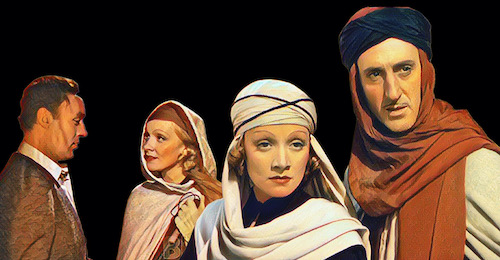
The filming in the Yuma, Arizona desert, in temperatures above 45 degrees Celsius only made the tension worse, but the result was an absolute success. Today, The Garden of Allah represents exactly the kind of outdated film, created to emphasize the glamour of its star to the detriment of the story. Cheesy, exaggerated, laughable, but technically brilliant.
The award-winning photography and lighting by Harold Rosson and W. Howard Greene is still incredible, combining the black-and-white technique with the innovative technology of color. Marlene Dietrich, let us warn you, has never looked as beautiful as she does in this film.
Cyndi Lauper helped revive the film
Forty years ago, when the beautiful video for Time After Time hit MTV, it was introduced with a long, romantic scene from The Garden of Allah, when Charles Boyer says goodbye to Marlene Dietrich and Cyndi lip-syncs the entire dialogue, which gains dramatic force as she turns off the television and begins to sing her classic.

“I have made up my mind,” we hear Boyer saying, “I am going away.” “Then I will be alone,” Dietrich responds. “That trip to the desert you once told me about, will you take it alone?” he asks. “What else can I do?” she replies, looking beyond. “You once told me that Peace and Happiness could be found there. You gave me hope, but now we must say Goodbye,” he explains, with Cyndi exaggerating the lip-sync. “Goodbye,” we hear Dietrich.
Thanks to these few seconds of reproduction, the 1936 film was immortalized in pop culture simply and directly, without new generations actually having seen the whole thing.
Is it worth it? Yes, if you are a fan of the Seventh Art. With all the reservations already presented.
Descubra mais sobre
Assine para receber nossas notícias mais recentes por e-mail.
 miscelana.com