
I have been a collector of soundtracks since I was a teenager (actually before, but technically I shared the collection with my father) so I follow composers with more interest than directors. Music has always transported me to the magic of imagination, without needing the images or words of others. Obviously, among the best of the best is the German Hans Zimmer, who has dominated Hollywood for almost 40 years with innovative and memorable melodies and orchestrations.
One of the most influential and prolific composers in cinema, he has 11 Oscar nominations (and counting), with two wins, Grammys, and long partnerships with at least two of the most important directors of recent years: Ridley Scott and Christopher Nolan. It is no exaggeration to call him the most influential composer of the moment, on the same level as the legends Ennio Morricone and John Williams.

Zimmer is known for his ability to combine elements of electronic music with traditional orchestrations. He often uses synthesizers and electronic instruments to create unique sound textures, while also incorporating orchestral instruments to give depth and richness to the music. This can be seen in soundtracks such as Inception and Interstellar.
The soundtrack – now with dated arrangements – that made him a reference was that of the film Rain Man, in 1988, where he mixed flutes and keyboards. The originality caught the attention of Ridley Scott, at the time filming Black Rain, with Michael Douglas. According to him, he was so impressed with the work of the German musician in the film starring Tom Cruise and Dustin Hoffman (which won the Oscar), that he considered the music to be greater than the story, arousing his curiosity about the musician.
Hans Zimmer, who came from a world of new wave music, jokes that he got nervous and asked the director “How could I avoid being fired”, to which Ridley replied, “Just don’t write me a symphony, but write a song that is appropriate for the film”. Curiously, a German was looking for Japanese melodies (the film is set in Osaka and New York), but it didn’t scare the two. The soundtrack for Black Rain is not available on Spotify, but it is spectacular.
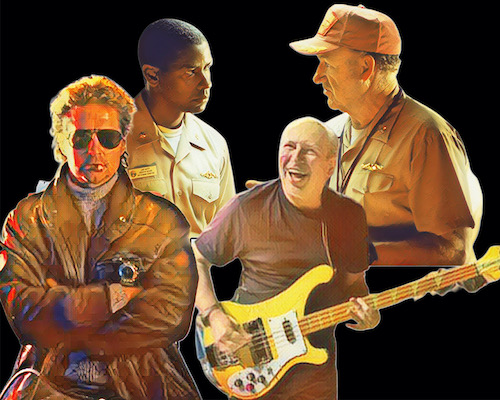

The film, now practically forgotten, was a box office success with very stereotypical male characters and a classic police revenge plot. Therefore, the grandeur of Zimmer’s melody, easy to remember and exciting, fit perfectly. He innovated by establishing his signature electronic orchestra with lyrical and pop tones. It was progressive rock with classical music and Japanese instruments. Something he used in the following films (many with Ridley’s brother, Tony Scott).
The lone guitar of Thelma & Louise, in 1991, is still moving, simple, and precise to me. The soundtrack for Crimson Tide, in 1996, is less cited today but is one of the best in his filmography and earned Zimmer a Grammy for Best Original Score. Two years earlier, he had already won an Oscar with his legendary and powerful melody for The Lion King, in 1994, a mature and completely distinct soundtrack in the Disney universe.
The end of the 1990s came, for me, with Zimmer’s masterpiece: The Thin Red Line, composed in 1999 for Terrence Malick‘s comeback film and which changed the composer’s signature, influencing all his work since then.


According to the musician, the reclusive Malick reversed the usual process and asked that the soundtrack be composed BEFORE filming began. Without having the images and only the concept in hand, Zimmer recorded six and a half hours of music. The climax of the film, which is when the soldiers dominate the hill that has become a deadly wall for them, The Journey to the Line, uses four chords in a theme that repeats itself, with the clock ticking away until the grandeur becomes inevitable. Used in trailers and other films, it is the basis for Pirates of the Caribbean, Inception, or even Interstellar.
Having already used singing in the soundtrack for The Prince of Egypt, in 1998, when Hans Zimmer signed the soundtrack for Gladiator, in 2000, Lisa Gerrard‘s voice created one of the most iconic themes in recent cinema. Although she did not sign the sequel, we can only look forward to the moment in the film when the theme is used.
The partnership with Christopher Nolan, including the Batman franchise up to Oppenheimer created an infallible duo. The music of The Dark Knight is as remarkable as Heath Ledger‘s performance as the Joker. And now, working on the Dune franchise, with Denis Villeneuve, he won his second Oscar.
Another great highlight in Hans Zimmer‘s career, without a doubt, is the Pirates of the Caribbean franchise, where he brings together almost all of his melodic, orchestral, rhythmic, and grandiose qualities. The pirate theme is by Klaus Badelt, who had worked with Zimmer before, but when he took over the baton for Pirates of the Caribbean: The Curse of the Black Pearl in 2003, it was almost humiliating. The love theme, the theme for Davy Jones, and how he used the theme song for the park, what can I say? I listen to it over and over again at any possible moment.
With his style often described as grandiose and emotional, Hans Zimmer’s music does more than capture the essence of a scene or a character; it transforms the cinematic experience for the viewer, as one critic put it perfectly: “It provides listeners with the same kind of popcorn escapism that the film provides to viewers.” A genius. A god!
Descubra mais sobre
Assine para receber nossas notícias mais recentes por e-mail.
 miscelana.com