
Maria Callas‘ concert in Paris, recorded on December 19, 1958, at the Paris Opera, is perfect. She was at the height of her beauty, vocal ability, life, and fame. And she knew it. She was one of the most famous women in the world, certainly in the world of Opera. The gala event was so important that it was televised live and was attended by the President of France at the time, René Coty, as well as French and international celebrities such as Jean Cocteau, the Duke and Duchess of Windsor, Charlie Chaplin, Brigitte Bardot, Roland Petit and Zizi Jeanmaire, among others. As they said at the time, “le tout Paris” or “all of Paris”. It was the event of the year.
“My name carries a considerable responsibility and sometimes I feel frightened,” Maria commented at the time before stepping on stage. The concert was extremely important to silence the critics of her Art and her personality.

The repertoire included two arias from Norma by Bellini, obviously including Casta Diva, as well as excerpts from Il Trovatore by Verdi, La Forza del Destino, and The Barber of Seville by Rossini. Always accompanied by the Paris Opera Orchestra and Chorus, with conductor Georges Sebastian, in the second part of the evening, she performed the complete second act of Tosca, where she brought the audience to tears with her interpretation of Vissi D’Arte. A single night that marked our farewell to Callas forever, introducing us to Maria. Of course, no one suspected this, least of all Maria Callas herself.
Slim, perfectly made up and with a costume designed by her favorite designer, Elvira ‘Biki’ Bouyeure, Giacomo Puccini’s stepdaughter, she wore a long red velvet gown adorned with jewels estimated at over a million dollars. The contrast with the checkered floor and the choir with the men in evening wear and the women in black blouses and skirts made her stand out even more.
Before playing the role that would become “hers” – Tosca–Callas showed how the red gown could be transformed into three or four parts with small gestures. She opened with her signature aria, Casta Diva, changed the position for the somber Miserere from Verdi’s Il Trovatore, and made us laugh with her incomparable interpretation of Una voce poco fa from The Barber of Seville. Perfect. Divine.
The black and white film now has a recovered and colorized copy, which includes interviews with the famous people in the audience and the changes of scenery. It was an absolutely historic performance.
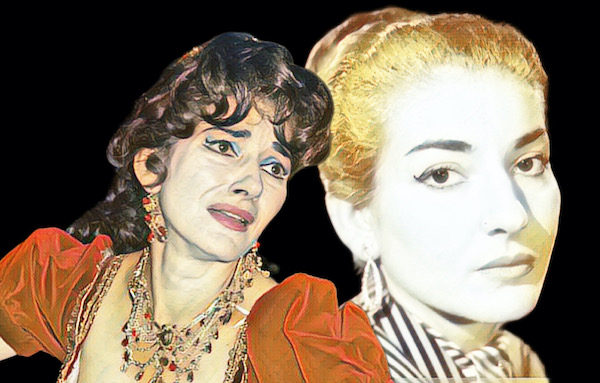
On that night in 1958, no one could have imagined that Paris would become her destination city, where she would settle and where she would die less than 20 years later, in 1977, at just 53 years old.
“Last night, they were immediately filled with warmth. There was a kind of understanding between me and the audience, naturally, I was afraid, because there was so much publicity, so much of everything, the French wanted so much, they wanted everything, and I wanted to give them more than anything! And… that’s a bit difficult,” she described after the performance.
The Concert is still considered one of the landmarks of the 20th century and Maria Callas donated her five million franc fee to the Legion of Honor.
What her fans also like to remember is that, in the audience, more enchanted than the rest and planning a future that would change Maria Callas’s life, was Aristotle Onassis.
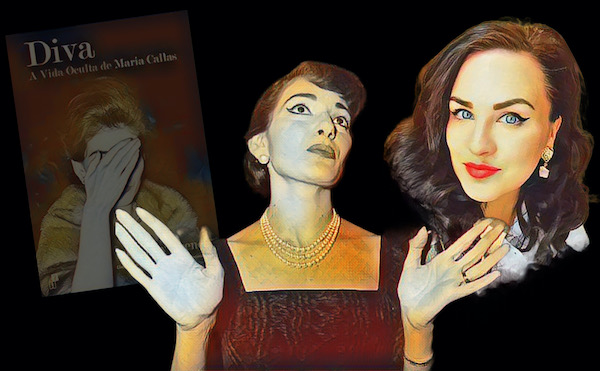
Besides him, as her biographer Lyndsy Spence (whom I interviewed for CLAUDIA on the centenary of Callas’s birth in 2023) describes, others showed the disciplined 35-year-old artist that “there was another, more pleasurable side to existence.” Maria, the author says, was ready for Paris. “Maria felt accepted, appreciated, and loved in Paris. She had recently suffered some painful experiences with audiences in Italy and America. Some critics complained that her voice was not pure, polished, or consistent enough. But Maria sang like a force of nature, with the full range of emotions, and perhaps that is what Paris appreciated, that she sang in a way that a 19th-century romantic heroine might have sung,” she describes.
“Paris also promised the lure of a new passion,” she adds of Onassis. The Greek shipowner sent her a series of luxurious bouquets of roses and began to flirt openly with her, even though they were both married.
He met a beautiful woman, frustrated in her marriage and ready to fall in love. It all started that night in Paris…
Descubra mais sobre
Assine para receber nossas notícias mais recentes por e-mail.
 miscelana.com