
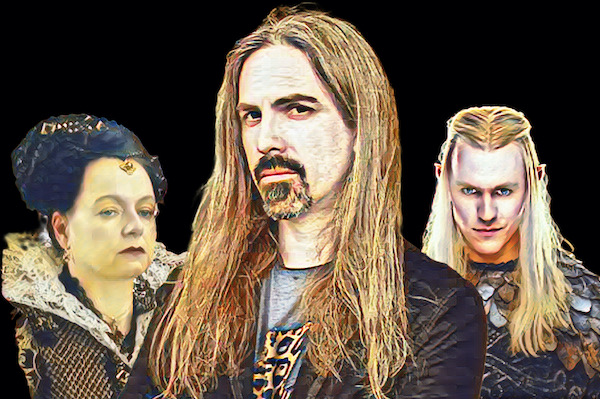
Composer Bear McCreary‘s name appears in series and films that can provoke imaginary encounters between Sauron and Catherine de Medici, as well as Zombies, Soldiers, and “Outlanders”. Award-winning and sought-after, Bear is responsible for iconic soundtracks, such as The Walking Dead, Outlander, The Serpent Queen, and Rings of Power, to name a few titles. And if you follow at least two of them, you will witness that he never repeats himself.
Son of writer Laura Kalpakian and professor Jay McCreary, Bear revealed talent and connection with music from an early age, following in the footsteps of his brother, Brendan. Having studied piano and accordion, Bear always wanted to compose soundtracks and in college, he was a student of the legendary Elmer Bernstein, with whom he reconstructed the soundtrack for 1963’s Kings of Sun.
Debuting under such important tutelage, it was no surprise that the path to success was assured. His first work as a writer came with the cult series Battlestar Galactica, in 2003, which immediately established Bear McCreary as a name to watch. On this project, Bear was initially second to Richard Gibb, but when the musician left the series, he took on the challenge alone and remained on the team until its completion in 2009. The success was astronomical and, as a result, proposals kept coming in.
A fan of comics and classic literature, as well as games, Bear McCreary quickly set the tone for many generations, as his music can be heard in action, drama, fantasy, and suspense series. How could we forget the theme from The Walking Dead or the game God of War?
What stands out in Bear McCreary’s music is the way he mixes orchestra and rock, without ever repeating himself. His incidental score for The Serpent Queen was crucial in sustaining the conclusion of the second season on a high note.
But of all his recent work, the one he’s most excited about is scoring Rings of Power. “I always like to find the sound that means something to a project,” he explained in an interview a few years ago.
One of the biggest challenges here is that Howard Shore’s award-winning music casts a long shadow over any new theme, and McCreary was still in college when the trilogy was in theaters. As a huge fan of The Lord of the Rings (he read the book when he was young), he was thrilled when he was hired to create the music for the series, especially since he already had an idea of the soundtrack he would write.
But even with all the experience we’ve mentioned, including awards and accolades, when he sat down to plan, the composer found himself facing the biggest challenge of his career. For the first season, there were almost two and a half hours of music and it took him over a year to work on it. His approach was to consider everything as a puzzle to which he added new pieces.

“Not only was there the legacy of Howard Shore’s iconic work, but we also have protagonists and main characters in six different cultures,” he explained to Esquire in 2022. “Each of these different cultures—the Harfoots, the Elves, the Dwarves, the Short Men, the Tall Men, and the Orcs—required a unique style of music, instruments, and musical traits.”
In 2024, it’s not necessarily a soundtrack that has the musician occupied, but rather the release of his solo concept album: The Singularity, which features appearances by Slash, Serj Tankian, Rufus Wainwright, Corey Taylor, Jens Kidman, Joe Satriani, Scott Ian, Brendon Small, Steve Bartek, and John Avila. This, he explains, is where he can use his imagination to its fullest.
And his influences? Here are your 12 favorite soundtracks:
Conan the Barbarian (1982), by Basil Poledouris
Batman: The Animated Series (1992-1995), by Shirley Walker
Gremlins 2: The New Batch (1990), by Jerry Goldsmith
Star Trek: The Motion Picture (1979), by Jerry Goldsmith
Edward Scissorhands (1990), by Danny Elfman
Spirited Away (2001), by Joe Hisaishi
Star Wars: Episode V – The Empire Strikes Back (1980), by John Williams
Psycho (1960), by Bernard Herrmann
The Mission (1986), by Ennio Morricone
To Kill a Mockingbird (1962), by Elmer Bernstein
Braveheart (1995), by James Horner
Back to the Future (1985), by Alan Silvestri
Agree with it?
Descubra mais sobre
Assine para receber nossas notícias mais recentes por e-mail.
 miscelana.com