
Unsurprisingly for purists who have read George R. R. Martin’s Fire & Blood, it was no surprise that the writer used his blog to criticize the adaptation of the series House of the Dragon.
“I’m not looking forward to the other posts I need to write about everything that went wrong with HOUSE OF THE DRAGON… but I need to do that too, and I will. Just not today,” he wrote on August 30 on his blog, Not a Blog.
Social media, many of them alternating between praise and statements of “blasphemy” and hatred of the showrunners, celebrated the fact that Martin was dissatisfied as validation for the violent posts about the absolutely spectacular series. After the wave of hatred for the last seasons of Game of Thrones and the cyberbullying to which Dan Weiss and David Benioff were subjected, fans took over the Universe of Westeros, and if once Trekkers were a headache for channel programmers and producers of the Star Trek franchise, today, circulating in the world and surviving it requires a healthy and protected mental health.
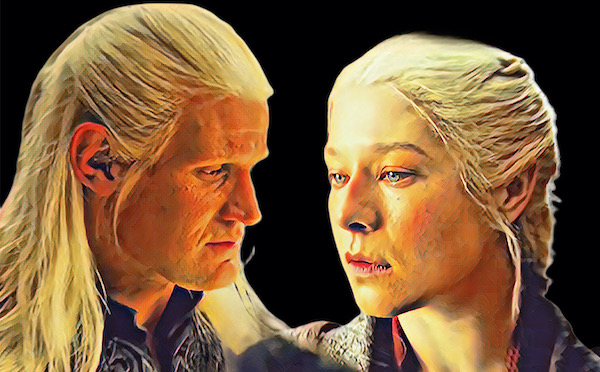
George R. R. Martin actually wrote his complaints but deleted them later, so I have Variety Magazine as the source of the words, which reproduced what was quoted.
Until then, I considered that Ryan Condal‘s closeness to Martin put him under a cloak of protection that does not exist. Not only did the writer complain about significant changes to his story (some of which I completely agree with and was massacred by friends when I spoke out), but the writer is also concerned about future seasons.
According to the American magazine, the post “Beware the Butterflies” went deep into Martin’s dissatisfaction with the plot of Blood and Cheese and the death of Jaehaerys Targaryen. This is nothing new, on July 5th Martin posted “What an ending it was powerful, I thought… a punch in the gut, especially for viewers who have never read FIRE & BLOOD. For those who have read the book, however… Well, there is a lot to be said about it, but this is not the place for me to say it. The issues are very complicated. At some point, I will make a separate post about all the issues raised by Blood and Cheese… and Maelor the Missing. There is a lot to say”, he warned.
The fact is this and those who read MiscelAna know that I was looking forward to this sequel for over two years because it is one of the most violent and unexpected passages in the entire saga. By having rushed through time, but having made the characters older, the showrunners of House of the Dragon omitted, no, ERASED the existence of the third son of the couple Aegon II and Helaena Targaryen, keeping only the twins, Jaehaera and Jaehaerys. By discarding Maelor, who Martin has now named Maelor The Missing, the violence of the sequence in the series – although extremely violent – “lost” the main impact not only of the scene itself but of what is to come.


In the 1st season, the series had already discarded one of the sons of Viserys I and Alicent, Daeron Targaryen, but “fixed” the mistake by mentioning his existence and bringing him into the plot – as he was in the book – in the next season. Even Olivia Cooke joked about this in interviews, poking fun at the showrunners for having “forgotten” Daeron. In the case of Maelor, there is no going back.
In the book, Alicent and Helaena are held hostage by Blood and Cheese and after hours of torture and desperate pleas for the children’s lives, Helaena is forced to choose which of the two boys – Jaehaerys or Maelor – should die. She chooses the younger, Maelor, but, to her and our shock, the assassins behead Jaehaerys and even tell Maelor “See? Your mother chose YOU to die”. Understandably, Helaena never recovers from the trauma.
In House of the Dragon, there is no choice, the assassins do not know how to differentiate Jaehaerys from Jaehaera and demand from Helaena (alone, without Alicent who was having sex with Ser Criston Cole in another room) who the boy is, and she, without resistance, shows them her son, fleeing with her daughter while Blood and Cheese cut off the child’s head. Decidedly horrible, but tortuously less impactful.
Excluding Maelor only makes another future change more complicated.


Helaena is one of the saddest and most tragic Targaryens of all because she is a sweet person and suffers attacks and losses just for being in the middle of the conflict between her husband and brother, Aegon II, and Rhaenyra. According to the book, after Blood and Cheese, she never returned to normal, barely leaving her room or speaking coherently. In the series, she is in mourning and sad, but calm. And she even says that her pain is less than that of the women of the people who have no way to feed their children. HOW SO?
This need for House of the Dragon to make its protagonists think of a greater good not only sounds false but is also out of tune with the original characters. Part of the tragedy is really the egocentrism and the lack of empathy of the Targaryens who cared mainly about maintaining Power, there was no room to think about the “small folks”.
Maelor’s absence will be complex because he was linked to Helaena’s fate. She begins to torture herself psychologically for having chosen him for execution and when the child is dismembered by the starving population (when they were trying to “save” him from Rhaenyra), the news of his death is decisive for the princess to jump (or be thrown) from the tower of the Red Keep. Of course, Helaena can still end her own life or be killed, but the fact that she dies right after the animalistic murder of her second son is when she gains the eternal sympathy of the fans. Once again it will be strong, but it could be even worse.


“When Ryan Condal first told me what he intended to do, a long time ago (in 2022, perhaps), I argued against it, for all these reasons”, wrote Martin. “However, I did not argue much, nor very vehemently. The change weakened the sequence, I felt, but only slightly. And Ryan had what seemed like practical reasons for it; they didn’t want to deal with casting another child, especially a two-year-old. Children that young will inevitably slow down production, and there would be budgetary implications. Budget was already an issue in HOUSE OF THE DRAGON; it made sense to save money wherever possible. Plus, Ryan assured me that we weren’t losing Prince Maelor, just postponing him. Queen Helaena could still give birth to him in season three, presumably after getting pregnant at the end of season two. That made sense to me, so I withdrew my objections and agreed to the change. I still love the episode and the Blood and Cheese sequence in general. Losing the “Helaena’s Choice” beat weakened the scene, but not to a great extent. Only readers of the book would notice its absence; viewers who’ve never read FIRE AND BLOOD would still find the scenes heartbreaking. Maelor didn’t DO anything in the scene, after all. How could he? He was only two years old. There is another aspect to removing the young prince, however,” George R. R. Martin shared in the now-deleted post.
The problem here is that Helaena no longer can get pregnant and have a child with Aegon, it would have to be Aemond’s, and he is already on his way to another romance (with Alys Rivers). There is no more time to build that relationship unless it is something completely different from the book.
For the writer, removing Maelor from the story affects the story’s part in the final two seasons (we are heading into the third and it ends in the fourth).
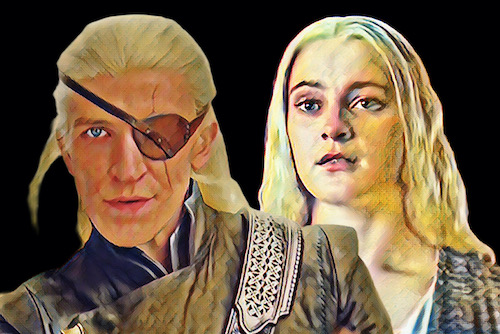

“Maelor alone means little,” Martin wrote. “He is a small child, has not a line of dialogue, does nothing of importance other than die… but where, when and how, that matters. Losing Maelor weakened the ending of the Blood and Cheese sequence, but it also cost us the Bitterbridge scene with all its horror and heroism, it undermined the motivation for Helaena’s suicide, and that in turn sent thousands into the streets and alleys, screaming for justice for their ‘murdered’ queen. None of this is essential, I suppose… but it all serves a purpose, it all helps tie the storylines together so one thing follows another logically and compellingly,” he continued. I don’t want to brag, but I said just that here on the blog and in the paragraph that preceded the quote. He’s 100% right here.
“And there are bigger, more toxic butterflies to come if HOUSE OF THE DRAGON goes ahead with some of the changes that are being contemplated for seasons 3 and 4…”, he warned. More?
Martin didn’t address other things that angered the “purists”. I’ll share a few here:
The Death of Laenor Velaryon. Rhaenyra’s first husband was originally murdered, suspiciously and at a conveniently opportune time so that the widower Daemon Targaryen could finally marry Rhaenyra. The series made it so that Daemon and Rhaenyra helped Laenor escape and pretend to be dead so she could live happily in Essos with her lover.
What weakens the plot? First, it is once again Rhaenyra knowingly knowing that she is disrespecting the moral rule of Westerosi society and presenting bastards as legitimate children. The first three were from her lover, Ser Harwin Strong and the marriage with Daemon is null since Laenor was alive.
Since dragons only change riders when the original dies, we know that Seasmoke chose Addam of Hull because Laenor ‘probably’ died and Rhaenyra’s indifference makes her inconsistent with the affection she had for him until now.


Alicent and Rhaenyra are childhood friends. In the book, Alicent is much older than Rhaenyra and is suspected of not only killing Viserys but also King Jaehaerys before him. An intelligent woman, Alicent antagonizes her stepdaughter, but the war is between siblings and insists that the two ‘friends’ are so connected that rivals lose their meaning in the second season, forcing meetings between them just to have their protection. female agonists in the same scene.
The absence of Netlles. The plot of the young woman who would conquer Daemon and tame the dragon Sheepstealer was apparently passed on to Rhaena Targaryen. This takes away the love triangle that would leave Rhaenyra on the spiteful and cruel tip. As they did with Daeron Hightower, they may change their minds about Nettles’s entry, but the dragon seems to have gone to Daemon’s daughter.
The death of Lucaerys Velaryon was accidental and Aemond felt sad and guilty for the mistake. The fact that Aemond had no control over Vhagar is already somewhat creative, but having him confess that he regretted it was out of character. Aemond hated his nephews and even though he had killed them “by accident”, he would not regret it. The list could grow, and some changes were more positive, such as Rhaenyra’s more sexual and dubious relationship with Mysaria, Aegon and Aemond’s more complex personality, as well as Viserys I’s humanity, were details that enriched the drama.
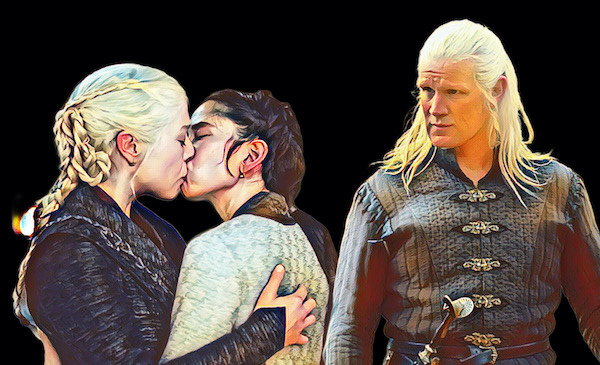
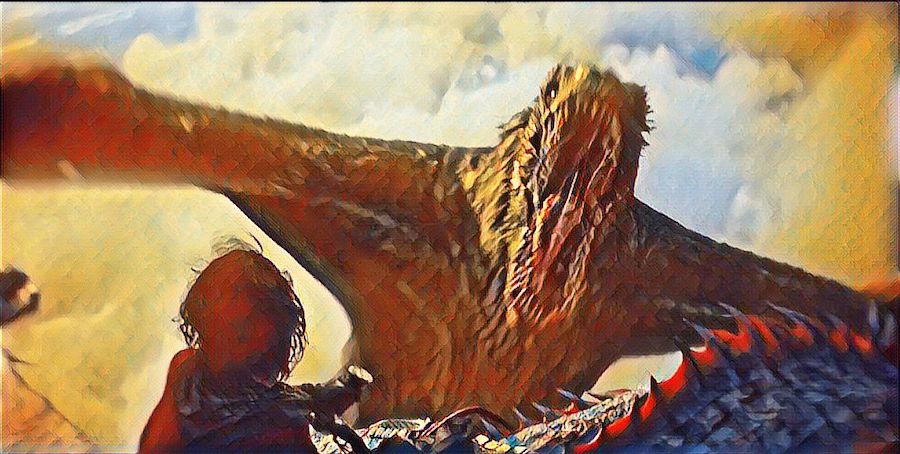
Returning to George R. R. Martin, his transparency created unease and MAX released a statement saying that “there are few bigger fans of George R. R. Martin and his book ‘Fire & Blood’ than the creative team of ‘House of the Dragon’, both in production and at HBO. Often, when adapting a book for the screen, with its own format and limitations, the showrunner ends up being forced to make difficult choices about the characters and stories that the audience will follow. We believe that Ryan Condal and his team did an extraordinary job and the millions of fans that the series accumulated in the first two seasons will continue to enjoy it.” And the post was deleted, so Martin may have regretted going into more depth about what he really thought of the team’s “difficult choices.”
Living with the expectations of audiences unfamiliar with the books, those devoted to literature, and the author himself is no easy task. On the official House of the Dragon podcast, Condal had already addressed the science of frustrations in general and, in particular regarding the Maelor issue, defended himself by claiming that it was a casualty of war.
“Our young children in this show are very young. Very, very young,” he said. “Because we compressed this timeline. So these people could only have children of a certain age and make it believable where it didn’t feel like we weren’t holding to the realities of the passage of time and the growth of children in any real way. And people, people look at these things. And particularly with a show like this, they look very closely. So it was a choice that was made. It had a ripple effect, and we decided we were going to lean into that and try to make it a strength, rather than a weakness,” he added.


The production team is currently working on the third season, which is not expected to air until 2026. The final season, on that count, is expected to premiere in 2028. With George R. R. Martin starting off the second season with rave reviews, there is hope that the future will be more positive.
Some of the biggest praise Martin gave to House of the Dragon was the changes to Paddy Considine as Viserys I (“essentially recreated King Viserys, giving him a very different backstory and much more depth than the happy-go-lucky, party-loving king I created for FIRE & BLOOD. He should have won an Emmy,” he said), Tom Glynn Carney as Aegon II (“[he] brings Aegon to life in ways we’ve never seen before; he’s more than a villain here, he shows us the king’s anger, his pain, his fears and doubts. His humanity,” he described), Phia Saban as Helaena (“she’s a richer, more fascinating character than the one I created in FIRE & BLOOD,” he acknowledged), but most of all, he loved the mutt that only exists in the series. “I’m not usually a fan of writers adding characters to the source material when adapting a story. Especially when the source material is mine. But that dog was brilliant. “I was prepared to hate Cheese, but I hated him even more when he kicked that dog,” Martin wrote on the blog. “I wish I had thought of that dog. I didn’t, but someone else did. I’m glad I did,” he joked.
That’s right: he complained more about what went out than what came in. Do we agree with him? I do every syllable.
Descubra mais sobre
Assine para receber nossas notícias mais recentes por e-mail.
 miscelana.com
2 comentários Adicione o seu