
For Brazilians, thanks to the popularity of the traditional production by the Theatro Municipal do Rio de Janeiro, the ballet Coppélia has always been extremely known. However, in the United States, it is not a ballet that is so frequently featured in the repertoire of companies, something that the New York City Ballet is reversing with the remounting of George Balanchine‘s version, which will be 50 years old in 2024.
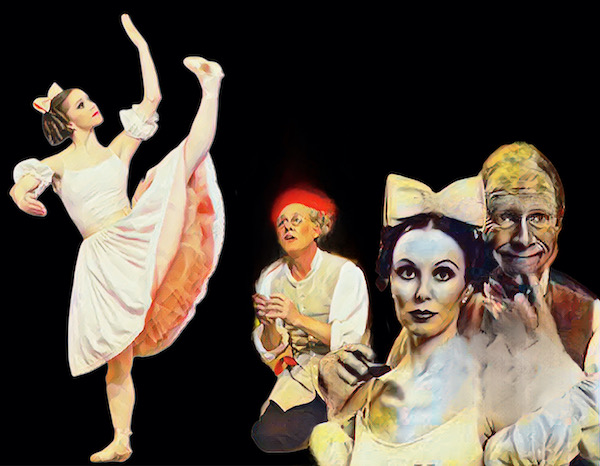
Balanchine’s Coppélia, like his Nutcracker, is the main basis for many of the later versions since the original itself was lost in time. The version by the Municipal do Rio, for example, has a lot of it, but it is written by Enrique Martinez and arrived here in 1984, being the same one that the American Ballet Theatre premiered with Carla Fracci and Erik Bruhn.
Balanchine’s vision is also the basis because it not only predates ABTs but is a revision of what Alexandra Danilova danced with the Ballets Russes in the 1930s. In other words, it could not be more traditional because it is at least 86 years old and is based on the vision of Marius Petipa, which she and Balanchine saw at the Mariinsky in St. Petersburg when they were young, before leaving the country in 1924.


But let’s look at the version that is returning to the stage, which is from 1974. The original cast had Patricia McBride as Swanilda, Helgi Tomasson as Franz, and Shaun O’Brien as Dr. Coppélius, and there are images of them on YouTube that I recommend watching.
As the company’s program defines it, Coppélia is “considered one of the greatest comic ballets of the 19th century,” with a fun story that is easy to enchant adults and children alike. The world premiere, in 1870, was written by Arthur St. Léon and was restaged by Petipa in 1884, revised by Cecchetti in 1894, and has been re-released in countless versions since. As the NYCB points out, none of St. Léon’s original choreography remains in today’s productions, and while Acts I and II have retained their ideas and story, the nature of some of the roles has changed. What hasn’t changed, they continue, is that “this production by Balanchine and Alexandra Danilova—which has been called the definitive Swanilda—also contains the most authentic of the characters’ dances.”
And authenticity is irresistible, don’t you agree?
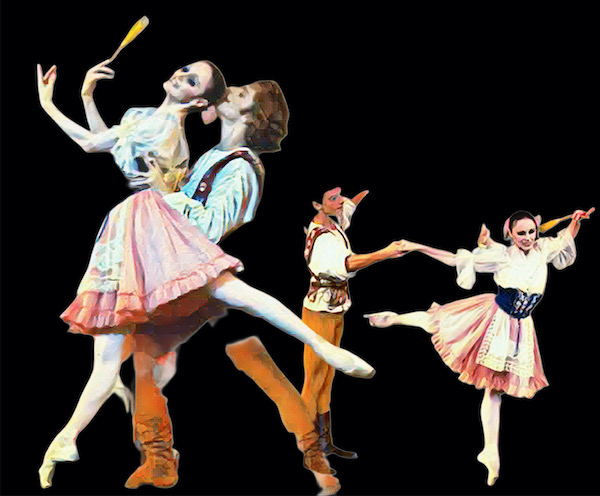

The “real” story of Coppélia, on the other hand, is far more complex than the simplified versions that have made it to the stage. The original tale came from the mind of German writer E.T.A. Hoffmann and is a dark psychological fantasy about a man’s destructive passion for a lifelike mechanical doll. In addition to the ballet, this story is also included in the opera The Tales of Hoffmann, with music by Jacques Offenbach, which preserved the tragic and surreal atmosphere of the original.
This less profound version of Coppélia has kept it alive and popular, even though its last production with Balanchine’s company was in 2014. In 1974, when Balanchine decided to revive this ballet for the American public, he took the opportunity to add some male solos, more pas de deux, and a new third act, which – like “The Wedding of Swanilda and Franz” – is a party with no connection to the story per se. He convinced the resistant Lincoln Kirstein (who preferred new works at the NYC Ballet) that staging a classic like Coppélia would allow him (as in The Nutcracker) to put young students on stage and that it would encourage the family and friends of each of the 24 girls to be in the audience.
At the time, he called on Danilova to re-stage the dances she knew so well for the first two acts and to coach the main roles, giving her co-creation credits.
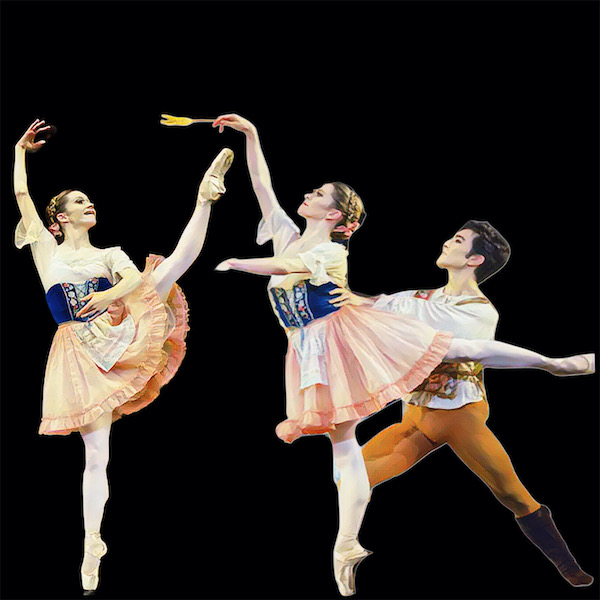
In the score by Léon Delibes, one of the most prominent composers who managed to transform ballet into something greater, what gains relevance is the fun and sweet vision of the plot, focusing on Swanilda’s strong personality more than Dr. Coppélius’ strange obsession with creating a doll that looks just like her. Many consider Delibes, always extremely melodic, to be “easy” to dance to, and as a result, his works are appreciated by both dancers and musicians. Coppélia is, therefore, the first symphonic ballet score that included motifs (themes) to identify the characters, took advantage of the customs of national dances to create beautiful melodies, and thus gained great popularity. Since many of the choreographies have been forgotten, it is the music of Coppélia that bridges the gap between the French Romantic style and the Russian Classical style in ballet.
Another thing that many credit Coppélia with is functioning as a basic theme that was used for almost all ballets of the 20th century: a plot in the 1st and 2nd that demands pantomime and generates drama, to close in the 3rd with a party that is nothing more than a sequence of dances without dramatic purpose.
Returning to Balanchine’s version, at the time of its premiere, the New York Times critic Anna Kisselgoff, praised the darker touches that the choreographer inserted in the first acts, mentioning that the ballet “emphasizes the Hoffmannesque source of the original libretto (Coppélius is a gothic and not a comic figure),” she describes, praising the production as witty, delightful and visually sophisticated. “The attempt is not to reproduce Petipa’s choreography, but to work within the spirit of Petipa in an idiom for our time. There is no doubt that Mr. Balanchine has been highly successful,” she concludes.

Coppélia is a ballet in which the title character is a supporting character and in which the protagonist, the temperamental Swanilda, dominates her partner, Franz, but has a complex antagonist in Dr. Coppélius. He is often a comic figure, but Balanchine gave him another perspective, one that critic Jennifer Dunning particularly praised in 1980 with Shaun O’Brien himself bringing to life. “Shaun O’Brien has given his brilliant portrayal of Dr. Coppelius, the mad old dollmaker,” she began. “Mr. O’Brien seems to add new dramatic nuances each season, but while the shading changes a bit, he makes the cantankerous Coppelius a tragic figure of heroic proportions, staying well within the ballet’s fairytale dimensions.”
NYCB’s 50th-anniversary version opens September 27. A great effort to keep the classics alive. And timeless.
Descubra mais sobre
Assine para receber nossas notícias mais recentes por e-mail.
 miscelana.com