
Anyone who loves cinema knows that John Williams is God. Throughout his career spanning more than 60 years, with 5 Oscars (and 54 nominations), the 92-year-old American conductor and composer has impacted the lives of millions of people worldwide, with musical themes that immediately transport us to a world of fantasy and magic. If I were to list everything, I would have to write an encyclopedia! In November 2024, the documentary The Music of John Williams will arrive on the Disney Plus platform, a tribute to one of the most important artists of the 20th and 21st centuries.
Although it is presented as a ‘documentary’, it is more of a tribute than a biography, which is always deserved! Williams’ friendliness, simplicity, and calmness are surprising for an artist of his stature (and height, he is over 1.90m). And I warn you, this musical journey will move you.

One of the most interesting things about the documentary, which is a little over an hour long, is that it is a great opportunity for new generations to relive the long path that John Williams has taken in Hollywood and the world of music. His songs have left an invaluable mark on our parents, grandparents, and children: you may not have seen the film, but you know his music. And if you have seen the film, you will always remember his melodies.
I always say this here, I have been a collector of soundtracks for over 30 years, I still have some LPs that I inherited from my father, I have the collection repackaged on CDs, and not everything is on music platforms, so I am attached to my collection that has been carefully curated over the decades. My Top 5 composers are Ennio Morricone, Patrick Doyle, Hans Zimmer, Michel Legrand, and, OF COURSE, John Williams. (Of the younger ones, I collect Danny Elfman, Ramin Djwadi, Bear McCreary, and Clint Mansell). And from this list, Morricone and Zimmer are the ones who come closest in terms of versatility and volume of work to the American.
Music and cinema have always been part of John Williams‘ life since he was born. His father was a professional musician and that’s why, after playing in big bands, he went with his whole family to Hollywood to work in film studios recording soundtracks. Little “Johnny” therefore dreamed of being a classical pianist, but he grew up visiting film sets and watching his father work with famous composers and conductors in the world of American cinema and music. This created an impact that would later become a creative force in Hollywood.
Unsurprisingly, he began working as a hired musician and as a pianist, he is credited on soundtracks such as the Peter Gunn series and films such as Breakfast at Tiffany’s and West Side Story, among several hits until he began writing the soundtracks himself for series such as Lost in Space, a huge hit in the 1960s.
With his gentle personality and an impressive ability for melodies, John Williams moved into film, being immediately nominated for an Oscar for his soundtrack to the classic Valley of the Dolls, in 1967, and winning the first for the adaptation of the musical Fiddler on the Roof, in 1971.
And it was exactly 50 years ago that Williams’ most successful partnership with director Steven Spielberg began, in a way neither of them expected. Spielberg, at the time, was a promising young filmmaker, but virtually unknown and making the transition from TV to film. The musician already had an Oscar and several other awards at home, in addition to two decades of life. Still, it was a meeting of souls.
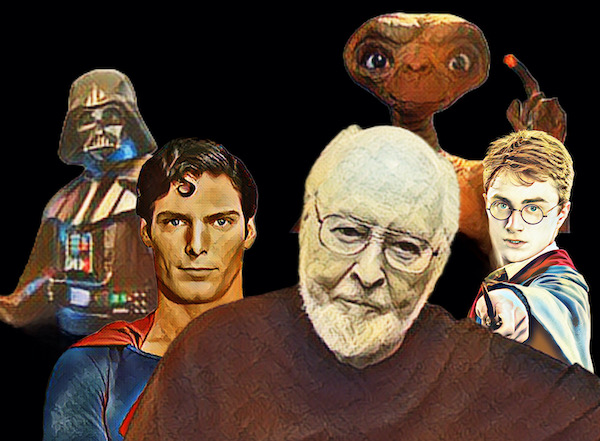
All of this is recounted in the documentary with testimonies from both artists and other artists, on the same piano where the maestro created so many unforgettable themes. I’m talking about themes like those from Jaws, E.T. – The Extra-Terrestrial, Indiana Jones, Jurassic Park, Close Encounters of the Third Kind, Schindler’s List, and many others. You’ll get goosebumps and cry at each one, without a doubt. In addition to these, Williams also created the themes for Superman, Harry Potter and, of course, the most special to me, the Star Wars saga. Pure magic without words.
The Music of John Williams is a cinema lesson with just the right tones of nostalgia. At times didactic, but always touched on the emotional key. As his directorial partners and fans comment, his music is part of the world’s collective imagination, it tells a story that we see on the screen as well as the one we imagine in our heads, and the humility with which Williams talks about his work is inspiring.
There are some “flaws” if we consider that it would be a ‘documentary’: the part about John Williams’ personal life, marked by his unexpected widowhood at the age of 41 when his wife, actress Barbara Ruick, died of an aneurysm in early 1974, in addition to an emotional absence for his children (hinted at by his daughter who says she was used to (who was given the maternal role to his brothers and who took on this responsibility after the death of his mother), is somewhat out of place in what seemed to be a sea of tranquility in his life. The composer mentions that he “wasn’t working for a long time” while mourning, but then we move on to what was the most creative phase of his repertoire, precisely the classics of the 1980s. Williams is a discreet man, that much is clear.
Likewise, his turbulent time with the Boston Pops Orchestra is mentioned and commented on, without delving too deeply into the controversial rejection by the musicians who considered him a film composer and not classical enough to lead them, facts that we learn (or are reminded of), but which remain superficial.
Another detail that is omitted in Williams’ creative process is his extremely strong (I’m being gentle) ‘inspirations’ in classical composers such as Tchaikovsky, Dvorak, and especially Stravinsky, among others, to create some of his most striking themes such as Jaws and Star Wars. Would it be technical? Yes, of course, but at the same time, it is interesting to understand how he borrowed some notes to change them in the cinema. I say this so that you don’t come across YouTube or other sources where experts are making comparisons.

Even with all this, no one can take away from John Williams‘ enormous talent for understanding the creative process of cinema so well, being so versatile and agile. His shyness made him, for many years, somewhat apart from the circuit because he believes, and he is right, that his music speaks for itself.
And for those who love an orchestral soundtrack (I can’t imagine any other), it is wonderful to pay homage to the composer who was one of the most important in maintaining and saving the tradition that was almost retired and replaced by options that were more collections or that used only electronic instruments. Jaws uses two notes to scare us, but with five, the main theme of Close Encounters of the Third Kind is the perfect metaphor for how music is the universal language.
The most enthusiastic interviewee in the documentary is, without a doubt, Steven Spielberg. He convinced the reclusive John Williams to embrace the spotlight and finally take us through his impressive collection of spectacular music. It seems Williams thought no one would be interested in him, but we, passionate film fans, would beg to differ.
The Music of John Williams is not just a documentary; it is a celebration of a genius who transformed every note into a piece of cinematic history.
Descubra mais sobre
Assine para receber nossas notícias mais recentes por e-mail.
 miscelana.com