
One of the most (still) modern and influential works of literature is 134 years old and its impact, including on cinema, is undeniable. I am talking, of course, about The Picture of Dorian Gray, Oscar Wilde‘s novel published in 1890, which discusses in an almost definitive way the themes of beauty, youth, and morality. The story of Dorian, a young man who remains physically young and beautiful while his portrait ages and becomes deformed by his actions and vices, is a powerful allegory about the consequences of vanity and moral decay.
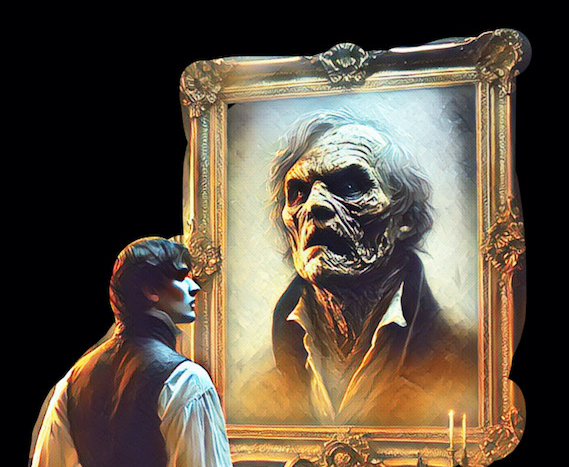
Wilde’s simple and brilliant text was certainly at its peak in this work, which makes several criticisms of society and human nature, which are universal and timeless themes. Since man is man, he has spoken of eternal life and even more, of eternal youth. And here, the vain Dorian Gray desires eternal youth and beauty, something he obtains at the cost of his soul, with his portrait aging and deteriorating in his place. In the Victorian era, there was pressure on ideal behavior and appearance, and Wilde questioned the obsession with perfect appearance. Today, this theme resonates even more with the culture of youth and aesthetic perfection, intensified by social networks and the search for impossible standards of beauty.
The situation is perfect: when Dorian sees the record of his image “in his prime”, he envies himself because he could never have the same appearance forever. What seems to be just inconsequential vanity gradually reveals itself to be something more sinister.
“Youth is the one thing worth having“
Dorian Gray in The Portrait of Dorian Gray
Dorian’s portrait is a symbol of moral conscience, where his immoral actions and excesses are reflected, even though his appearance remains young and pure. Wilde challenges the idea that people can escape the consequences of their actions and questions the morality of the time. In today’s world, this idea continues to be relevant, especially with Social Media. In a society where people often seek pleasure and success at any cost, the work reminds us that choices have profound impacts, even if they are not immediately visible.
Wilde also uses the novel to criticize the hypocrisy of Victorian society, where appearances were maintained above all else, but where there was a lot of falsehood and moral repression, a criticism that is still applicable because hypocrisy is still relevant today. In times when people can build unrealistic and superficial images on social media, there is a parallel with Dorian’s secret life, who appears to be perfect on the outside but hides a dark and corrupt side.
“The only way to get rid of temptation is to yield to it“
Lord Henry Wotton in The Picture of Dorian Gray
Another point that critics praise is that Wilde was one of the main defenders of the aesthetic movement, preaching that art exists for its own sake and does not need to have a moral function, but The Picture of Dorian Gray questions the relationship between life and art, and how much one can influence the other. If we look closely, we still discuss today whether art has the function of moralizing, inspiring, or just being beautiful, which makes the work current in debates about creative freedom and censorship.
In the psychological aspect, it can be said that it is a metaphor for Identity and Double Personality, since Dorian leads a double life: while he appears beautiful and socially respectable, the portrait accumulates the marks of his moral and physical degradation. This duality reflects an internal conflict of identity and self-control, themes that continue to be present in modern psychology. Isn’t it the same thing as the “selves” that people build online and offline, and how they maintain different versions of themselves?
“How sad it is! I shall grow old, and horrible, and dreadful. But this picture will remain always young“
Dorian Gray in The Picture of Dorian Gray
That is why, more than a hundred years later, The Picture of Dorian Gray continues to be read and interpreted for its intense and dark portrayal of fundamental human dilemmas: vanity, morality, identity, and the desire to be accepted. The timelessness of the novel lies precisely in how Wilde mixes these themes with irony and social criticism, leading us to reflect on our own society and on ourselves.

Dorian Gray only exists because its author, Oscar Wilde, had a provocative and reflective spirit that managed to transfer his ideas into precise text that explores the value of beauty, the nature of art, and the moral dilemma between pleasure and responsibility. Over time, Dorian began to appear as a gloomy character in horror series and films, but the concept discussed by Wilde – ironically – “does not age” in Hollywood. Youth and beauty continue to be currency and goals among actors and celebrities, a subject that Substance reflects heavily on and even bloody.
Oscar Wilde’s novel ends with Dorian Gray finally confronting the consequences of his life of hedonism and excess. After a series of tragic events, Dorian tries to change, seeking redemption. However, upon seeing the horrible state of his portrait – which now reflects all his sins and the corruption of his soul – he tries to destroy the painting in the hope of freeing himself from his past. However, this act results in his own death, with his body deteriorating and his appearance returning to that of an old and corrupted man. The painting, on the other hand, remains grotesque, symbolizing the true nature of his soul. As we say: brilliant.
Descubra mais sobre
Assine para receber nossas notícias mais recentes por e-mail.
 miscelana.com