
With each passing hour, the expectation that Dune: Prophecy will live up to expectations increases. While we say “Game of Thrones in Space,” actress Jodhi May, who plays Empress Natalya, suggests a “Handman’s Tale in Space,” which sounds even more dystopian and refined. And of course, given Travis Fimmel‘s stardom and popularity, his presence in the cast has attracted a lot of speculation, especially since his character is not part of the books (danger! danger!).
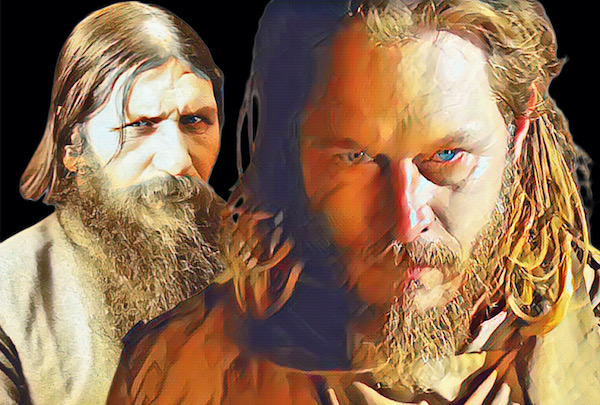
Travis, as we know, likes gray roles. Not even Ragnar Lothbrok from Vikings could be considered a perfect hero, so it’s time to pause when Desmond Hart is presented as a villain in a universe of villains. Even more so when the showrunners point to the source of inspiration for the character, none other than the controversial Rasputin.
First of all: Who was Rasputin?
Grigori Yefimovich Rasputin was a Russian mystic, a controversial religious figure, and one of the most enigmatic figures in Russian history. He was born in a small village in Siberia and gained fame as a healer and spiritual advisor, especially at the end of the Tsarist period.
He became close to the Russian imperial family, the Romanovs, especially Tsarina Alexandra Feodorovna, wife of Tsar Nicholas II. His influence began due to his reputation as a holy man capable of performing miracles. Since the crown prince was very sick (he suffered from hemophilia), his parents placed all their trust in the strange man with even more unusual habits. Alexandra believed that Rasputin was sent by God to protect the Romanov dynasty.
Gradually, the nobility and public opinion viewed Rasputin’s influence over Alexandra with great suspicion. He was accused of being involved in moral and political scandals, and many considered him a threat to the monarchy’s stability. He was assassinated in December 1916 by a group of nobles: poisoned, shot, and finally thrown into a river, where he drowned, his death reflecting the political chaos in Russia on the eve of the Russian Revolution of 1917.
Over time, Rasputin became a symbol of the decline and collapse of the Romanov dynasty. Although historians debate his true political influence, he remains a figure of fascination, portrayed in books, films, and legends as a mysterious, charismatic, and ambiguous character.
If Desmond Hart is like Rasputin, do we have any clues?
Desmond Hart, as a fictional character, and Rasputin, as a historical figure, offer fascinating parallels when compared, especially in a context like that of Dune, where mysticism, power, and political manipulation are central.

Rasputin is remembered as a figure who combined spirituality, charisma, and manipulation, managing to influence the politics of Tsarist Russia while remaining on the fringes of official power. This ambiguity — a spiritual advisor seen as both mystical and manipulative — echoes in several figures in Dune: Prophecy. If Desmond Hart shares similar traits, he could be seen as someone who moves between spheres of spiritual and political power, just as Rasputin did in the Romanov court.
Relationship with Politics and Mysticism in Dune: Prophecy
The Dune universe is deeply rooted in systems of control that feed on spiritual beliefs and psychological manipulation. Groups like the Bene Gesserit dominate precisely because of their control over perception and faith. Thus, Desmond Hart, as a “Rasputin-like” figure, perhaps symbolizes the ambiguous power of figures who operate behind the scenes, diverting the focus from visible protagonists like Paul Atreides, but decisively influencing the course of events.
Power over the Mind and Faith
Rasputin had a notorious ability to fascinate and manipulate people, especially the royal family. Likewise, Desmond Hart could be a character with powers or abilities similar to those of the Bene Gesserit—or perhaps an alternative type, more connected to “popular” beliefs. This connection suggests that, in Dune: Prophecy, faith, and spirituality are not just tools of domination, but also weapons for those who know how to use them in social and political contexts.

What this suggests about Dune: Prophecy
If Hart plays a role similar to Rasputin, it adds another layer to Herbert’s critique of power. Dune often warns of the danger of messianic leaders and the vulnerability of political systems that rely on charisma and mysticism. Hart as “Rasputin” would emphasize the theme of invisible power and the tension between the rational and the irrational in controlling the masses.
The presence of a “Rasputin” in Dune, personified by Desmond Hart, would reinforce the historical parallels that Frank Herbert incorporates into his work. This figure would be a powerful reminder that while the universe revolves around intergalactic conflicts, it is behind the scenes and in the minds of individuals that the most decisive battles are fought.
The connection with the Empress…
If Desmond Hart is placed in a parallel with Rasputin, it is easy to anticipate that Empress Natalya (Jodhi May) will play a role related to his, as Tsarina Alexandra did with the Russian religious leader. Alexandra Feodorovna is remembered as a tragic figure: a woman deeply religious and devoted to her family, but incapable of understanding the political and social changes that threatened the empire. Her personality and her choices, especially her association with Rasputin, are often seen as factors that contributed to the collapse of the Russian monarchy. This is not good news for Dune: Prophecy, is it? If they mirror the real, their positioning takes on a fascinating perspective, especially considering the dynamics of influence, power, and mysticism.
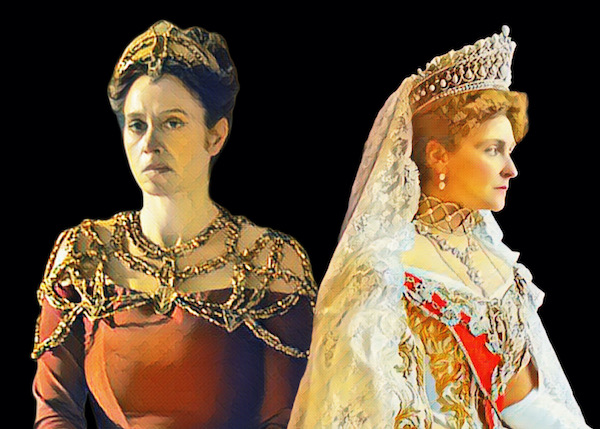
That is because if he is manipulative, she can be legitimizing. Obviously, we see in the trailer that Desmond acts directly in the ear of Emperor Javicco (Mark Strong), without Natalya’s help, but since the Empress does not trust the Bene Gesserit, she will certainly pay attention to what he says.
Also following the analogy, Desmond must operate in gray areas, representing both an indispensable advisor and an agent of chaos, a constant reminder of the dangers of charismatic figures who operate on the threshold of politics and faith. There is a torture scene already mentioned that will hardly be sympathetic to him. This also makes it so that, like Rasputin, Desmond can be seen as a threat to the traditional political balance, challenging the patriarchal and centralized structures of power.
The relationship between Desmond and Natalya has been omitted in the trailers and interviews, but some suggestions are obvious: having the two actors give interviews together and Travis’ friend mentioned in the premiere Desmond’s “sex scene” (without specifying with whom, but it is in episode 4), refers to the historical suspicion that Rasputin was the lover of Czarina Alexandra of Russia. And Travis warned that to achieve his goal, Desmond sees no moral or physical limits. If this connection does indeed exist, Natalya’s trust in Desmond could lead to unpredictable consequences, both positive and disastrous.
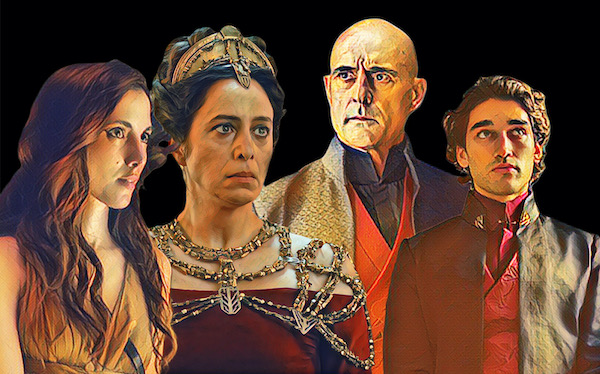

The alliance between the two, however, seems inevitable because they both understand the threat posed by the Bene Gesserit and together they could represent an “organic” force against the systematic and calculated manipulation of the Sisterhood. Together, Desmond and Natalya could symbolize the power of unpredictable forces, which operate outside of institutional control. This places them as agents of transformation or destruction, challenging the already precarious balance of the Dune universe. While the Bene Gesserit and other institutions try to shape the future, figures like Desmond and Natalya could represent the impossibility of completely controlling human and spiritual variables.
In other words, depending on the point of view, Desmond and Natalya could be seen as disruptive heroes, questioning oppressive systems, or as chaotic antagonists, whose influence further destabilizes a universe already in crisis. For example, Natalya could be a woman who seeks to escape traditional impositions, finding in Desmond a way to break paradigms — even if this puts her on a collision course with other dominant forces. Or, alternatively, Natalya could be “corrupted” by Desmond’s influence, leading to a narrative arc of rise and fall, in which she belatedly realizes the dangers of depending on him.
What will we get? As protagonists or antagonists, both would reinforce Herbert’s recurring theme of the danger of blindly trusting in messianic figures or seemingly unshakable hierarchical systems.
Descubra mais sobre
Assine para receber nossas notícias mais recentes por e-mail.
 miscelana.com
3 comentários Adicione o seu