
In classical dance, there are excerpts taken from complete ballets that end up becoming more famous than the complete work in which they were inserted. When I was still dreaming of the stage, ballets with Spanish settings always seemed to be among the most fascinating: there was agility, humor, and exoticism. However, although Paquita was among the most beautiful pieces and danced by several companies, I had a hard time seeing the complete ballet. Something I only managed to do recently, I must confess.
Whether it was my expectation or my lack of knowledge, I was disappointed… but I have to explain. Visually, considering the choreography, I was astounded by the beauty and brilliance of Petipa at the height of his creative power. But Minkus’s music didn’t move me, and the plot? What a mess. I found The Corsair to be excessively confusing, and Paquita dispensed with the dramatic part.
But what is the history of Paquita and its relevance? Let’s evaluate.
Creation of Paquita
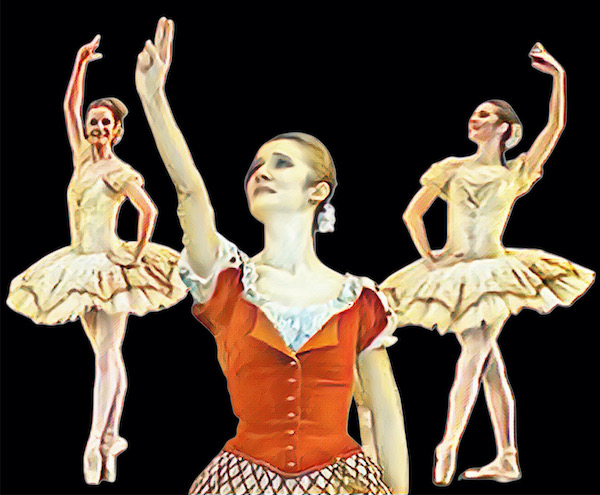
Paquita was created in 1846 for the Ballet de l’Opéra de Paris, with choreography by Joseph Mazilier and music by Édouard Deldevez. The romantic plot reflects the trends of the time, with a heroine who moves between different social classes and faces challenges to reveal her true identity. The ballet is set in Napoleon’s occupied Spain, which gives it a touch of exoticism and historical drama.
Paquita was Deldevez’s second ballet, a kind of commitment by the director to give him a new opportunity after his first work was not well received, not for the music, but for the libretto. In Paquita, the script was written by the author Paul Foucher, who was Victor Hugo‘s brother-in-law and wanted a simple, direct, and easy-to-follow plot. Exactly what I didn’t think it would be, but the narrative mixes romance, intrigue, and a sense of adventure that pleased the Parisian public.
Instead of betting on Jean Coralli, who had written Giselle, Mazilier was hired, who was considered more musical. Everything was in line!
Reception in France
In the 19th century, Paquita was well-received for its combination of virtuosic technique and popular narrative elements. Mazilier’s choreography emphasized the dramatic and technical skills of the leading ballerinas, consolidating its popularity in the French repertoire. Despite this, its fame in France did not have the same longevity as it gained in Russia.
Carlotta Grisi, fresh from the resounding success of Giselle, was Paquita in the premiere, alongside her partner, Lucien Petipa. Both were extremely praised, of course.
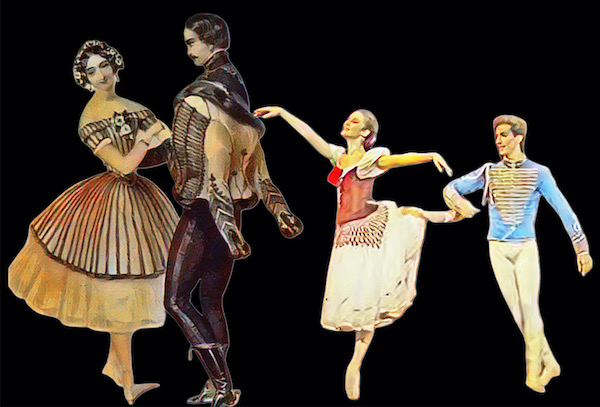
Despite the success of Paquita, the ballet was quickly forgotten. It had no more than forty performances in Paris before being removed from the repertoire in 1851. It took another 150 years for it to return to the Opéra stage. Again, it is easy to understand why.
Adaptation by Marius Petipa in Russia
In 1847, Marius Petipa, recently arrived in the Russian Empire, took on the production of Paquita for the Imperial Ballet of St. Petersburg. He danced the role that had been originated by his brother, making a success of his debut. At the time, he had no idea that he would be in Russia to stay, but ballet would be fundamental to the choreographer’s career. The idea of staging Paquita was not his, but it was a perfect fit.
Legend has it that at the first performance in St. Petersburg, a member of the audience threw a dead black cat on stage with a small card tied to its tail that said: “For the première danseuse”. Of course, the ballerina fainted on the spot. The effect was the opposite of what the aggression had intended: the audience began to support the star and Paquita became a resounding success.
Years later, in 1881, Petipa revised the work significantly and included an appendix called Grand Pas Classique, with additional music composed by Ludwig Minkus. At this point, he no longer danced and the leading roles went to Ekaterina Vazem and Pavel Gerdt.
In general, Petipa did not significantly change other choreographers’ productions and closely followed Mazilier’s direction about the libretto and the action/mime scenes. On the other hand, there is some doubt as to whether the rest is entirely Petipa’s or Mazilier’s. But what no one disputes is that what was added here is brilliant.
Petipa simply transformed Paquita into the best vehicle for displaying pure classical technique, mixing musicality, ensemble dancing, and virtuoso solos. He also created the Mazurka des Enfants, which is still one of the pieces used to present students on stage. But most importantly, he adapted the ballet to the Russian aesthetic, which valued grandeur and technical virtuosity, making his contribution timeless. So much so that the most popular piece to this day is precisely the Grand Pas Classique.
The Legacy of Paquita
Today, the ballet Paquita is known mainly for this version by Petipa, which remains in the repertoire of several ballet companies around the world. It is also an example of the cultural exchange between France and Russia in the 19th century, illustrating how a work can be reinterpreted and transformed over time.
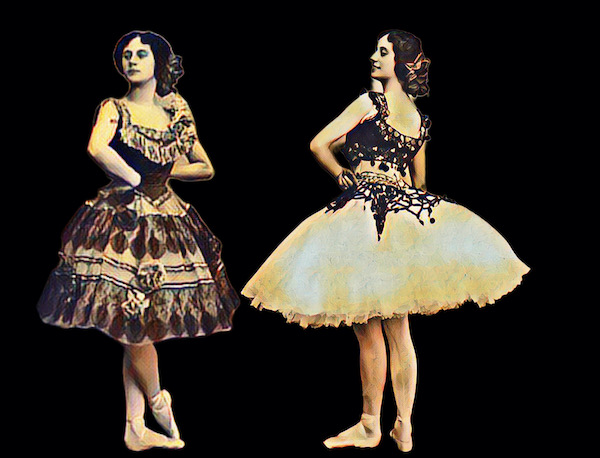
The person who popularized the Grand Pas Classique of Paquita as an independent piece was Anna Pavlova, who used an abridged version of the ballet (but the complete grand pas) on her tours. Paquita became so associated with her that it was one of her last performances during her lifetime. However, even though it was more popular than in France, the complete version of Paquita also fell into oblivion after the Russian Revolution.
The first attempt to revive the complete work began in the 1950s, but it only returned to the stage in the late 1970s, always in Russia. The Grand Pas remained extremely popular, with versions by Rudolf Nureyev and Natalia Makarova in several companies in the West.
Pierre Lacotte brought Paquita to Paris in 2001, with significant changes, but it was only in the 2014 version, by Alexei Ratmansky, that Petipa’s vision returned to the stage. In Russia, the complete Paquita only returned in 2017, with Yuri Smekalov‘s signature for the Mariinsky Ballet, but with a change in the libretto, based on Miguel de Cervantes.
The version that enchanted me was the one by OPéra de Paris, recorded in 2023, in the complete version.
Despite the libretto, a beautiful work
We talked so much about Petipa’s most famous works, but I was enchanted by the technical beauty of Paquita. There are so many fascinating sequences of solos and groups that it is a shame to have such a weak and forgettable story interrupting the sequences. The challenge for Paquita now is just to overcome this.
Descubra mais sobre
Assine para receber nossas notícias mais recentes por e-mail.
 miscelana.com